
Turn over almost any mug, rice bowl, or restaurant teacup in Japan and there's a fair chance the base reads Mino ware or simply made in Gifu. It is the pottery you are most likely to eat off, and least likely to have heard of. Mino accounts for roughly half of all ceramics produced in Japan, which makes it the country's largest pottery region by a wide margin, and also its most invisible. Mino's whole story is that gap: as common as it is unknown. It splits in two.
The pottery with no face
Most famous Japanese wares announce themselves. You know unglazed, iron-dark Bizen or blue-and-white Arita on sight. Mino has no such signature, which is why its name doesn't stick. Based in the Tōnō region of Gifu Prefecture (chiefly Tajimi, Toki, Mizunami, and Kani), Mino makes everything: mass-produced diner cups, delicate tea bowls, glazed and unglazed, stoneware and porcelain both. When Mino ware was designated a national Traditional Craft in 1978, the listing spanned fifteen distinct varieties, an official acknowledgment that Mino is less one style than a whole toolbox.
So when you read "Mino ware" on a base, no single image comes to mind, because the region deliberately never grew one face. Having no fixed style is the Mino style. It is a workshop that makes the props for everyone else's play, and stays off the poster.
The roots run deep. Potters here were firing Sueki stoneware in hillside anagama kilns (single-chamber tunnels dug into a slope that could reach around 1,400°C) as far back as the late 7th century, more than 1,300 years ago. Over the centuries the kilns evolved: the larger ōgama of the Momoyama period made high-fired glazing possible, and the multi-chambered climbing noborigama of the Edo period turned Mino toward mass-produced daily tableware. By the Meiji era, railways, factory production, and copper-plate transfer printing sent Mino dishes across Japan and overseas. When the First World War halted European tableware output, Mino helped fill the world's shelves. The workhorse was built to be enormous.
The masterpieces it forgot it made
The second invisibility is stranger. Mino didn't only make cheap cups. During the Momoyama period (late 16th to early 17th century) it produced four of the most celebrated tea wares in Japanese history: Shino, Oribe, Ki-Seto, and Setoguro. Yet for centuries these were believed to have been fired in Seto, the neighboring pottery town in Aichi. The confusion is baked into the names: "Ki-Seto" means yellow Seto and "Setoguro" means Seto black, even though both were made in Mino.
The record was only set straight in 1930, when the potter Arakawa Toyozō (1894–1985) found old shards at the ruins of an ōgama kiln at Mutabora, in Kani, and proved that the great Shino and Oribe of the Momoyama era had been fired in Mino, not Seto. Mino had spent centuries watching credit for its finest work go to the town next door. Arakawa went on to rebuild the Mutabora kiln in 1933 and revive the lost Shino technique, and in 1955 was named a Living National Treasure for Shino and Setoguro. He gave Mino back its own history.
Four glazes from one clay
What Mino invented in that burst looks like a small map: same region, same era, same clay, four different colors, each decided by one choice of metal and fire (the logic behind every Japanese glaze):
| Glaze | Color | How it gets there |
|---|---|---|
| Shino | Milky white | Thick feldspar glaze — Japan's first white glaze — with reddish "fire color" and pitted yuzu-skin texture |
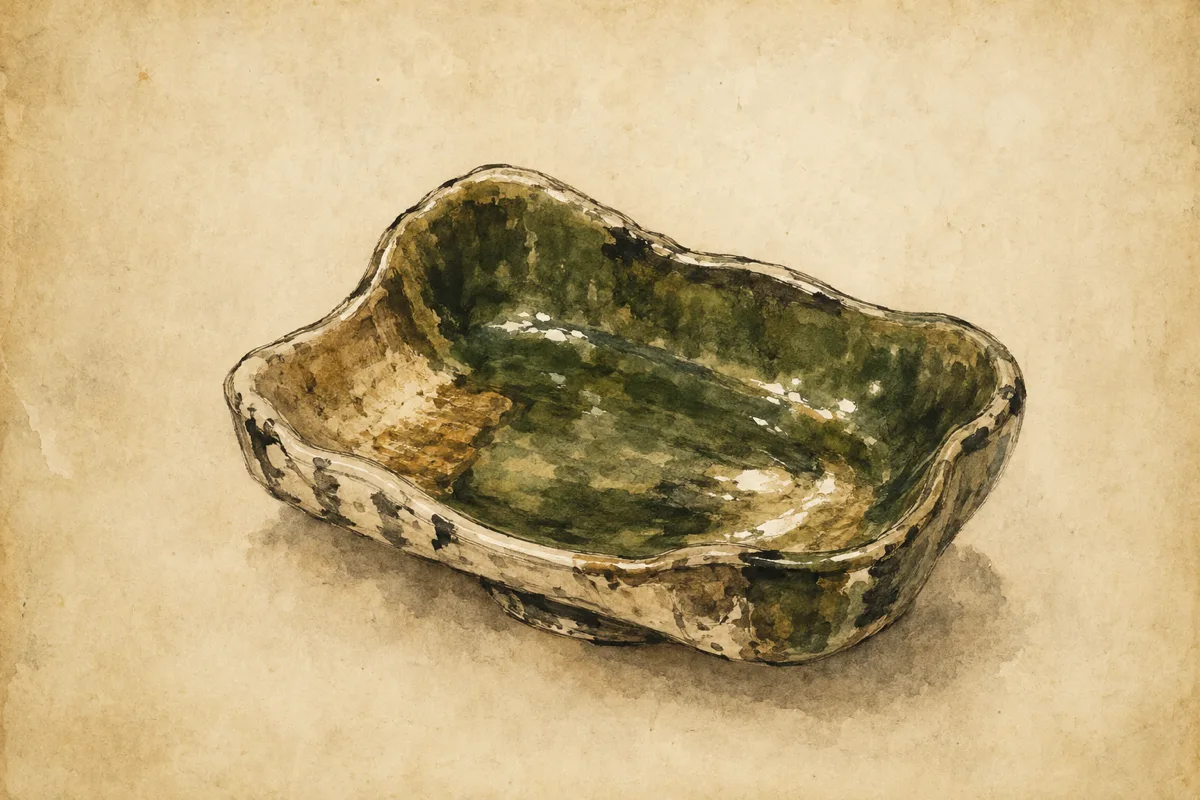
| Oribe | Vivid green | Copper glaze fired in oxygen; usually on warped, asymmetric shapes |
| Ki-Seto | Amber yellow | Plant-ash glaze with 1–3% iron, fired in oxygen |
| Setoguro | Matte black | Iron glaze on a piece pulled from the kiln red-hot and shock-cooled |
Shino was the breakthrough. It was Japan's first white glaze, and e-Shino, Shino painted with iron-oxide designs before glazing, is often called the first painted pottery in Japan. In one glaze, Japanese ceramics gained both white and pictures. The thick, low-melting feldspar cools to a soft, satiny surface, freckled with the red hi-iro where flame kissed the clay.
Oribe is the loud one, and it comes with a life story. It's named for Furuta Oribe (1544–1615), a warrior and tea master born in Motosu, in old Mino Province, so the style's namesake is a local son. A pupil of the great Sen no Rikyū, Furuta became the foremost tea master in the land after Rikyū's death and taught the art to the shogun Tokugawa Hidetada. Where Rikyū prized stillness and balance, Oribe broke it, pushing tea taste toward distortion, asymmetry, and bright copper green. Oribe ware is deliberately lopsided, the first Japanese style to want to look warped, a founding gesture of the wabi-sabi taste for imperfection. His end was as dramatic as his aesthetic: in 1615, during the Siege of Osaka, Furuta was suspected of treason against the Tokugawa and ordered to commit seppuku alongside his son. The foremost tea master in Japan, condemned for conspiracy: the story clings to every green, off-kilter Oribe dish.
Reading Mino now
Once you know the double identity, Mino stops being a blank label. The mug in your cupboard stamped "made in Gifu" is the everyday half, the region that makes half the nation's tableware and asks for no credit. The milky tea bowl with red-blushed edges is Shino; the warped green plate is Oribe — the masterpiece half, made in the same hills, once mistaken for its neighbor's work. Japan's biggest pottery hides in plain sight on your table. For where Mino sits among the country's other kilns, see the regional guide; for how these glazes are actually fired, how Japanese pottery is made.