
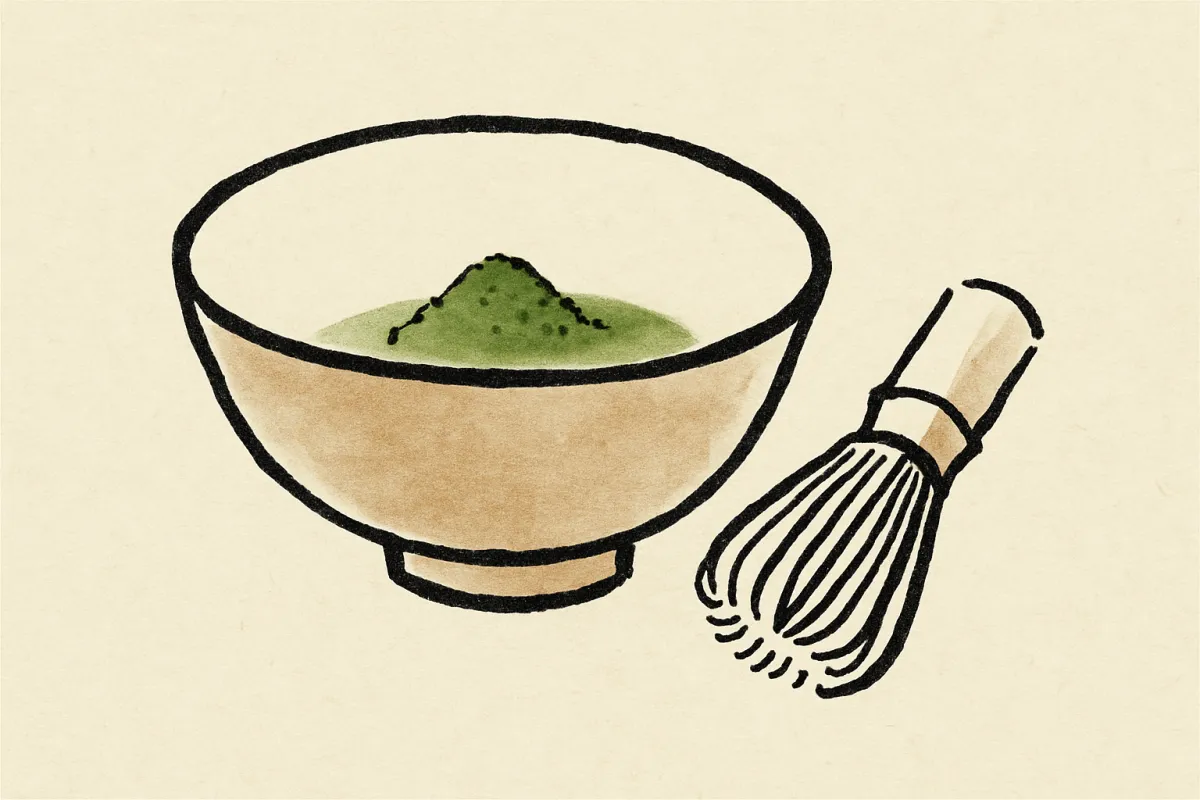
A "matcha bowl" gets sold as if any wide bowl will do, and most buying guides end at "pick one you like." That is fine advice for a decorative object and useless advice for a tool. A chawan (茶碗) is a tool: the surface a bamboo whisk has to travel across fast enough to beat air into thick green powder. Two things decide whether that happens: how much room the whisk has, and what the clay does with water. Color, glaze, and the maker's name matter enormously, but for beauty and ceremony, which is a separate axis from whether the tea foams and whether the bowl is a chore to keep. Sort those two axes apart and the choice gets simple.
Whisk clearance and porosity
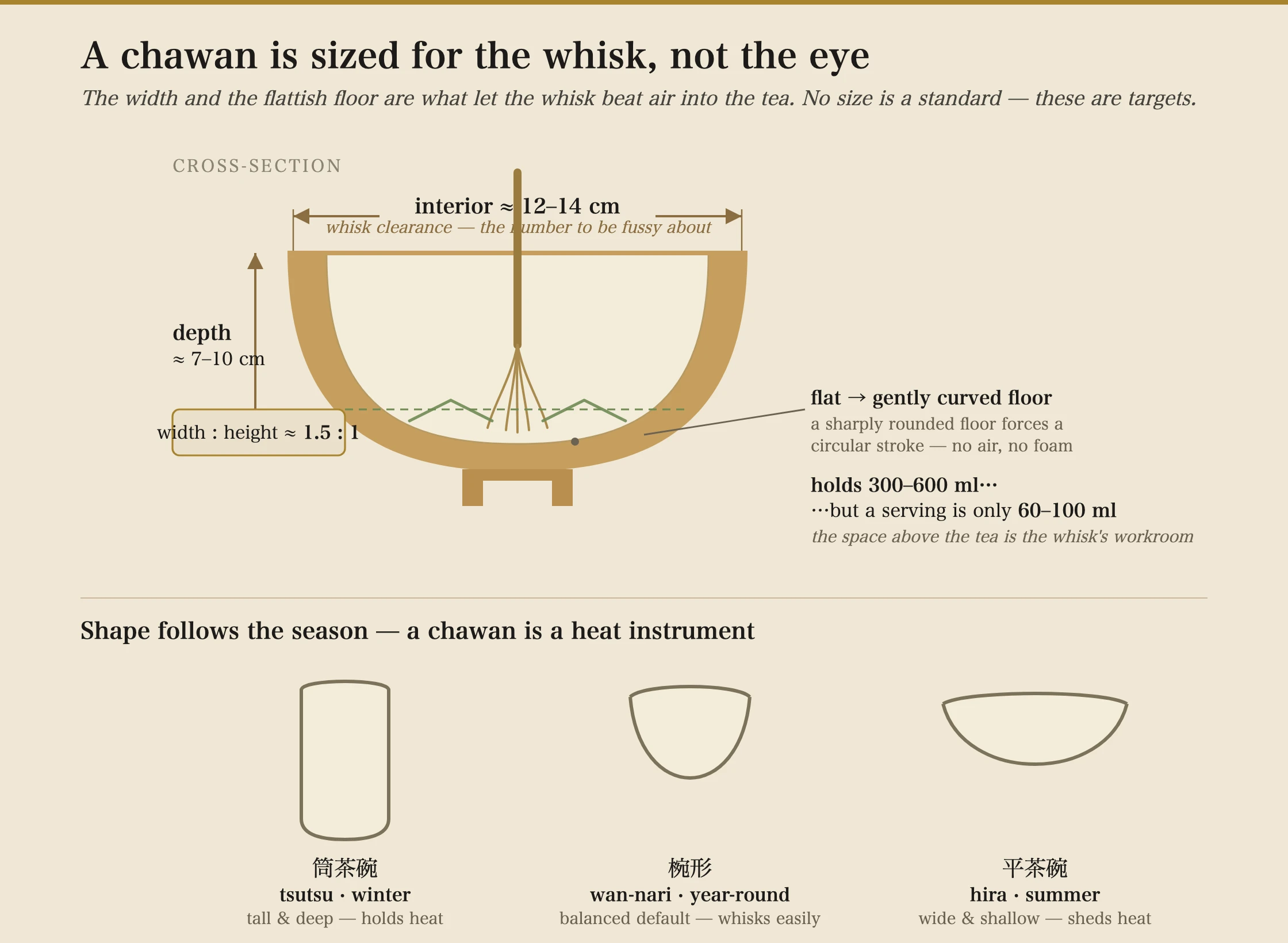
Width. The whisk (a chasen) works in a quick zig-zag, sketching a W or an M across the bottom of the bowl. It needs room to travel without its tines slapping the wall. A tall, narrow mug forces the whisk into a cramped little circle, and you get thin, uneven froth and a bamboo head that frays early. Wide and shallow is the geometry that lets the whisk travel.
The floor. Flat, or very gently curved. A flattish floor lets the whisk sweep the bottom and drag the dry powder up into the water. A sharply rounded floor rounds your stroke into a circle, so no air gets in and no foam forms. Sharp interior corners are worse: they trap dry clumps that never dissolve. And the inside should be smoothly glazed. A rough interior shreds the whisk tips and grabs matcha you then can't rinse out.
The numbers, with a caveat
There is no industry-standard chawan size. Retailers disagree, and antique tea bowls vary wildly, so treat everything below as a target, not a rule. Across matcha sellers the usable range clusters:
- Interior (rim) diameter ≈ 12–14 cm, sometimes as small as 9–12 cm. This is the whisk-clearance number, the one to be fussy about.
- Depth ≈ 7–10 cm, enough freeboard that the tea doesn't slop over when you whisk hard.
- A width-to-height ratio around 1.5 : 1, the numeric version of "wide and shallow."
- Capacity ≈ 300–600 ml, but a single serving of matcha uses only 60–100 ml of water. The empty space is the whisk's workroom.
The shape changes with the season
Serious tea people own more than one bowl because a chawan is quietly a thermodynamic instrument.
- Winter → the tsutsu-chawan (筒茶碗), a tall, straight-walled "cylinder" bowl. The narrow mouth and deep well trap heat and keep the tea hot longer. A deep fukazutsu pushes this further.
- Summer → the hira-chawan (平茶碗), a wide, shallow "flat" bowl, literally the natsu-chawan, the summer bowl. Its broad surface sheds heat fast, so the tea cools to something comfortable to drink.
- Year-round → the wan-nari (椀形), the rounded, balanced default. It whisks easily and never feels wrong in any season, which is why it's the sensible first bowl.
The clay reinforces the same logic: winter bowls tend to be heavier, coarser stoneware that feels warm in the hands; summer bowls run thin and smooth. Shape and material point the same way.
Clay, the ranking, and the care decision
Chanoyu has a famous pecking order for tea-bowl clays — ichi-Raku, ni-Hagi, san-Karatsu (一楽二萩三唐津): Raku first, Hagi second, Karatsu third.
Raku is hand-built (pinched and pared by hand, never thrown on a wheel) and fired low, around 800°C. The low firing leaves the body porous, and porous means insulating: a Raku bowl keeps the tea warm while staying cool enough to cradle. It was born when the tea master Sen no Rikyū had the tile-maker Chōjirō build bowls for his stripped-down wabi tea, which is why it tops a ranking about tea, not about technical polish.
Hagi is porous too, with a crazed glaze (kannyū) that lets tea seep in through the cracks over years and slowly shift the bowl's color: Hagi no nanabake, the "seven transformations." Owners prize a bowl that matures with use rather than one that stays factory-new.
Porcelain (jiki) is the opposite end: fired hot, dense, non-absorbent, and its white ground makes the green look vivid, which is why the bowl feels summery in use.
Porosity is the practical fork: porous ware (most Raku and Hagi, much Karatsu) has to be seasoned before its first use. It's called medome, "closing the pores": you simmer the piece in the cloudy water left from rinsing rice so it won't seep, stain, or turn musty. Porous bowls also dislike long soaks, the dishwasher, and being put away damp. Vitrified porcelain skips all of it. The quick test: turn the bowl over and wet the unglazed foot ring. If the clay drinks the drop, treat it as porous and give it the care that suits it.
Matching the bowl to how you drink
- Whisking thin tea (usucha): the wide, flat-floored, smoothly-glazed bowl described above: wan-nari as a default, tsutsu in winter, hira in summer.
- Thick tea (koicha): it's kneaded rather than foamed, so a slightly deeper bowl suits the motion better. (If you're not sure which you're making, start here.)
- Lattes: you still want width for the whisk, but you can drop the ceremony. A big glazed bowl, ideally one with a pouring spout, is the practical pick, and glazed porcelain spares you the seasoning ritual.
- A gift: a Hagi or a Kyoto bowl shows off beautifully. But if the person will actually whisk in it, don't let the looks talk you out of the interior width and the flattish floor.
The short version: give the whisk room to move (roughly 12 cm-plus across, a flat-ish floor, a smooth glaze inside), pick the shape for the season if you enjoy that, and decide up front whether you want a porous bowl you season and slowly raise or a porcelain one you can treat casually. The color, the crackle, the maker's hand: those you get to choose purely because you love them.