
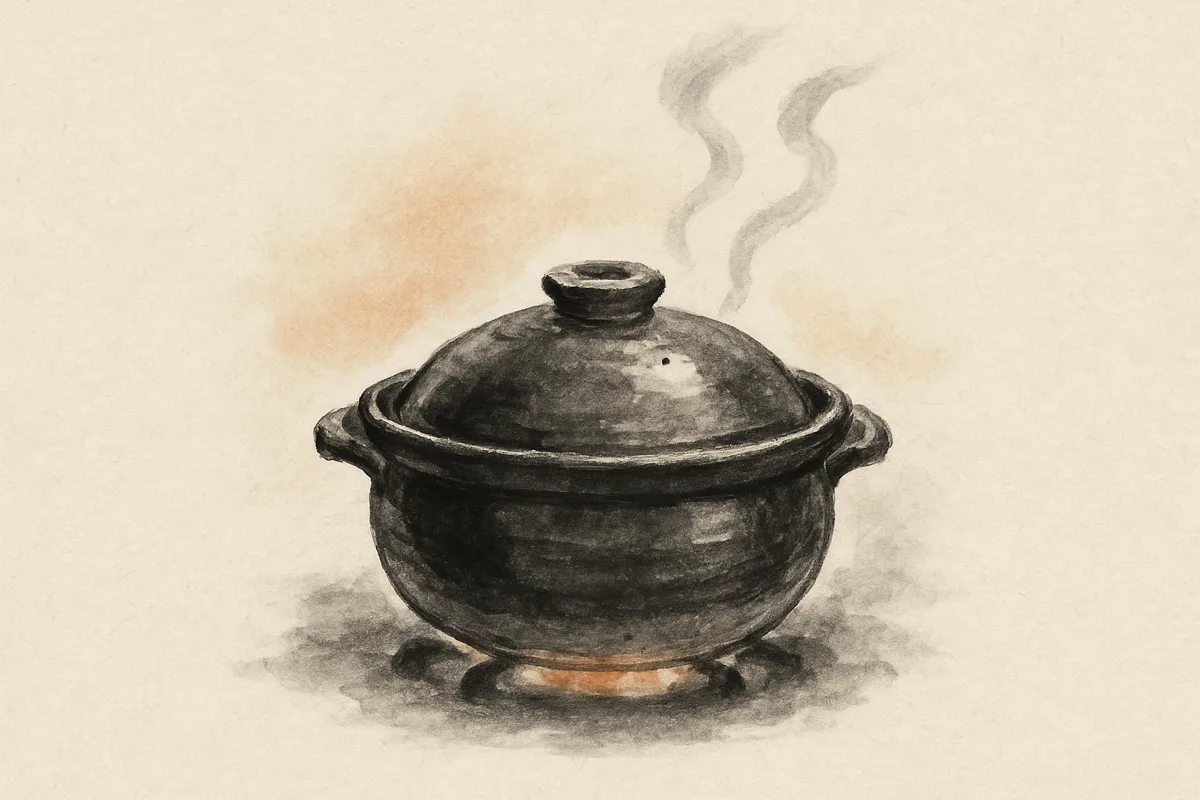
Set a donabe next to a stainless pot and they look like the same tool for the same job. They are not. A metal pan is built to move heat fast; it conducts quickly from the burner into the food and cools just as quickly the moment you take it off. A donabe (土鍋, literally "clay pot") is built the other way. Its thick, porous clay wall takes its time warming up, then holds that heat and gives it back slowly, so the food keeps cooking after the flame is out and stays hot in front of you at the table. Nearly everything about choosing, seasoning, and cooking with one follows from how it handles heat.
What a donabe is
A donabe is heat-resistant earthenware, a low-fired porous ceramic, shaped to sit straight on a flame. It is the everyday Japanese pot for hot pots (nabe) like shabu-shabu and yosenabe, for stews and steaming, and, famously, for rice. If you want the material picture behind that "porous, low-fired" description, it's the earthenware corner of the stoneware-versus-porcelain map: fired cooler, never fully vitrified, full of open pores. On most ceramics that porosity is a thing you manage. In a donabe it is the thing that makes the pot work.
Porous clay takes a direct flame
A dense, glassy ceramic hates sudden heat and cracks under it. A donabe thrives on it, because of what its clay is made of.
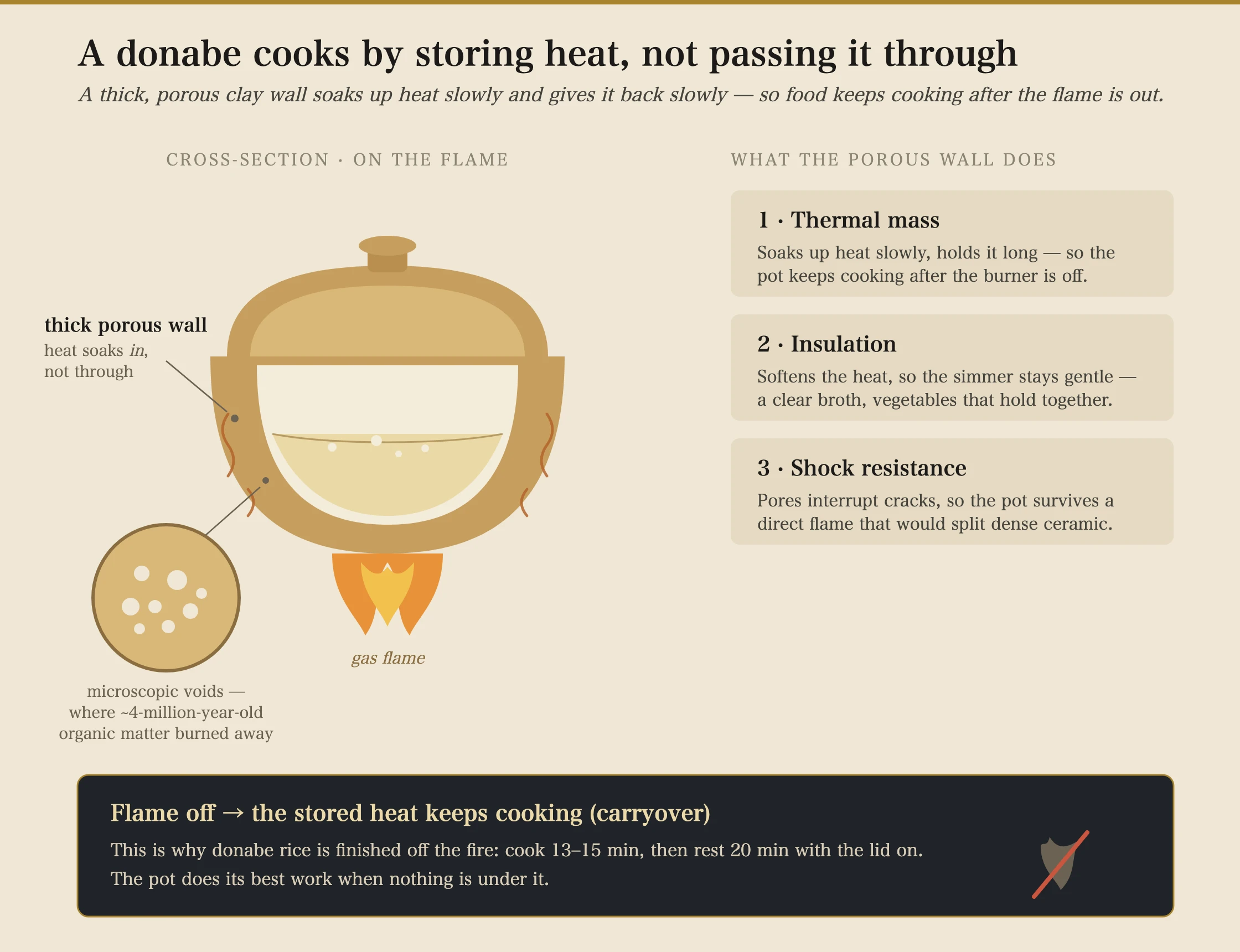
The classic donabe clay comes from Iga in Mie Prefecture, and the ground there is old: the deposits are the bed of ancient Lake Biwa, laid down on the order of four million years ago and packed with fossilized organic matter: microbes and plant material. When the pot is fired, that organic material burns away completely and leaves a web of microscopic voids behind. Those tiny air pockets give the thick wall a large thermal mass, so it soaks up heat slowly and radiates it back long after the burner is off, which is the carryover cooking. The same voids work as insulation, keeping the simmer gentle so a broth stays clear and vegetables don't thrash apart, and they give the clay its thermal-shock resistance: the pores interrupt the tiny cracks that temperature stress would otherwise drive through solid ceramic. The pot survives the flame precisely because it isn't dense.
Sellers often claim a donabe radiates "far-infrared" heat, three to four times a metal pot, to explain its even cooking. That line is marketing more than measured physics. The effect you can count on is the plain one above: a thick porous wall that stores heat and keeps cooking off the fire.
Iga, Banko, and where donabe really come from
Iga is the traditional, high-heat-storing name, and it's fair to call it the donabe's spiritual home, since the region shares its clay and its old kilns with neighboring Shigaraki. But if you buy a donabe today, the odds are it wasn't made in Iga at all. Roughly 80% of Japan's donabe come from Banko ware in Yokkaichi, which blends in about 40% petalite, a lithium mineral that makes for an exceptionally heat-shock-resistant, thinner, faster-heating pot. The split is simple: Iga is the traditional, slow-and-deep heat keeper; Banko is the mass-produced, ultra-heat-proof workhorse. Then there are modern glazed and porcelain donabe, often built for induction and sold as "no seasoning needed."
Choosing one: use, size, lid, heat source
-
Use. A general hot-pot donabe is a wide, single-lid pot. A rice donabe is a different animal; see the lid note below.
-
Size. Donabe are measured in gō (号). The rough guide (makers vary, so treat it as a target):
Gō Rim diameter Serves 5-gō 14–16 cm 1 6-gō 17–19 cm 1–2 7-gō 20–22 cm 2–3 8-gō 23–25 cm 3–4 9-gō 26–28 cm 4–5 10-gō 29–31 cm 5–6 -
Lid. A single lid is standard for hot pots. A double lid (an inner lid and an outer lid) is the mark of a dedicated rice donabe: steam collects between the two lids and gently pressurizes the pot, like a soft pressure cooker, while preventing boil-over. The best-known example is Nagatani-en's Kamado-san, made in Iga since 2000, with a base about 1.5 times thicker than a normal donabe, so it holds more mass and more carryover.
-
Heat source. Assume a gas flame unless the maker says otherwise. Traditional porous clay won't work on induction (IH) unless the pot is specifically built for it.
Season it first: medome
A porous donabe needs one ritual before its first meal, the same "close the pores" idea covered for porous tableware in caring for Japanese pottery, scaled up for a cooking pot. It's called medome (目止め), and it uses starch to seal the clay so the pot won't seep, stain, or smell.
- Fill the donabe 70–80% with water and stir in a starch source: a couple of tablespoons of raw rice, or better, a bowl of cooked leftover rice (more starch), or roughly one-fifth of the water's volume in rice.
- Bring it slowly to a gentle simmer over low heat, stirring now and then, and cook it into a loose porridge for about 30 minutes to an hour.
- Turn off the heat and let it cool all the way to room temperature, ideally overnight. Don't rush it.
- Discard the porridge, wash gently with a soft sponge and warm water, and dry it completely, upside down, before first use.
Glazed and porcelain donabe have no open pores to seal, so they skip all of this.
The four ways people crack a donabe
They are all the same mistake, a sudden temperature swing, wearing four hats:
- Heating it empty (karadaki). The liquid or food inside is what buffers the pot against a fast temperature climb. Dry heat cracks it.
- Cooling it suddenly. Never plunge a hot donabe into cold water or set it on a wet cloth. That thermal shock is the classic killer.
- A wet bottom on the flame. Dry the outside of the pot completely before it goes on the burner, or it will crack.
- Any abrupt change. Start gentle, don't blast a cold pot on high, and let it cool on its own.
And after cooking: don't leave it soaking in soapy water, since the porous body drinks up detergent and odors. Wash, dry fully, and store it with the lid ajar (a sheet of paper inside helps pull the last moisture out) so it doesn't go musty.
Cooking a first pot of rice
Rice is what the donabe does best. Using a Kamado-san as the benchmark: rinse the rice, add water at about a 9:10 ratio (rice to water), and let it soak in the pot for 20 minutes. Cook over medium to medium-high heat for 13–15 minutes; you'll know it's nearly done when steam jets vigorously from the lid. Then turn off the heat and, without lifting the lid, let it rest 20 minutes. During that rest the pot's stored heat finishes the rice from the inside, the same carryover effect built into a kitchen step. Want a crackly bottom (okoge)? Give it one to two more minutes of heat before you cut the flame.
That twenty-minute rest shows the donabe in one gesture. The pot cooks longest when nothing is under it, and a slow, porous, heat-hoarding piece of four-million-year-old lakebed was made for exactly that.