
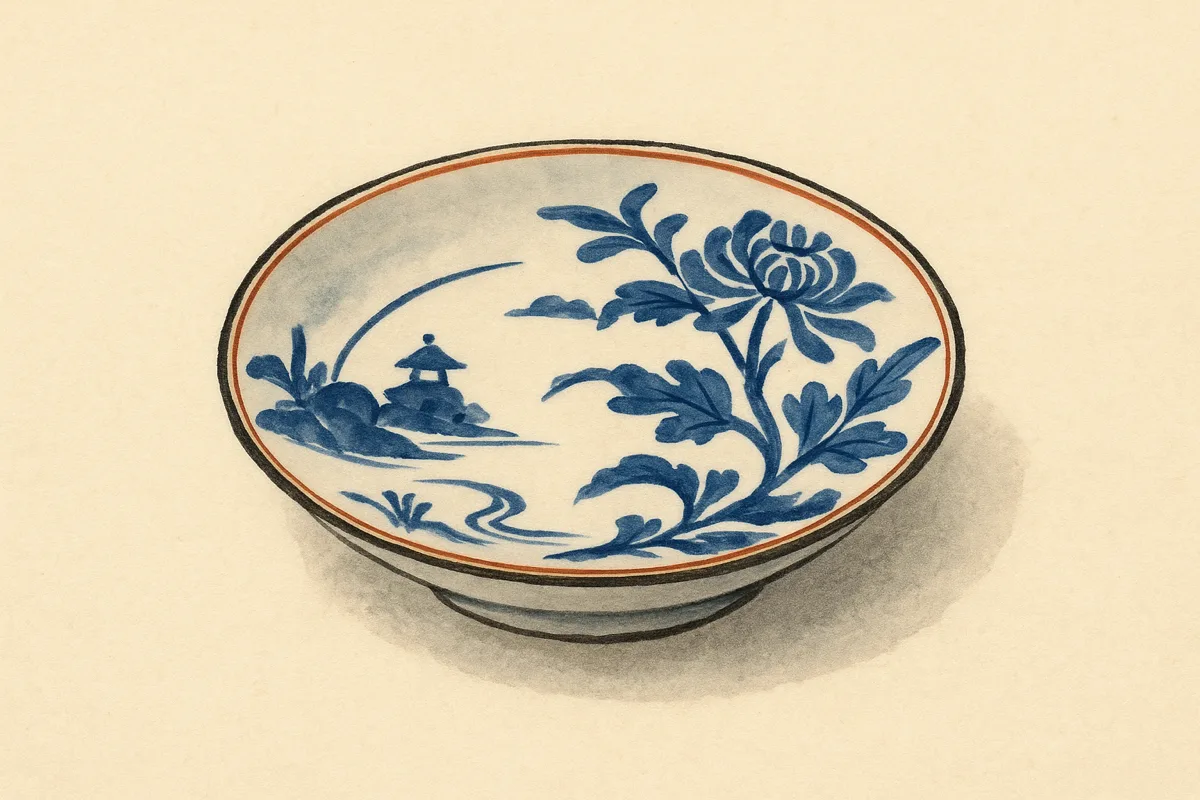
Somewhere in a grandparent's cabinet, or under glass in an antique shop, there is a Japanese plate: white porcelain painted in deep cobalt blue, often crowded with iron-red and gold. The label says Imari. But the name misleads: Imari is not where it was made, only the harbor it shipped from. The porcelain itself came from Arita, a town a few valleys inland, and that is where the tangle of names begins.
Arita: where Japan first made porcelain
Before the 1600s, Japan made earthenware and stoneware but no porcelain; the hard, white, translucent ware had to be imported from China and Korea. That changed in Hizen Province, in what is now Saga Prefecture on Kyushu. Traditionally the birth is dated to 1616, and credited to a Korean potter, Ri Sampei (Yi Sam-pyeong), given the Japanese name Kanagae Sanbee, who is said to have found porcelain stone at the Izumiyama quarry near Arita and fired Japan's first porcelain. Many historians dispute the tidy version: the single-founder framing is contested, and the enabling discovery of porcelain stone may reach back to the late 16th century. Treat 1616 and Ri Sampei as the traditional account, not settled fact.
Either way, the human backstory is real enough. Korean potters came to Kyushu as captives of Toyotomi Hideyoshi's invasions of Korea (1592 and 1597), campaigns nicknamed the "pottery wars" because the daimyō brought skilled potters home as spoils. The Arita area already made Karatsu stoneware, but porcelain was a leap: it needed a different raw material, white porcelain stone rather than the iron-rich clay of ordinary pottery (this material difference is what separates porcelain from stoneware). By around 1630, good Izumiyama stone had turned a lucky find into a full industry.
"Imari" is a port, not a kiln
Arita's porcelain was carted to the nearby harbor of Imari and shipped from there to Nagasaki and abroad. Foreign buyers, who never saw the inland kilns, named the wares after the port they arrived through. So "Imari ware" and "Arita ware" are the same Hizen porcelain: one name for where it was made, one for where it sailed from. In the Edo period the terms were near-synonymous; the modern habit of reserving "Imari" for the flashy gold-heavy export decoration is a collector's convention, not a material line.
The blue-and-white first century
The first Arita porcelain was sometsuke, blue-and-white, and it was blue for a chemical reason rather than an aesthetic one. The pigment is gosu, an impure cobalt ore that looks blackish-grey in the pot; the painter works almost blind and trusts the fire to reveal the color. It is brushed onto the raw body, sealed under a clear glaze, and fired once at about 1,300°C, so the blue ends up locked inside the glass, where it can never wear off. At that temperature only a handful of metal oxides survive, and cobalt gives the most dependable, vivid color, and blue-and-white became the founding look in China, Korea, and Japan alike.
Color came later, and it sits on top of the glaze. By the mid-17th century Arita added overglaze enamels: reds, yellows, greens, and gold painted onto the already-fired glaze and set in a second, cooler firing around 800°C (more on that two-fire process here). A grand Imari plate usually carries both: underglaze blue fired first, overglaze red and gold fired second.
Three styles from one town
Enamel split Arita porcelain into three canonical styles, and telling them apart is most of what "reading" a piece means:
| Style | Made for | Look | Gold? |
|---|---|---|---|
| Ko-Imari / kinrande | Sale & export | Underglaze blue + overglaze red + gold, packed edge to edge | Yes — the point |
| Kakiemon | Sale & export | Soft enamels scattered on a warm milky-white ground, much of it left bare | Rarely |
| Iro-Nabeshima | The domain's own use & gifts | Blue then red/yellow/green, restrained, standardized | Never |
Ko-Imari in its collector sense is the porcelain of the golden export era, roughly 1660–1740, and kinrande ("gold brocade") is its signature: dense blue, red, and gold that reads like woven cloth. Wikipedia notes, unusually bluntly, "a tendency to over-decoration that leads to fussiness" — maximalism was the selling point.
Kakiemon is the opposite instinct. Credited to Sakaida Kakiemon (1596–1666), it scatters gentle red, yellow, blue, and green enamels across a warm, creamy white called nigoshide, named from a Saga word for rice-washing water, deliberately leaving the white bare as the real subject. European factories could copy the motifs but not that warm ground; their imitations came out a cold blue-white. Nigoshide was so hard to fire that production lapsed in the 18th century and had to be reverse-engineered and reproduced in 1953 by the 12th and 13th Kakiemon.
Nabeshima is the strangest of the three: the porcelain that was never for sale. The Saga (Nabeshima) domain ran a private official kiln whose output existed only for the clan's use and as gifts to the shogun and daimyō. Around 1675 the lords moved it deep into the Ōkawachi valley between Arita and Imari, an act of industrial security to guard the potters and glaze secrets. Iro-Nabeshima uses blue and restrained enamels, no gold at all, on standardized circular plates made in sets of five and ten, often with a distinctive comb-tooth pattern on the foot. Its restraint, refusing the very gold that made Imari rich in Europe, was the marker of rank. The kiln closed in 1871 when the feudal domains were abolished.
How it ended up in European palaces
The reason a Japanese plate sits in a Dresden gallery is a Chinese civil war. Through the 1640s the wars of the Ming–Qing transition wrecked Jingdezhen, China's porcelain capital, cutting off Europe's supply of blue-and-white. Under Japan's closed-country policy the Dutch East India Company (VOC), confined to the artificial island of Dejima off Nagasaki, was almost the only way out, and it turned to Arita to fill the gap. The orders exploded: a first sizeable VOC order of 4,149 pieces in 1656 jumped to 64,866 in 1659, a leap so sudden it took the Arita kilns two years to fill, with peak years later running into six figures.
Europe didn't just buy it; it obsessed. Augustus II the Strong of Saxony amassed some 20,000 pieces of Asian porcelain and in 1710 founded the Meissen factory to crack hard-paste porcelain himself, Europe's first. Meissen, Chantilly, Chelsea, and Worcester all copied Kakiemon and Imari designs. The most charming relic of the trade is a pair of porcelain elephants in the British Museum (c.1660–1690): the Arita potters had never seen a real elephant and worked from drawings, so the anatomy is subtly, endearingly wrong: porcelain made for a world its makers would never visit. The boom faded as China re-entered the trade; Japanese export had all but stopped by the 1740s, before a Meiji-era revival rode Europe's taste for all things Japanese.
A plate labelled "Imari" was made in Arita, shipped from Imari, painted blue because of the fire and gilded because of Europe. Whether it is dense kinrande, sparse Kakiemon white, or gold-free Nabeshima tells you roughly when it was made and who for, which is more than the word on the sticker ever does. For where Arita sits among Japan's other kilns, from unglazed Bizen to painted Kutani, see the regional guide.