
A plain, unglazed Bizen jar can outprice a flawless white porcelain bowl. The difference comes from the fire, not the clay. Yet nearly every Japanese pot, from a rough tea bowl to a painted Kutani plate, follows the same process: the clay is shaped soft, dried hard, and fired twice. How it is formed, whether it is glazed, and which kiln finishes it account for the rest.
Shaped soft, then fired twice
Raw clay is refined and kneaded by hand. Wedging evens the moisture so the wall throws and dries without warping and, above all, drives out trapped air: a trapped bubble expands in the heat and can crack or blow the pot apart. The Japanese method is a spiral fold called kikumomi (菊練り, "chrysanthemum kneading"), named for the petal pattern it leaves.
The piece is then formed (below), dried to leather-hard, and trimmed: foot-ring and walls pared with a metal kanna (the step is kezuri). Now it meets fire. The bisque firing (素焼き, suyaki) is deliberately low, roughly 800–900°C (Kutani near 850°C), which turns fragile clay into porous, handleable bisqueware that drinks glaze evenly instead of slumping when dipped. Painted decoration often goes on here, between the firings.
After glazing comes the main firing (本焼き, honyaki), and this one is hot: typically 1,250–1,400°C (Kutani 1,300–1,400°C for 15 to 20 hours). It vitrifies the body and melts the glaze to glass. Decorated porcelain adds a third, low firing (~800–900°C) to fix its enamels, so a painted plate may pass through the kiln three or four times. The common case stays low to set, high to vitrify.
Wheel, hand, or mold
Three families of forming, chosen by the shape wanted:
- Wheel-throwing (轆轤, rokuro) raises a spun lump into a wall by spin and hand pressure; it starts with centering and excels at round forms: bowls, cups, bottles.
- Handbuilding (手びねり, tebineri) uses no wheel: pinching open a ball, coiling (himozukuri) rope-like coils, slab-building (tatara) from rolled sheets for plates and angular forms, and kurinuki, hollowing a solid block.
- Molding presses or slip-casts clay for repeatable shapes, the route taken by much production ware, Kutani included.
Glaze is glass, and the fire chooses the color
A glaze (釉薬, yūyaku) is a mineral slurry, not paint: classically wood ash, feldspar, silica, a flux, and a colorant. It turns glassy only in the high firing, setting color, sheen, and texture. Unglazed wares like Bizen skip it and let the kiln finish the surface.
That firing hides another variable: its atmosphere. Oxidation (air-rich) leaves a copper glaze green; reduction (air-starved) pulls oxygen back out of the oxide and the same glaze comes out blood-red (辰砂, shinsha). The fire decides the color.
Two kinds of kiln: controlled and wood-fired
The modern split is between controlled kilns and wood-fired ones. Electric and gas kilns dial in a temperature and repeat it. Electric runs clean and oxidizing; gas can be choked into reduction for copper reds and celadon greens. They are the default for glazed tableware, because piece two matches piece one.
Wood-fired kilns give that up on purpose. Flame and flying ash write the surface, so no two pieces come out alike. Bizen, Shigaraki, and Iga are prized for it. Within wood-firing, two historic designs split the field.
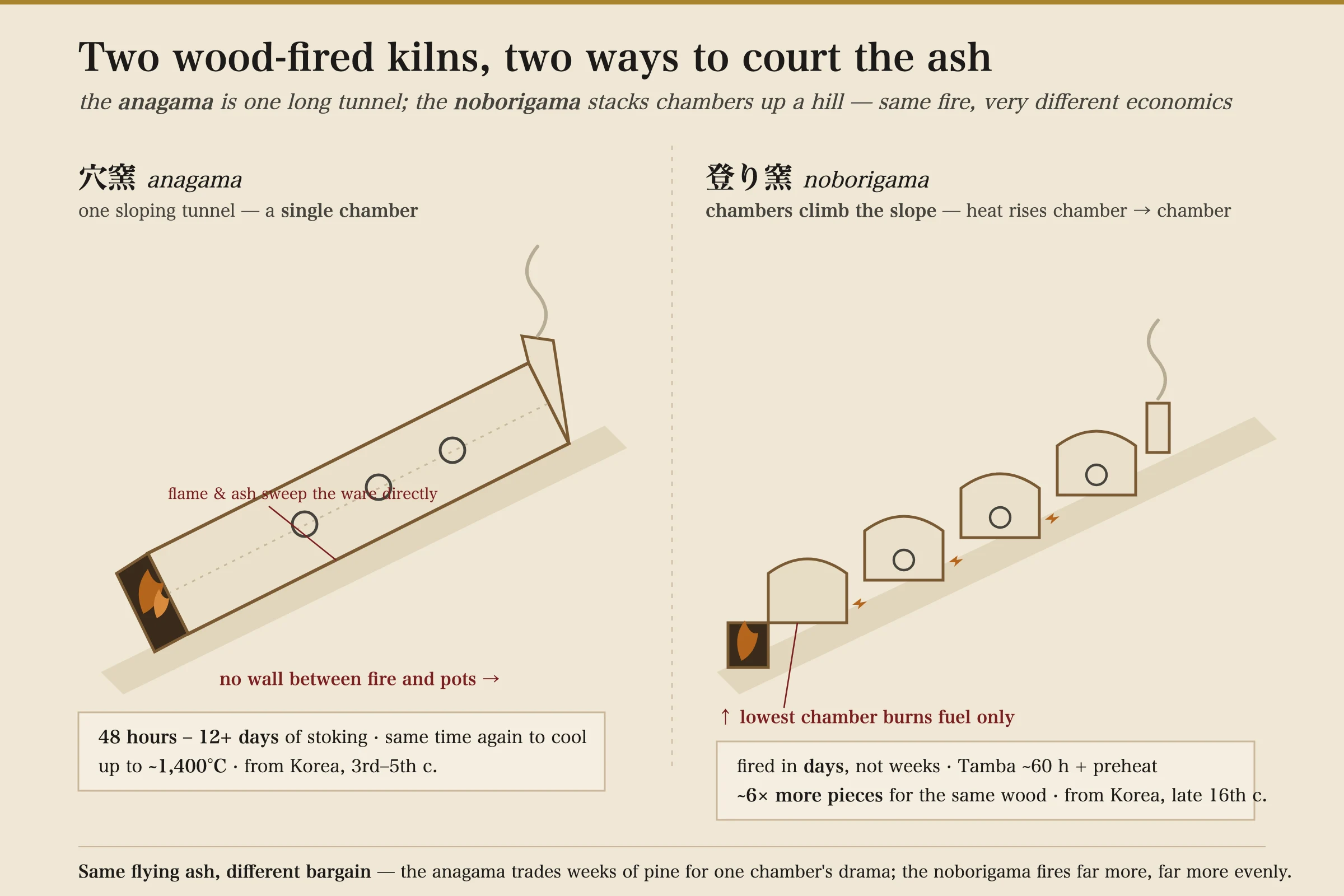
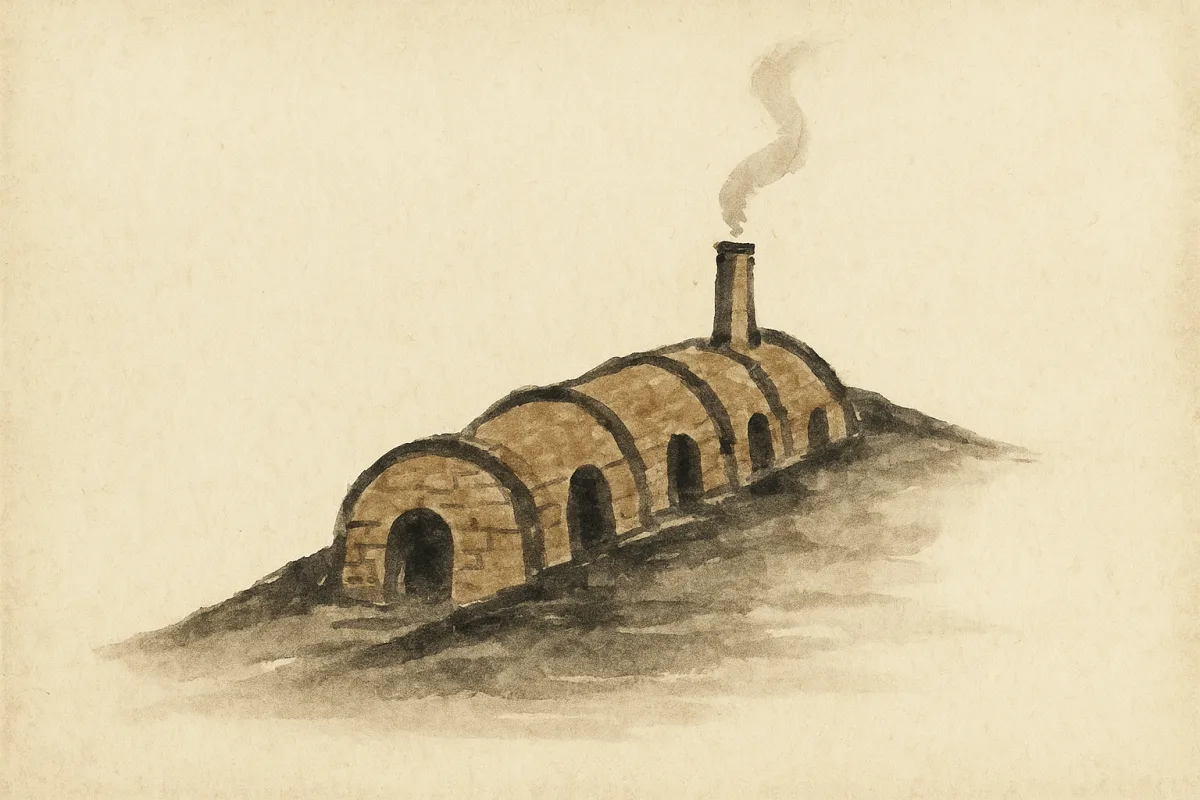
The anagama (穴窯) is one long sloping tunnel, a single chamber dug into a hillside, firebox low and chimney at the top. Its defining trait: no wall between the fire and the pots, so flame and ash sweep straight over the ware. It fires 48 hours to 12 or more days round-the-clock (Tamba's runs about two weeks), needs about the same again to cool, and reaches up to ~1,400°C. It arrived from the Korean peninsula via Kyūshū in the 3rd–5th centuries and underlies both ancient Sue ware and the medieval Six Ancient Kilns.
The noborigama (登り窯) is a staircase of connected chambers climbing a slope. Heat rises from one into the next, side ports feed split pine to each, and the lowest chamber often burns fuel only to steady those above. It reaches around 1,300°C and fires in days (Tamba runs its chambers about 60 hours after a 30–40 hour preheat), and for the same wood it fires over six times as many pieces as a single-chamber pit, more evenly. It came much later, in the late 16th century, brought by Korean potters taken to Japan during Toyotomi Hideyoshi's 1592 campaign, the wave that also seeded the Karatsu, Arita, Hagi, and Satsuma kilns. (One captive, Yi Sam-pyeong, is traditionally credited with finding Arita's porcelain clay, though historians dispute the attribution.)
The wood kiln's one-of-a-kind marks
What the fire does on its own is yōhen (窯変, "kiln transformation"): the unplanned shifts of color, texture, and glaze that firing produces. The most striking is natural ash glaze (自然釉, shizen-yū). As pine burns for days, fine ash drifts through the chamber, settles on the pots, and above about 1,200°C melts and fuses to the clay as a genuine glass glaze that nobody brushed on. The chemistry is ordinary: wood ash is rich in calcium and potassium oxides, which act as fluxes, melting the clay's silica and alumina into glass at around 1,250–1,300°C. It pools green and glossy where ash landed thick, and stays dry and bare where little did.
This was discovered by accident: ash was glazing pots on Japan's ancient Sue ware by the late 6th century, before anyone did it on purpose; deliberate, brushable ash glaze came only later, at the Sanage kilns around the 9th century.
The last piece is placement. In that wall-less tunnel, where a pot stands is everything: near the firebox, heavy ash and heat; buried in embers, a reduced, smothered patch; behind another pot, a bare "shadow." The potter courts these effects but cannot dictate them, so each piece is unique, and the marks are read, named, and prized.
So "how is Japanese pottery made" has two answers: the near-universal process, and the kiln that separates a factory mug from a collected tea bowl. Bizen is unglazed stoneware finished entirely by the wood kiln; whether a piece is stoneware or porcelain was decided back at the clay; the porous bisque stage is why some ware needs seasoning before use; and where each style is made traces these kilns across the country.