
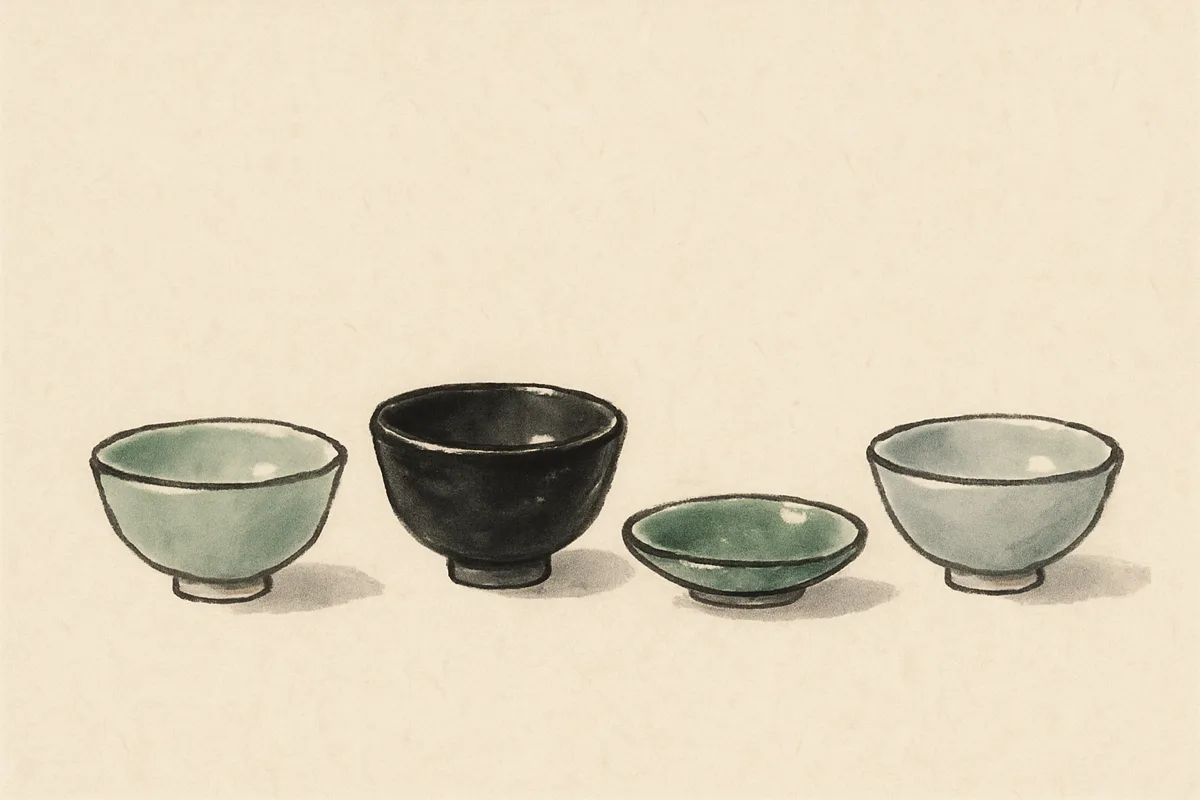
Place three Japanese bowls side by side: a celadon dish the color of pale jade, a tea bowl of deep tenmoku black, an Oribe plate in glossy green. They look like three different materials, but often they are not. The pots can start from closely related clay and the same handful of ingredients. What splits them is a glaze, and a glaze is more readable than it looks.
Two questions decode most of it: which metal colored the glaze, and whether the kiln burned rich in oxygen or starved of it. Those two axes matter more than any list of names.
What a glaze is
A glaze is a thin coat of glass fused onto the clay. Its skeleton is silica (SiO₂), the same glass former as a windowpane. Silica alone will not melt until well past 1,700°C, far hotter than a pottery kiln, so potters add a flux (soda, potash, calcium, or boron oxides, delivered in practice as wood ash, feldspar, or lime) to drag the melting point down into reach. A third ingredient, alumina (Al₂O₃), thickens the melt so it clings to the pot instead of running off, and its ratio to silica sets the finish: roughly 1:5 comes out matte, 1:8 glossy. Glass former, flux, stabilizer: everything else is color.
The two-axis map
Color comes mostly from a metal oxide dissolved in that glass, and the same metal gives different colors depending on the kiln's air.
An oxidation firing is oxygen-rich, the default of an electric or gas kiln. A reduction firing is oxygen-starved: the fuel burns incompletely and throws off carbon monoxide, which strips oxygen back out of the metal oxides in the glaze and flips their color. As Musubi Kiln puts it, iron oxide "typically produces yellow to brown or black with oxidation firing, but bluish tones with reduction," while copper oxide "produces a green color in oxidation firing and a red color in reduction." That sentence contains the grid:
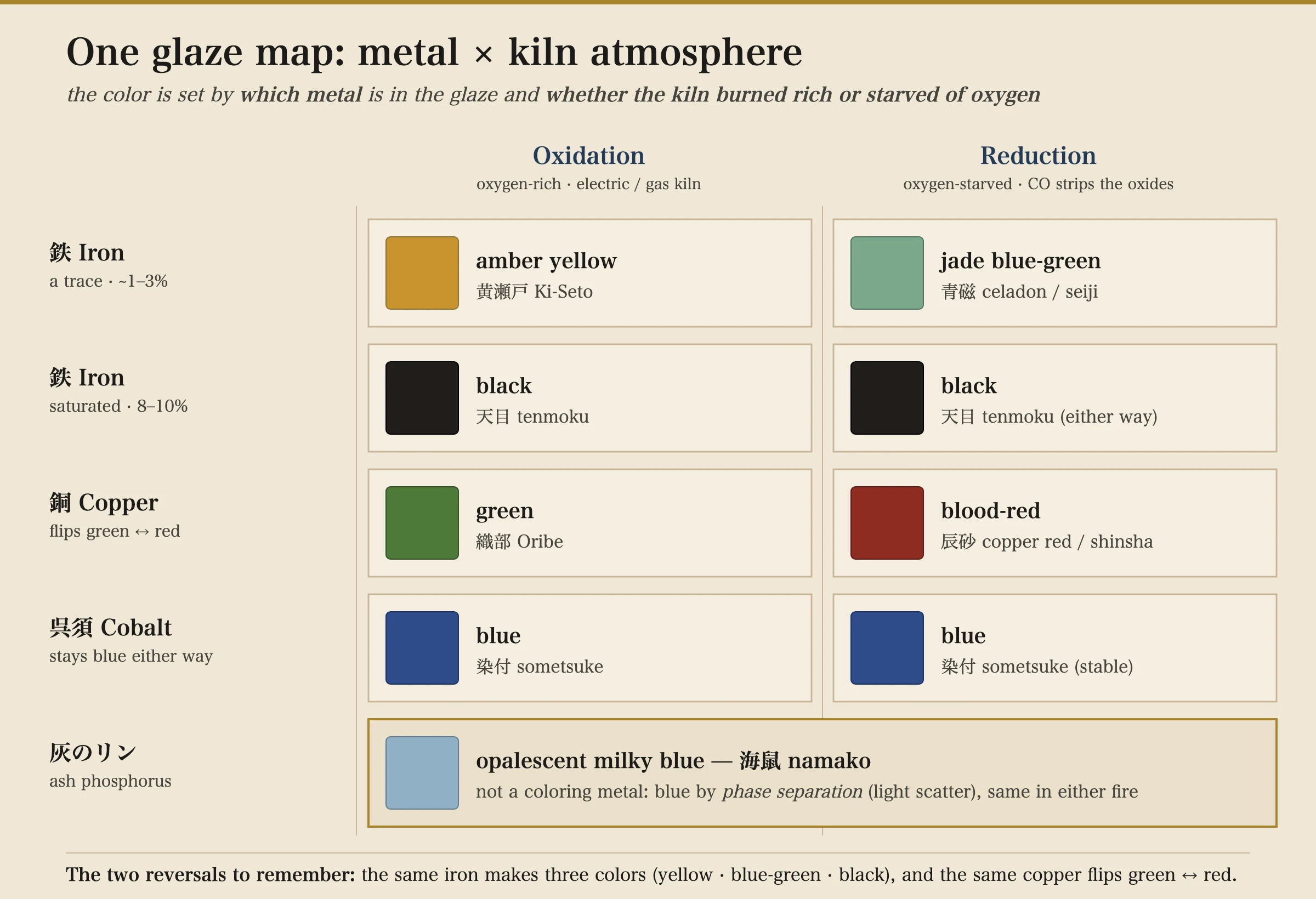
Two reversals do most of the work. Iron is a single metal that makes three colors. A trace of it (1–3%) fired in reduction gives celadon its blue-green; the same trace in oxidation gives a warm amber; saturate the glaze to 8–10% iron and it goes black. Copper flips between green and red, Oribe's green in oxidation and a blood-red in reduction, so two pots the same green can be there for completely different reasons. Cobalt is the outlier: it holds its blue no matter how the kiln burns, so it became the reliable pigment for painted sometsuke underglaze (see our guide to Arita and Imari porcelain).
Reading the classic glazes off the grid
Ash glaze (haiyū) is the trunk of the whole tree. The first glazes arrived by accident: in a long wood firing, ash from the burning pine settled on the pots and melted into glass, with no one applying it. Japan's ancient Sue ware shows this natural glaze by the late 6th century, and by the 9th century potters at the Sanage kilns near modern Nagoya were deliberately mixing ash into a glaze and brushing it on. Ash is mostly calcium and potassium oxide, pure flux, so it fires blue-green in reduction and yellow-brown in oxidation at 1,250–1,300°C. That same wind-blown ash still writes the surface of unglazed Bizen ware.
Celadon (青磁, seiji) is the iron-plus-reduction case at its most refined, an attempt, historically, to make clay imitate jade. The Chinese Yue kilns made the earliest celadons and the Southern Song Longquan kilns turned it into a famous export; Korea's Goryeo potters (918–1392) took it in their own inlaid direction. The chemistry is exact: reduction converts ferric iron to ferrous (Fe₂O₃ → FeO), and Wikipedia notes the sweet spot is narrow: "too little iron oxide causes a blue color… too much gives olive and finally black; the right amount is between 0.75% and 2.5%."
Tenmoku (天目) is the far end of that same iron scale, a glaze saturated to 8–10% iron, which is why it reads black. The name comes from Mount Tianmu in China, where Zen monks collected the iron-glazed tea bowls of the Jian kilns in Fujian; those were fired in oxidation near 1,300°C with a wood-ash flux. Cooling, not just heating, finishes the effect: slow it down and the iron crystallizes into the fine streaks called nogime (hare's fur) or the silvery discs of yuteki (oil spot). The peak of the type is yōhen tenmoku, which shifts through rainbow color as you tilt it. The three complete yōhen bowls left in the world are all Japanese National Treasures; none complete survive in China, only excavated fragments, and how the effect was made is still not understood. In 1406 the Ming Yongle Emperor sent ten Jian bowls to the shogun Ashikaga Yoshimitsu; that is the esteem this black glaze carried.
The four Mino glazes show the whole map inside one place and time: the tea-ware boom of the Momoyama era, in the Mino kilns of Gifu that still make roughly half of Japan's ceramics today. Shino is Japan's first white glaze, made from feldspar almost alone; laid on thick it comes out milky, with scarlet hi-iro flushes and a pitted yuzuhada ("citron skin"), and painted Shino (e-Shino) is counted as the first decorated Japanese pottery. Oribe, named for the warrior-tea master Furuta Oribe (1544–1615), is plant ash plus copper fired in oxidation, the copper-green case, on deliberately warped forms. Ki-Seto is the same plant ash with 1–3% iron, fired in oxidation for an amber yellow, celadon's iron under the opposite air. Setoguro is an iron glaze pulled from the red-hot kiln and quenched (hikidashi) to lock in a matte black. White, green, yellow, black: one clay, four glazes, sorted by flux, metal, and fire.
One glaze sits off the metal grid. Namako ("sea cucumber") glaze gets its milky opalescent blue from structure rather than a colorant: phosphorus, carried in rice-straw ash, breaks up the silica network so that droplets of a second glass separate out inside the first, and those nanoscale droplets scatter light blue. It is blue the way the sky is blue, a physical effect unlike the cobalt pigment of sometsuke.
Reading your own piece
Now you can run the map in reverse. A soft translucent blue-green almost certainly means a trace of iron reduced in the kiln: celadon. A dense black tea bowl is iron saturated to the top of the scale. A bright glossy green is copper in an oxygen-rich fire; a blood-red on the same recipe means the fire was starved. A warm amber and a jade green can be the same iron, parted only by the air. The two questions, metal and atmosphere, are all these surfaces are answering. For where these glazes sit in the making, see how Japanese pottery is made; for the clay bodies underneath them, stoneware versus porcelain.