
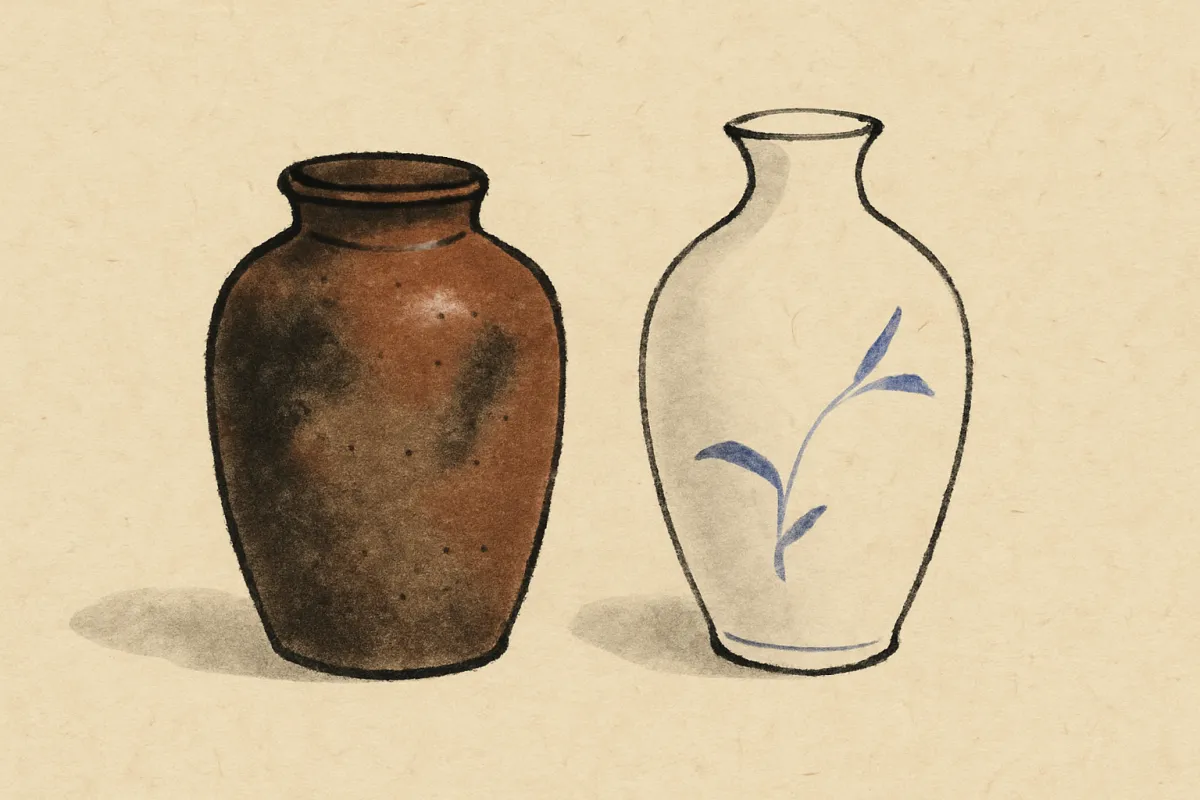
Turn a Japanese cup over and the base may say stoneware or porcelain. Set a Bizen tea bowl next to an Arita plate and the two barely look related: one is rough, reddish-brown, and matte; the other is smooth, white, and almost glows. People reach for the same word, pottery, for both, then wonder why one drinks water and stains while the other wipes clean and rings like a bell.
There is a single system underneath all of it, and it is simpler than the shelf makes it look. Two inputs, what the body is made of and how hot it was fired, decide what you can test for: whether it absorbs water and whether it lets light through.
Four classes, not two
Japanese groups fired-clay ware (陶磁器, tōjiki) into four classes. English usually keeps only "pottery" and "porcelain" and drops the third, which is the class that confuses buyers most.
- 土器 (doki), earthenware. Low-fired, 700–800°C, usually unglazed. Very porous, opaque, soft-edged. Prehistoric Jōmon and Yayoi ware and plain terracotta flowerpots sit here.
- 陶器 (tōki), pottery. Fired hotter, very 1,100–1,250°C (low-fired lead-glazed earthenware can be as cool as 800–900°C), and almost always glazed. The body stays opaque, colored (often buff or brown), and water-absorbent: the glaze seals the surface, but the clay under a chip or an unglazed foot-ring still drinks water. Much everyday handmade tableware, Hagi, and Mashiko live here. Tap it and you get a dull thud.
- 炻器 (sekki), stoneware. Fired 1,200–1,300°C, in Japan often unglazed and high-fired (a technique called yakishime). The body is vitrified (dense and non-absorbent) but still opaque and colored, because it is made from iron- or alkali-bearing clay. Bizen, Tokoname, and Shigaraki, all among the Six Ancient Kilns, are stoneware.
- 磁器 (jiki), porcelain. Fired to around 1,300°C (sources range from 1,200 to 1,400). White, vitrified, non-absorbent, and translucent, thin and hard, and it rings when tapped. Arita/Imari, Kutani, and Nabeshima are porcelain.
(Firing temperatures shift from source to source, so the figures are approximate.)
The grid to carry in your head
Put material along the top and porosity down the side and the four classes fall into a square with one telling gap.
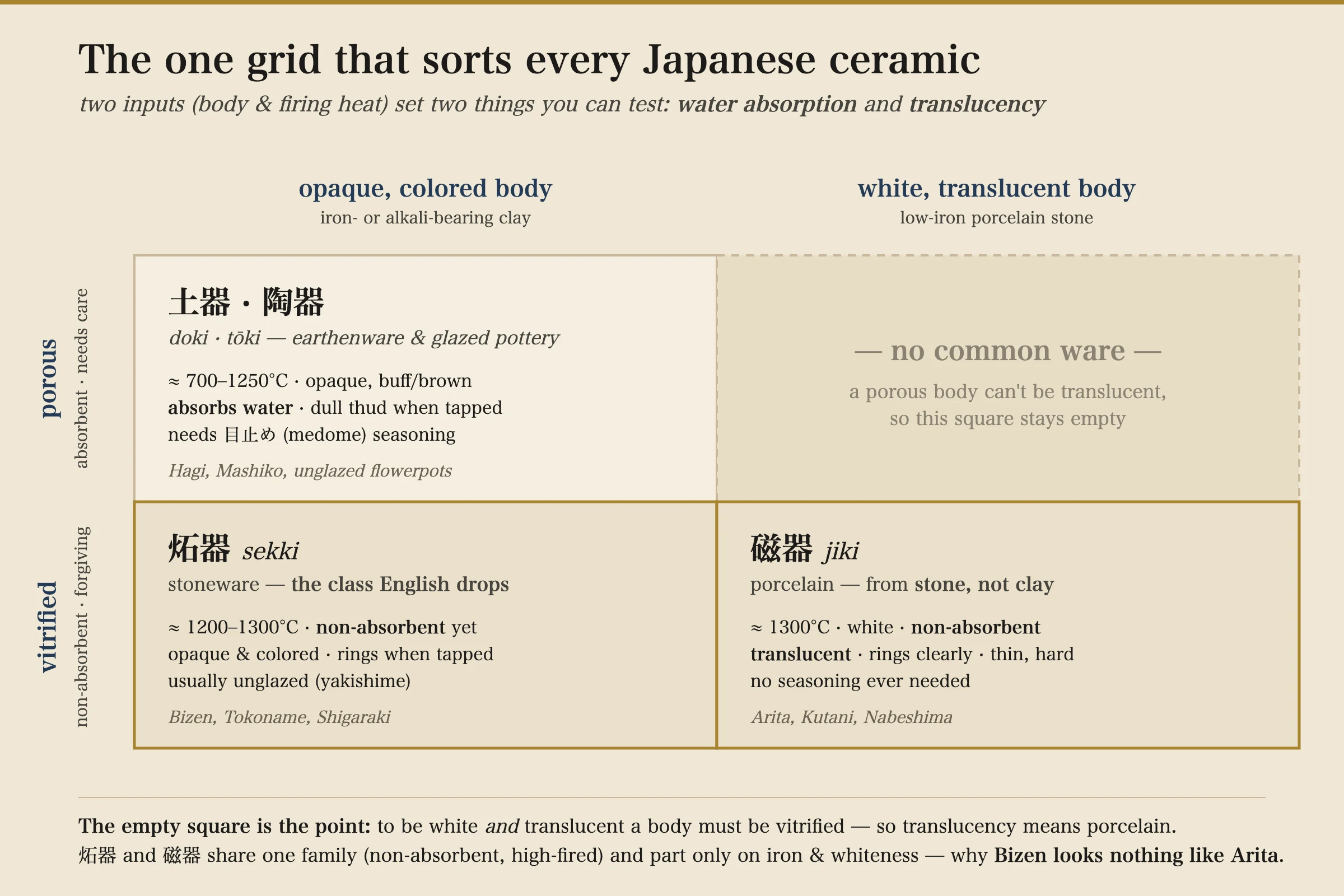
The empty square matters. To be white and translucent, a body has to be vitrified, so translucency means porcelain. And to be non-absorbent yet still opaque and earthy is what stoneware is: the "missing middle" that English drops when it says only pottery-versus-porcelain. Notice too that stoneware and porcelain sit in the same bottom row. They are one family, both fired to glass, both essentially waterproof, and part ways only on iron content and whiteness. That is why Bizen and Arita look like opposites: not different degrees of firing, but a dark iron clay against a white stone.
Porcelain is made from stone, not clay
Porcelain differs from the rest in what it is made of. Earthenware and stoneware are thrown from clay dug out of the ground. Porcelain is not: it starts from crushed 陶石 (tōseki), porcelain stone, a pale volcanic rock ground to powder and mixed with water. That single stone already carries what a porcelain body needs: quartz for the structural skeleton, feldspar for the flux that melts and glassifies it in the kiln, and enough fine white mineral to hold its shape wet. This is why Japanese porcelain leaned on stone alone where European makers had to blend china stone with separate kaolin clay. Low iron and titanium make it fire white; full vitrification makes it translucent, non-absorbent, and clear-ringing, and means it never needs seasoning.
Japan is unusually lucky in its raw material. Amakusa porcelain stone (天草陶石), quarried on Amakusa-Shimojima, supplies roughly 80% of the country's porcelain-stone output and is rare in that, crushed and watered, it sinters into porcelain on its own with no additives, where most porcelains have to be blended. Japanese porcelain itself was born at Arita, in Hizen (modern Saga), in the early Edo period, after porcelain stone was found at the Izumiyama quarry; tradition credits a Korean potter, Yi Sam-pyeong (Ri Sampei), though historians dispute the attribution. The wares shipped to Europe from the port of Imari, which is why the export style became known in the West as "Imari," a port name, not a kiln.
Placing a piece in your hand
You do not need a lab. Three tests settle most pieces:
- Hold it to light. If a thin edge glows and passes light, it is porcelain. Opaque means earthenware or stoneware.
- Tap it. A clear, high ring means a vitrified body: porcelain or stoneware. A dull, low thud means porous earthenware or pottery. (A ring can also reveal a hidden crack: a cracked piece thuds even when the body is dense.)
- Put a drop of water on the unglazed foot-ring. If it soaks in and darkens the clay, the body is porous and wants care. If it beads, the body is vitrified.
That last test is the practical one. Porous ware, earthenware and much everyday pottery, is the ware that needs 目止め (medome), the rice-water seasoning that fills the pores against stains and leaks, and it is the ware most prone to crazing and staining. Vitrified stoneware and porcelain are forgiving by comparison. So the same grid that explains why Bizen looks nothing like Arita also tells you, before the first wash, which of your pieces needs looking after and which you can simply use. For the seasoning and washing rules, see our guide to caring for Japanese pottery; for the stoneware end of the family up close, see Bizen ware; and for where each class is made, Japanese pottery styles by region.