
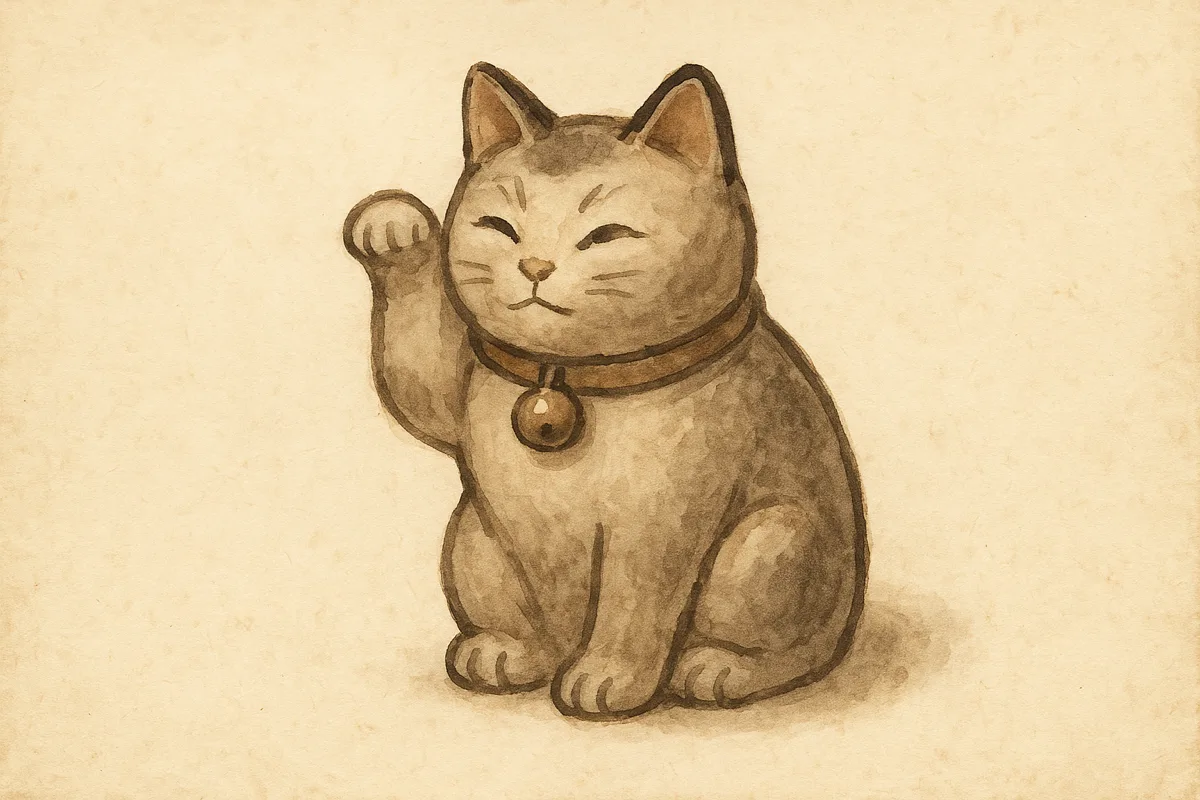
A white cat sits upright by the register of a ramen shop or on a souvenir shelf, one paw held high. It looks like it is waving goodbye, but it is doing the opposite. The maneki-neko (招き猫), literally "beckoning cat," is calling you and whatever luck you carry in.
A maneki-neko can be read. The raised paw tells you who it beckons; the color, what it beckons for; the coin, how much. The cat itself, souvenir though it looks, is a piece of pottery with a real hometown.
It's beckoning, not waving
The pose copies a specific Japanese gesture. To signal "come here," you hold your hand up with the palm facing down and fold the fingers toward yourself. That is what the cat is doing. To someone raised on the Western palm-up "come here," it looks like a friendly wave, so cats made for export are often molded with the paw turned palm-up instead, to look like beckoning to the people buying them.
Which paw: who the cat is calling
The first thing to read is which paw is up.
- A raised left paw beckons people: customers, guests, connections. This is the cat you meet at the door of a shop, restaurant, or bar, pulling foot traffic in.
- A raised right paw beckons money and good fortune. This is the one for a home, an office, or beside the cash box.
- Some cats raise both paws. A few people read both raised paws as greedy; makers intend it as asking for people and money at once.
The cat at the entrance and the cat by the till are usually not the same cat.
Which color: what the cat is calling for
The other half of the code is color. A few colors are old and tied to clear wishes; others are more recent, added as the cat became a mass-market gift. Not every color is ancient tradition.
| Color | Wish it carries |
|---|---|
| White | Overall good luck and good fortune |
| Gold / yellow | Wealth and money |
| Black | Warding off evil and bad luck |
| Red | Health, and keeping illness away |
| Pink | Love and romance (a modern addition) |
| Green | Household safety and study (a modern addition) |
| Calico (mi-ke) | The classic, most auspicious coat |
That last one is the traditional favorite. Calico, white with red-brown and black patches, is the coat of the mi-ke (三毛, "three-fur") cat. A male calico is genuinely rare, and that rarity is why the tricolor cat was considered especially lucky long before the color chart grew. The "default" lucky cat most people picture is a calico.
The coin, the bell, and the collar
Most maneki-neko clutch an oval gold coin to the chest. That is a koban (小判), the gold currency of the Edo period. Look closely and many are stamped with an amount, often senman-ryō (千万両), ten million ryō. That was never a real sum of money; no such coin existed. The exaggeration is deliberate: the cat is wishing you a fortune too large to count.
The bell on a red collar is a smaller clue to the cat's own history. Bells have hung from cats' collars in Japan since the Edo period, when owners used them to keep track of a pet wandering the house and garden. The maneki-neko simply kept the accessory. A few cats swap the coin for other lucky objects (a mallet, a sea bream, a gourd), but the coin-and-collar is the standard.
What it is: a molded pot from Aichi
The lucky cat is not a generic trinket. It is ceramic, and it comes from specific pottery towns.
The heartland is Aichi Prefecture, home to two of Japan's Six Ancient Kilns (the medieval pottery centers): Tokoname and Seto, whose kilns have run for something like a thousand years. Tokoname (常滑) is the one to know: it began making lucky cats in the late 1930s, and by 1950 it was Japan's largest producer of them. The shape most of the world now pictures, with its round body, big eyes and ears, and a koban hugged to the belly, took form in Tokoname in the late 1940s. The town leans into it today, with a giant cat monument watching over a "Maneki-neko Street" near the station.
Nearby Seto (瀬戸), the other Aichi kiln, has long turned out lucky cats using plaster molds and a wide range of glazes, and remains a major source. For the brightly hand-painted, ornate versions, look to Kutani (九谷) ware from Ishikawa, with its rich overglaze colors.
A tea bowl is thrown one at a time on a wheel; a maneki-neko is cast in a mold and made in numbers. That is not a knock on it. A folk lucky charm (engimono) is meant to be cheap and repeatable, so it ends up everywhere. (For how mold-forming and glazing actually work, see how Japanese pottery is made.)
Choosing one
With the two codes in hand, choosing is straightforward. Opening a shop and want customers through the door? A left-paw cat. Want to draw money into the house? A right-paw cat, and a gold one if wealth is the wish, or white for luck in general, black to keep bad luck out, red for someone's health. Then, if you can, choose one that was actually thrown of clay and fired in Tokoname or Seto rather than cast in resin far away. The beckoning cat has a hometown, and the pottery is half the charm.
The cat by the counter is beckoning, not waving, and the ceramic it is made of was very likely fired in Tokoname or Seto.