
If you own Japanese porcelain, the odds are good that some of it was made in a small town you have never heard of. By the reckoning of the Japanese government's own Highlighting Japan magazine, around 16 percent of all the everyday tableware used in Japan, roughly one dish in six, comes from Hasami, a town of about 15,000 people tucked into the hills of Nagasaki Prefecture. Between a fifth and a third of those residents work in some part of the pottery trade. And for most of the last century, the plates they made left town wearing a different name.
One valley over from Arita
Hasami sits just across a ridge from Arita, the celebrated town where Japan first made porcelain around 1616. They are so close that they share almost everything that matters: the same Hizen porcelain tradition, and the same raw material: Amakusa porcelain stone, the low-shrinkage white stone from further south in Kyushu. What separated them was the customer.
Arita made the prestige porcelain: the sparse, milky-white Kakiemon, the domain's private Nabeshima, and the dense red-and-gold "brocade" Imari that filled European palaces. Hasami went the other way entirely. It made the porcelain that ordinary people actually ate off: plainer, thicker, cheaper, and produced in enormous quantity. It was the same material aimed at a different goal.
That split is why a modern "Hasami Porcelain" mug can feel so different from a fine Arita plate even though they are, materially, close cousins. You are looking at the same stoneware-versus-porcelain distinction resolved on the same side (both are true porcelain), but two utterly different design briefs.
The bowl that democratised porcelain
Hasami's origin story runs to 1599, when, in the aftermath of Japan's invasions of Korea, Korean potters set up climbing kilns in the hills under the Ōmura domain. They started with stoneware; only after porcelain stone was found nearby did the town pivot, in the 1630s, to the blue-and-white porcelain it became known for. These were serious industrial kilns: the ruins of the Nakaoue climbing kiln run over 160 metres up the slope, and were made a National Historic Site in 2000. A climbing kiln is a mass-production engine: heat passes chamber to chamber, firing hundreds of pieces at once (more on how that firing works).
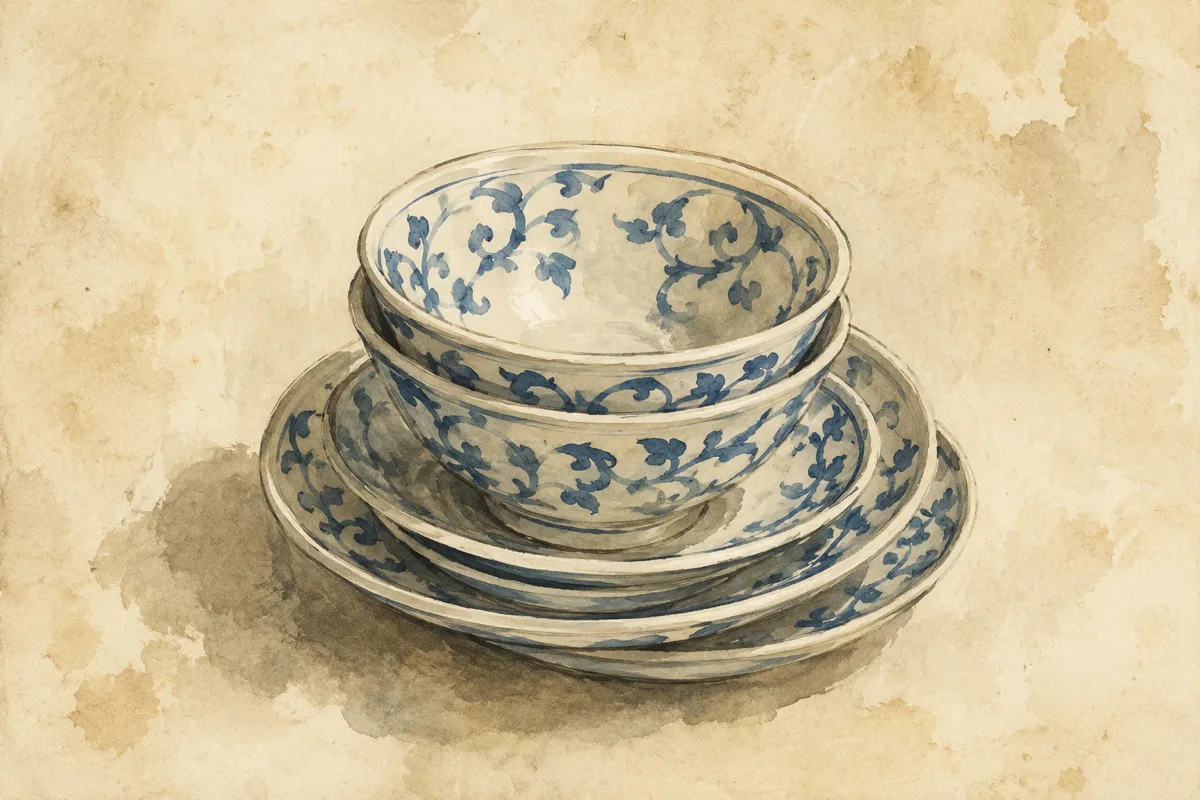
What came out of them was the kurawanka bowl (kurawanka-wan): thick, sturdy, and decorated with a quick, simple karakusa scrolling-vine pattern in cobalt blue. The name is pure Edo street life. On the Yodo River near Osaka, small boats called kurawanka boats would pull alongside the passenger ferries and hawk rice, soup and sake with a rough cry of kurawanka?, roughly "won't you eat?" The bowls that trade used were cheap enough not to matter and tough enough to survive being passed hand to hand across gunwales.
This is what Hasami changed. In the 1600s, porcelain was a luxury. By making it thick, plain and fast (the karakusa vine stays simple because it can be brushed at speed, without a master's hand), Hasami drove the price down until a farmer or a townsman could own a porcelain bowl. It was porcelain for the masses, and it reshaped the ordinary Japanese table. The town also had an export line, the compra bottles (from the Portuguese comprador) that carried soy sauce and sake out through Nagasaki, but its soul was the everyday bowl.
| Hasami (Hasami-yaki) | Arita (Arita/Imari-yaki) | |
|---|---|---|
| Made for | Everyday use, mass volume | Prestige, gifts, export |
| Signature | Cheap thick kurawanka bowls, plain blue-and-white | Kakiemon, Nabeshima, gold-brocade Imari |
| Clay | Amakusa porcelain stone | Amakusa porcelain stone (same) |
| Historic reputation | Long anonymous | Japan's "first porcelain," world-famous |
Hasami's invisible reputation
By the late Edo period Hasami was the single largest producer of blue-and-white porcelain in Japan. The obscurity came from working backstage. In the modern era Hasami's kilns became subcontractors for Arita, and Hasami porcelain was distributed through Arita and sold under the Arita and Imari names. The town made the dishes; another town got the credit. Generations of "Arita ware" in Japanese cupboards were, in fact, Hasami's work.
That only changed recently. From about 2002, Hasami began putting its products out under its own name, reviving, in effect, the old idea of well-made, affordable, everyday tableware, now aimed at modern life. The timing helped. A wave of contemporary designers seized on exactly what Hasami had always been good at (restraint, utility, volume) and turned it into the minimalist tableware now stacked in design shops worldwide: uniform-diameter mugs and plates that nest together into modular sets. The porcelain that spent four centuries being anonymous and unfussy is now prized for being anonymous and unfussy.
Is it practical? Yes, by design
For a buyer, the reassuring part is that Hasami's whole reason to exist is daily use. It is fully vitrified porcelain — fired hard, non-porous, and unfussy about the care that more porous wares demand. Glazed Hasami tableware is normally dishwasher- and microwave-safe, which is a big reason it works as genuine everyday ware. The one thing to check: some fashionable pieces have a raw, matte, unglazed outer surface, and those are often recommended for hand-washing, so read the maker's note for that specific finish.
The understated, use-worn beauty that design magazines now admire in it is the same thrift that shaped a cheap river-boat bowl 400 years ago, not a modern styling exercise. If you want porcelain built to be used rather than displayed, that is the tradition you are buying into. Browse the pottery shop with that in mind.