
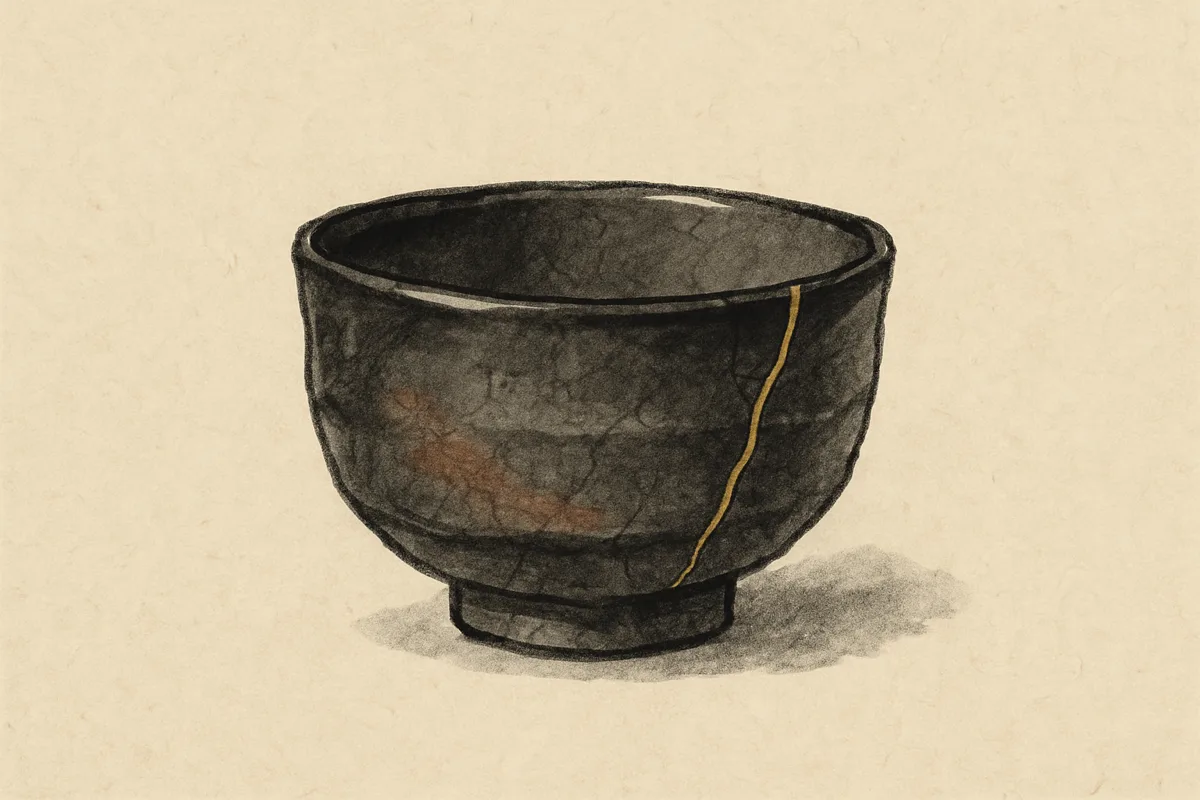
You've seen the word by now, usually floating over a photograph of a lopsided bowl or a linen-draped room: wabi-sabi, offered as shorthand for "beautifully imperfect" or "rustic living." That version isn't wrong so much as hollowed out. The real story is stranger and much better. It starts with two miserable words, runs through a tea-room rebellion that ended in a forced suicide, and is easiest to understand not as a mood but as an object you can hold.
Two words, not one
The first thing to fix: wabi and sabi are two different words with two different origins, joined into the compound "wabi-sabi" only in modern usage. And both of them began as words for hardship.
Wabi (侘) comes from the old verb wabu. As Paul S. Atkins, a professor of Japanese at the University of Washington, puts it flatly: "Wabu means to languish or be miserable." It named the wretchedness of exile and poverty; a ninth-century poem uses it for a man shedding tears of brine on a lonely shore. Only later did tea culture flip it into an ideal: not misery, but the richness of the simple, the frugal, the insufficient. Beauty found because of lack, not in spite of it.
Sabi (寂) comes from sabu / sabireru, "to grow desolate," related to sabishii, "lonely," and to the homophone sabi (錆), "rust." It's the beauty of age and weathering, of the patina that only time can lay down. One classic gloss says sabi is "not the loneliness of a man who has lost his dear one, but the loneliness of the rain falling on large taro leaves at night": impersonal, atmospheric, the feeling of things wearing away.
So wabi-sabi isn't a decorating style. It's a reversal of value: the plain, the incomplete, and the aged, reframed as more moving than the opulent and new.
Rooted in impermanence
The reversal rests on Buddhism. It grows from mujō (無常), the reading of reality as ceaseless change, "the world of flux," in the Stanford Encyclopedia of Philosophy's phrase, being "the only reality." It's the aesthetic sibling of mono no aware (物の哀れ), the "pathos of things," where beauty is made more poignant precisely because it passes. A perfect, permanent object has nothing to say about this. A cracked, weathered, obviously mortal one does.
Zen scholars have tried to pin down what makes an object read this way. The philosopher Hisamatsu Shin'ichi (1889–1980), in Zen and the Fine Arts (Japanese original Zen to bijutsu, 1958), named seven characteristics shared by Zen-grounded art, a checklist for why a pot looks wabi-sabi:
| Principle | Reading | Roughly |
|---|---|---|
| 不均斉 | fukinsei | asymmetry, irregularity |
| 簡素 | kanso | simplicity, sparseness |
| 枯高 | kokō | austere, weathered loftiness |
| 自然 | shizen | naturalness, no contrivance |
| 幽玄 | yūgen | subtle profundity, reserve |
| 脱俗 | datsuzoku | freedom from convention |
| 静寂 | seijaku | stillness, tranquillity |
These, Hisamatsu wrote, communicate something central to Buddhism: above all non-attachment.
Engineered in the tea room
Wabi-sabi didn't drift in on the wind. It was built in the tea room, over three generations of masters, as a revolt against imported luxury.
In late-medieval Japan, serving tea meant showing off costly Chinese karamono: gold, jade, porcelain. Against that, Murata Jukō (1423–1502), often called the founder of the tea ceremony, began swapping in rough, plain, native wares. Takeno Jōō (1502–1555) deepened it, tying the aesthetic to melancholy court poetry and shrinking the tea room. And Sen no Rikyū (1522–1591) perfected it into a spiritual path, reducing the tea space to a bare two-mat hut with a crawl-in door so low that even a warlord had to bow and leave his rank outside. (For where this fits in the wider way of tea, see getting started with matcha.)
It cost Rikyū his life. Though one of the ruler Toyotomi Hideyoshi's closest advisors, the master of austere tea was ordered to commit seppuku in 1591. The plain grass hut set against Hideyoshi's portable, glittering Golden Tea Room: a clash of values with an actual body count. Whatever the true motive, the era's greatest advocate of humble beauty died at the hands of its greatest lover of gold.
Told through the pots
All of which stays abstract until you look at a specific bowl. Here Japanese pottery earns its place as the clearest textbook of wabi-sabi:
- Raku ware: hand-pinched without a wheel, low-fired, undecorated, monochrome. Rikyū had the tile-maker Chōjirō make these bowls to serve wabi tea; one description calls them "a strong artistic statement negating what was then common practice." That's fukinsei and kanso, asymmetry and plainness, literally shaped in the hand.
- Hagi ware and its "seven changes" (Hagi no nanabake): a soft, porous body under a thin glaze that crazes into fine crackle, or kannyū (貫入). Tea seeps through the cracks and slowly stains the clay, so the bowl's colour deepens over years of use. This is sabi made touchable: impermanence you can watch happen in an object you own. (It's also why porous pottery needs seasoning; see caring for Japanese pottery.)
- Kintsugi: the broken seam mended in gold rather than hidden, "not only... no attempt to hide the damage, but the repair... literally illuminated." A break becomes part of the object's history instead of the end of it. (The full craft, and why the gold isn't the glue, is in what is kintsugi, which relies on the tree-sap lacquer urushi; more on that here.)
There's even a ranking of tea bowls that encodes all this: ichi-Raku, ni-Hagi, san-Karatsu, "first Raku, second Hagi, third Karatsu." Raku ranks first because it was born to serve Rikyū's wabi tea. If you want to see how these wares differ by clay and region, the regional styles guide maps them out.
One necessary correction
Because the internet has flattened wabi-sabi into "rough = good," it helps to end on a warning from the source. Jukō himself held that an "excessive concern with the imperfections and rustic aesthetic of Japanese utensils was as bad as a preoccupation with the regular forms and perfect glazes of Chinese ceramics." Wabi-sabi was never a licence to call anything lumpy profound. It's a balance and a discipline, a trained way of finding the whole of impermanence in a plain, imperfect, aging thing. Most of the English-language "wabi-sabi lifestyle" writing descends from Leonard Koren's 1994 book, usually stripped of the Zen, the etymology, and the pottery. Put those three back, and the word finally means something you can hold in two hands.