
Jubako: Why Osechi Comes in Tiers, and How to Choose One
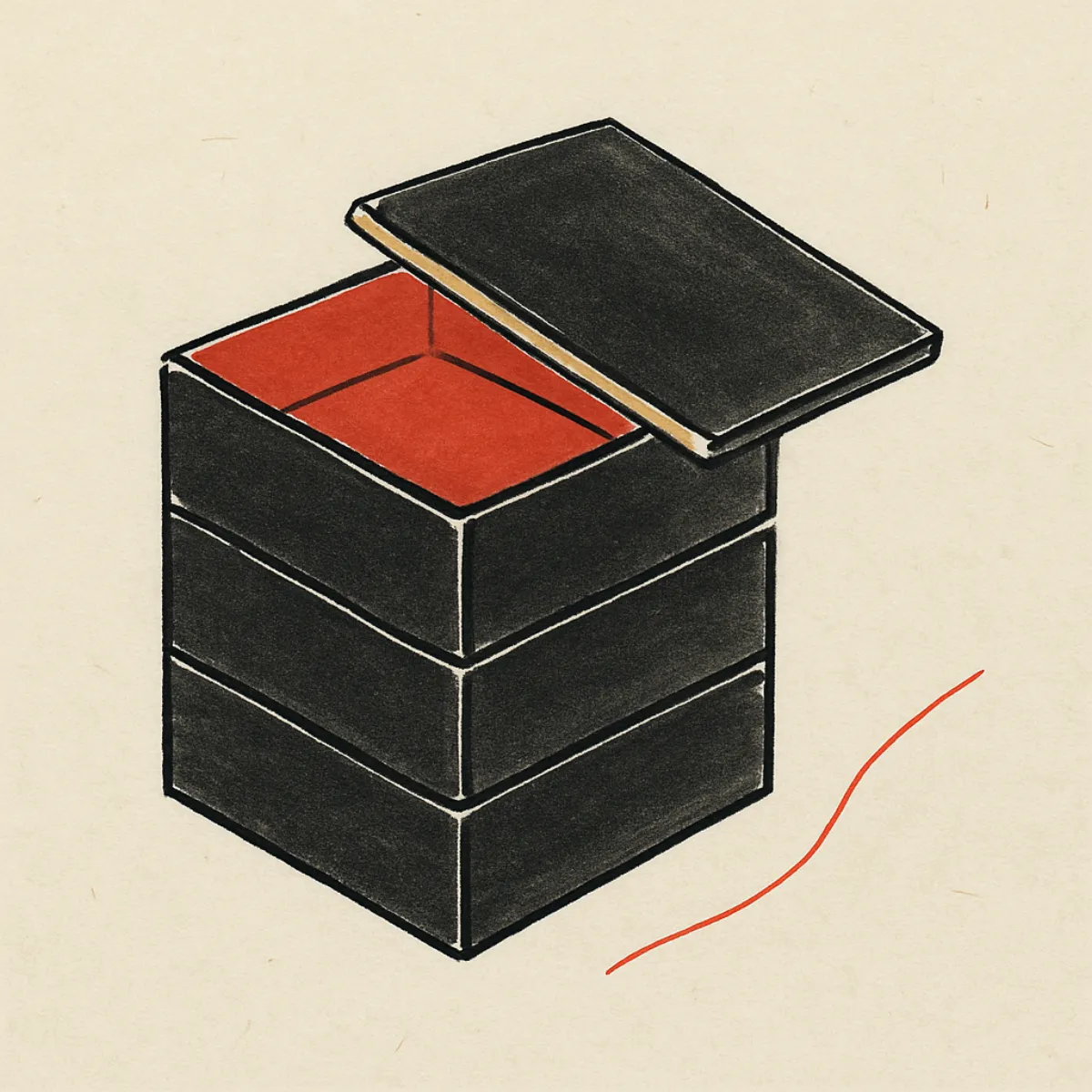
Open almost any photo of Japanese New Year food and the same object frames it: a black lacquered box, glowing red inside, stacked two or three tiers high and packed tight with small bright foods. Most people meet it first as a plastic tray of supermarket osechi: the same silhouette, snapped shut with a lid. The box has a name, jubako, and the gap between that plastic version and a lacquered one is wider than it looks. Here is what the tiers actually mean, and how to choose a box you will not regret.
The stacking is the point
Jubako (重箱) means, plainly, "stacked boxes." The word's first written appearance is in a late-Muromachi dictionary, the Manjuya-hon Setsuyoshu, and the form is thought to have grown out of a Chinese covered food container called jikirou. By the Edo period feudal lords carried ornate versions on outings, and from there the box worked its way down to ordinary households.
What makes it a New Year object rather than just a lunchbox is the stacking itself. Piling the tiers stands for piling up happiness and good fortune, layer upon layer, into the year ahead. The point to take away is simple: the shape of the box is the wish. You are not packing food into tiers for convenience; you are building a small tower of luck.
How to read the tiers
Tier counts vary: two, three, or five are all normal, and older sources will call four the traditional number. A three-tier box handles most home cooking. The tiers are read from the top down and each does a job:
- First tier (ichi-no-ju): the celebratory nibbles eaten with a drink: black beans (kuromame), herring roe (kazunoko), sweet chestnut paste (kuri-kinton), candied sardines (tazukuri), red-and-white fish cake. This is the "face" of osechi.
- Second tier (ni-no-ju): grilled things like sea bream and prawn, plus vinegared dishes.
- Third tier (san-no-ju): the simmered vegetables.
Two small details reward a closer look. When there is a fourth tier, it is not called shi-no-ju: shi, the plain word for four, is a homophone of the word for death, so it becomes yo-no-ju instead, borrowing a softer reading of the number. And in a full five-tier set, the very bottom box is traditionally left empty, not an oversight but a space kept open for the fortune the New Year god is meant to bring. A box whose form means "piling up luck" even edits its own numbering and leaves room for more.
Real urushi, synthetic, or plain wood
Buyers get lost here, because "lacquer box" covers three quite different objects at three very different prices.
| Hon-urushi (real lacquer) | Synthetic (resin + urethane) | Plain wood | |
|---|---|---|---|
| Body | Natural wood, e.g. hinoki | Molded resin/plastic | Bare unlacquered wood |
| Coating | Many coats of natural urushi | Sprayed urethane or cashew | None |
| Look | Deep glow from within, red-and-black | Even, surface-level shine | Matte grain |
| Dishwasher | Never (heat lifts the film) | Usually "yes" — and that's the tell | No |
| Care | Hand-wash, wipe dry at once | Wipe or machine-wash | Dries, stains easily |
| If it wears | Can be re-lacquered | Peels; discard | Sands, but marks |
| Price / use | High; heirloom, guests | Low; once-a-year | Low; rustic, casual |
The single most useful shortcut costs nothing. If a jubako is sold as dishwasher-safe, it is synthetic. Real urushi is damaged by sustained heat and harsh detergent, so an honest maker can never print that claim on it; the convenience is the giveaway that the coating is urethane, not lacquer. Beyond that, read the listing for the words urushi, "natural lacquer," or the Japanese 本漆 / 天然漆; be wary of vague phrases like "lacquer-style" or "lacquer finish," and of a "urushi" box priced too cheaply to contain any. The deeper method is in our guide to spotting real urushi from a synthetic coat, and the reason a genuine one is safe to eat from once cured settles the worry that lacquer is somehow toxic.
None of the three is simply "best." A resin box that appears once a year and wipes clean is a sensible buy. A hon-urushi box earns its price only if you will hand-wash it and actually use it.
Size, shape, and where it is made
Jubako are measured in sun, the old Japanese inch. The everyday size is the 6.5-sun box (about 19.5 cm across); a three-tier of that feeds four to five people, the default for a family osechi. Smaller households do well with a 5-sun (about 15 cm) or 4-sun (about 12 cm). Square boxes pack most efficiently; round ones read softer and more formal; flower-petal shapes exist too.
Boxes are not as strongly region-typed as bowls, but the names to trust are the same lacquer centres you would trust anywhere: Wajima in Ishikawa for the most durable, high-end work, Echizen in Fukui, the understated giant that makes most of Japan's commercial and restaurant lacquerware, and Aizu in Fukushima, whose division of labour keeps prices within reach. A jubako's classic dress, black outside and vermilion within, is itself a piece of lacquer grammar: black for formality, red for life and celebration, the two canonical urushi colours doing exactly the work they were chosen for.
Not only for New Year
The mistake is treating a good jubako as a January object that sleeps eleven months in a cupboard. Historically these boxes travelled (to cherry-blossom picnics, to outdoor banquets) and they still earn their keep at sports days, hanami, and any table where you want to serve small dishes with a sense of occasion. Split the tiers and one becomes a handsome bento; stack them and you have a centrepiece for guests.
Whichever you buy, treat a lacquered one gently: dust it with a soft dry cloth, wipe any residue with a well-wrung damp cloth and dry it immediately, keep it away from long soaking and out of the dishwasher. The full care routine for lacquerware applies to a jubako as much as to a bowl, and you can see a range of boxes in the shop. Cared for that way, a hon-urushi box does something the plastic one never will: it stacks up years, one New Year at a time.