
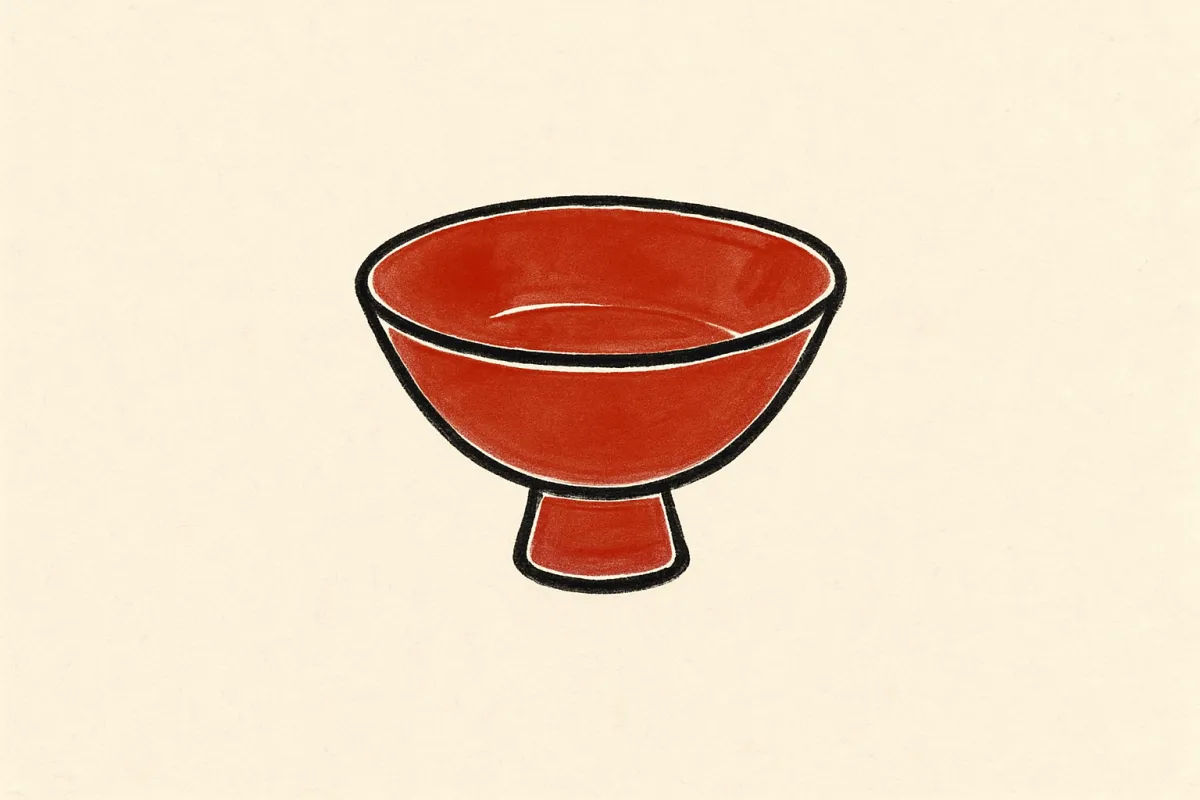
What Is Urushi? The Tree Sap That Hardens in Humidity
Most finishes dry. Varnish dries, paint dries, oil dries: solvent or water leaves the film and what remains goes hard. Urushi goes the other way. Japanese lacquer sets by taking moisture in, which is why a lacquer workshop keeps its drying cabinet wet rather than warm.
A tree, a knife, and a teacup of sap
Urushi is the refined sap of Toxicodendron vernicifluum, the Asian lacquer tree, a relative of sumac and poison ivy that grows across Japan, China, Korea and parts of Southeast Asia. A tree has to grow for at least ten years, often fifteen or more, before it is worth tapping. From June through autumn a craftsman scores shallow horizontal cuts into the bark and collects the grey sap that beads up, the same defensive response a rubber tree gives: a wound trying to seal itself.
The yield is brutal. A single mature tree gives only around 200 grams of sap across a whole season, a teacupful, and in the traditional Japanese method, koroshigaki ("tapping to death"), every last drop is drawn over roughly five months and the tree is then felled. Tappers in Jōbōji, the heart of Japanese urushi production, call those drops "blood." That scarcity is why genuine urushi objects cost what they do, and why "lacquer" on a cheap bowl usually means polyurethane pretending.
Raw sap is filtered and stirred (a stage called nayashi and kurome) to break up its particles and drive off excess water until it becomes the smooth, honey-thick material an artisan can brush. Left natural it cures to a deep transparent brown; mixed with iron it turns the signature jet black (roiro), and with cinnabar or modern red pigment it becomes the vermilion everyone pictures.
Urushi cures by absorbing water
Urushi is mostly urushiol, an oily phenol, suspended with water, plant gums, and an enzyme called laccase. Laccase is a catalyst. Given oxygen and moisture, it grabs urushiol molecules and stitches them to each other, an oxidation-and-polymerization reaction that links thousands of small molecules into one vast, dense, cross-linked network.
The enzyme only works in damp warmth. It needs 70–85% relative humidity and a temperature 20–30°C to stay active. Too dry and the laccase stalls; the lacquer simply stays tacky. That is why workshops cure pieces inside a muro (also called a furo), a humidified cabinet whose walls are kept wet, sometimes for days per coat. A hot dry day is bad for lacquer; a muggy rainy one is good. Recent materials research has even sped the reaction up with copper-ion catalysts, but the underlying mechanism is the same enzymatic oxidation craftsmen have relied on for millennia.
Each coat is thin, a fraction of a millimetre, and a finished piece may carry dozens of layers, every one applied, cured in the muro, then sanded back before the next. The depth you see in good lacquer is literal: you are looking down through many cured films into the wood.
What makes the cured film so tough
Once that polymer network forms, it is remarkably stable. Cured urushi shrugs off water, dilute acids and alkalis, salt and alcohol, and holds up to heat past 300°C, which is why lacquer was used for centuries on bowls, sake cups, food boxes, armour, and even ship and temple fittings. The same cross-linked density that makes it waterproof makes it a barrier: bacteria and moisture struggle to penetrate it, so a lacquered bowl is naturally hygienic and insulating enough to hold hot soup without burning your hands.
It is not indestructible. Ultraviolet light slowly breaks the polymer down and dulls the surface, so lacquer hates direct sun. But against ordinary kitchen life it is an exceptionally durable natural coating, and it ages gracefully; a matte finish slowly burnishes to a glow with years of handling.
The catch: raw urushi can burn your skin
Because the lacquer tree shares a family with poison ivy, raw urushi is an aggressive skin irritant. Urushiol is the same compound that causes poison-ivy rash, and uncured lacquer can trigger painful contact dermatitis on people who handle it; apprentices traditionally build up a tolerance the hard way over years. Once urushi has fully cured, the urushiol is locked into the polymer and the surface is inert. A finished lacquer bowl is completely safe to eat from. The risk lives entirely in the workshop, not on the table.
When someone calls urushi a "living finish," it is not quite poetry. It is sap that defends a tree, an enzyme doing chemistry in a damp box, and a film that keeps maturing for decades after it leaves the artisan's hand.