Why Is Japanese Lacquer Red and Black? The Colors of Urushi Explained
Japanese lacquerware keeps returning to the same two colors: a deep glossy black and a warm vermilion red. It can look like an aesthetic decision, a house style handed down for a thousand years. Mostly it isn't: raw urushi is neither red nor black, and for most of its history those two were very nearly the only colors the material would allow.
The sap is amber, not black
Straight from the tree, urushi is a cloudy grey-yellow. Refined (stirred and gently heated to break up its particles and drive off water), it turns translucent, its color moving through grey-brown to honey to a reddish amber, the shade of honey held up to the light. Brushed on thin it is see-through; left unpigmented and cured, it settles into a deep transparent brown. (This is the same living sap covered in what urushi actually is.)
That amber base shapes everything that follows. Every colored lacquer is built on top of it, which means the brighter the color you want, the harder the brown underneath fights you. Red and black win because they win against that brown.
Black is a reaction, not a coat of black paint
The signature black is one of the quiet marvels of the craft. It is not made by mixing in something black. It is made with iron.
Urushiol, the oily compound that makes up most of urushi, carries a pair of neighboring hydroxyl groups, a catechol structure. When iron is introduced, iron ions bond with those groups to form a coordination complex, and the clear lacquer develops a deep black as it oxidizes, usually over one to three days. In the workshop this means stirring iron (iron hydroxide, filings, historically even rusty water) into transparent lacquer. Called roiro or kuro-urushi, it is a black that is somehow still transparent: you look into it rather than at it, and it keeps the hardness of the clear film.
There is a cruder route: mixing in soot, or lampblack, which does turn lacquer black. But that black is opaque, and the film a touch softer. The finest black is a chemistry, not a filler.
Two reds, and a paradox about iron
Red comes in two grades, and they are chemically unrelated.
| Color | Source | Chemistry | Character |
|---|---|---|---|
| Black (roiro) | iron | Fe³⁺ bonds with urushiol's catechol groups | transparent, hard, deep — a reaction |
| Vermilion (shu) | cinnabar | mercury sulfide, HgS | brilliant, costly, sacred |
| Earthy red | bengara | iron oxide, Fe₂O₃ | browner, cheap, weatherproof |
The brilliant shu vermilion is powdered cinnabar, mercury sulfide, the same substance mineralogists call cinnabar and painters call vermilion. It is the most vivid red and the most expensive, and it carries centuries of prestige. The humbler red is bengara, iron oxide: browner, quieter, cheap and remarkably durable, which is why it coats building exteriors and mass-produced bowls. Its name traces to Bengal.
The iron cuts both ways. Metallic iron reacting with the sap makes black, while already-oxidized iron (iron oxide, bengara) mixed in as a pigment makes red. The same element, in two different oxidation states, sits at opposite ends of the lacquer palette. Because cinnabar contains mercury, today's makers usually reach for safe industrial pigments or pre-mixed colored lacquer instead.
Only these two, for so long
Urushi is a difficult host. It reacts with most pigments and dulls them to grey or black, so until the 19th century a lacquer artist had roughly five workable colors: red, black, yellow, green and brown. Of those, red and iron-black were the most stable, the most vivid, and the easiest to source.
Blue was effectively impossible: no reliable blue pigment survived contact with the sap. White was the hardest of all, because the base lacquer is itself brown, so any white pigment stirred in only reaches a pale beige. When artisans wanted true white, they didn't use pigment at all. They inlaid eggshell (rankaku) and ground it back to a matte white surface.
The palette only widened in the modern era, on two currents at once: imported Western synthetic pigments, and the restless experiments of Shibata Zeshin (1807–1891), often called Japan's greatest lacquer artist, who pushed color and mixed-in materials far past tradition. A dependable blue arrived only when Prussian blue (synthesized in Berlin) came into wide use in Japan around 1830 (it had trickled in through Nagasaki decades earlier but stayed rare and costly), the same pigment that was transforming ukiyo-e prints in the very same years.
Red came first, by nine thousand years
The two colors are old beyond easy imagining. Lacquer use in Japan reaches back to the Jōmon period, and the oldest known red lacquer (a red-lacquered thread ornament from the Kakinoshima B site in Hokkaido) is around 9,000 years old, among the oldest known lacquer artifacts. Red-lacquered wooden vessels roughly 5,500 years old survive from the Sannai-Maruyama site in Aomori. Both cinnabar and iron oxide appear in these ancient reds.
Red was never neutral. It was the color of fire, blood, sun and life force, layered on thickly for protection against evil. That charge never left it: vermilion is still the color of the shrine torii (the great gates of Fushimi Inari are its emblem), of the vermilion seal on official documents, of the teacher's correcting brush. Black stands opposite it as depth, formality and age.
The vessel that turns red into black: negoro-nuri
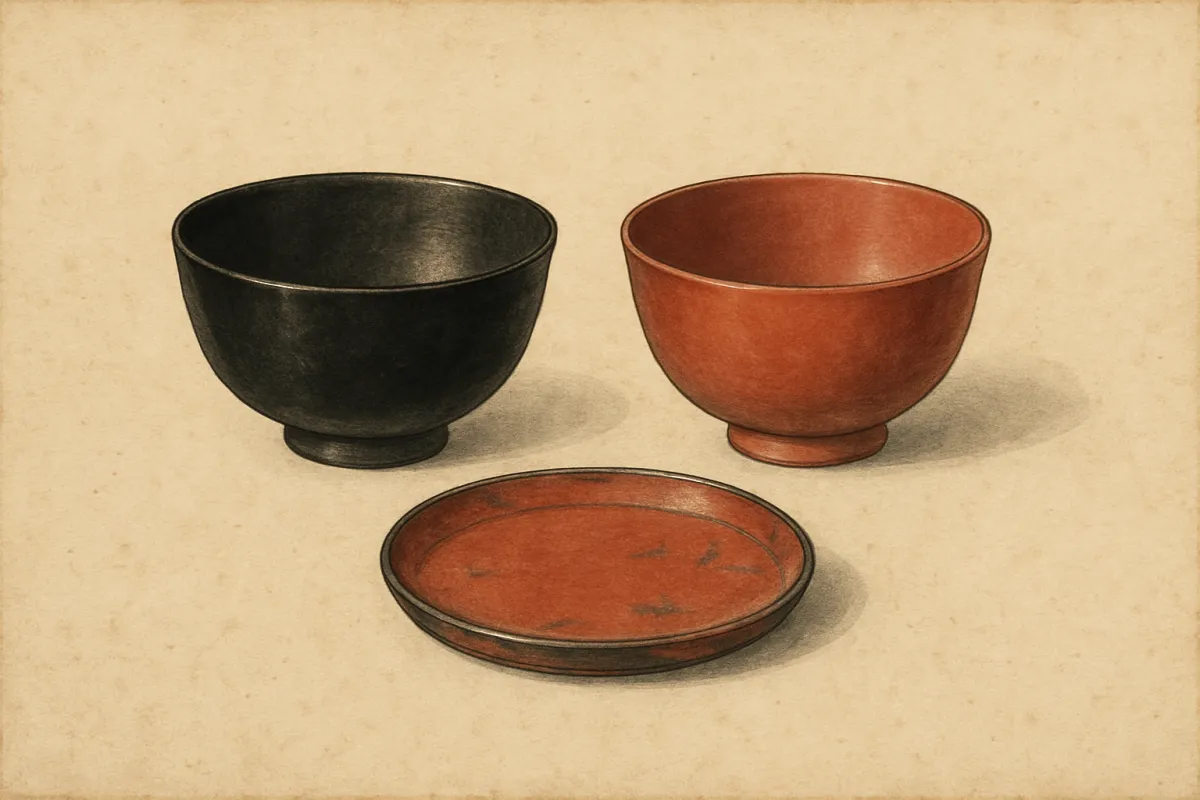
Negoro-nuri shows the whole thing at once. The construction is simple: black lacquer underneath, red lacquer on top. Then time does the rest. In daily use the red wears first from the rims, corners and footring, and the black beneath begins to show through; the surface turns a mottled red-and-black threaded with fine cracks that the Japanese eye sees as a landscape.
This wear is not damage. It is completion: a negoro piece is considered more beautiful used than new, which makes it a textbook object of wabi-sabi, and a favorite of tea masters. The style is named for Negoro-ji, a temple founded in 1130 whose monks mass-produced these plain, tough utensils through the Kamakura and Muromachi periods. Production ended abruptly when Toyotomi Hideyoshi burned the temple in 1585; the original technique was revived only in 2000.
Negoro holds red and black in a single object: the two canonical colors, the chemistry behind each, and time itself slowly rubbing one back to reveal the other.