
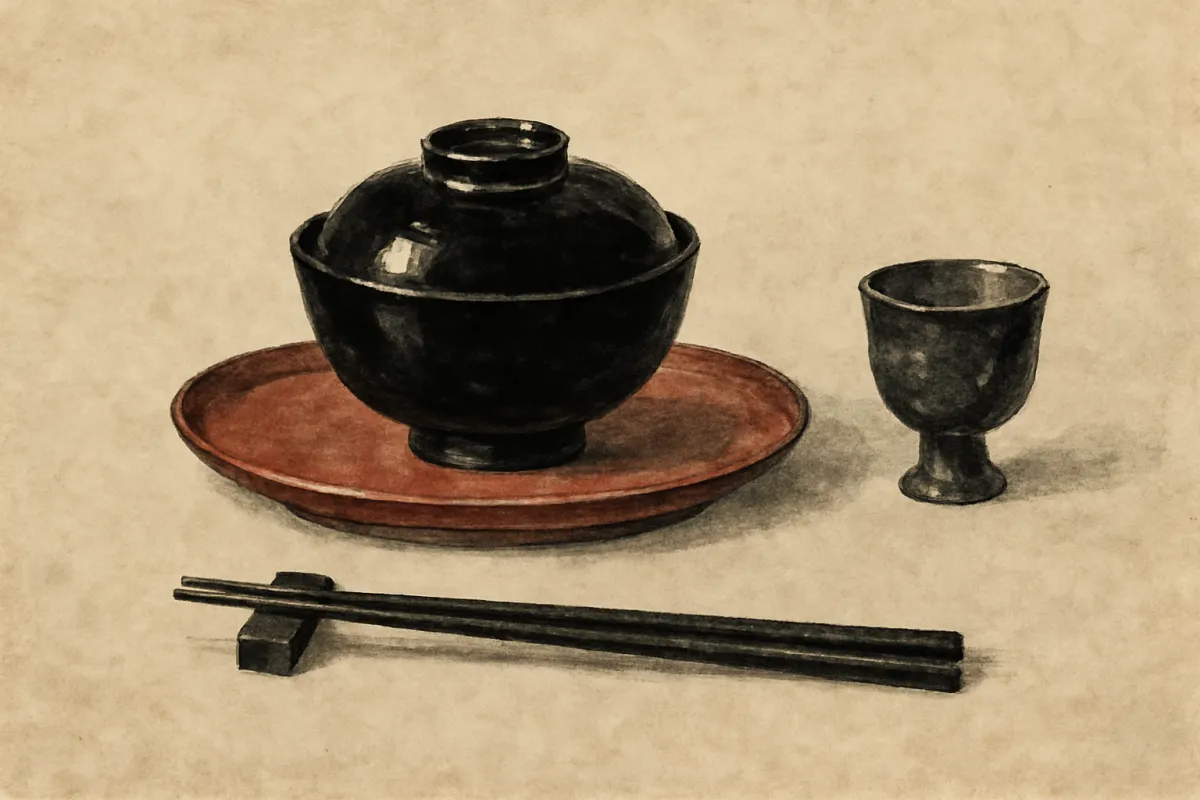
"Japanese lacquerware" means urushi brushed over a wooden core, which sounds like one material. But a black Wajima bowl built to outlive its owner and a bright red Wakayama tray made to sell cheap are both, correctly, lacquerware. Like pottery, lacquer is sorted by region: each craft is named for the town or province where its wood, its lacquer, and its decorators sit. What most separates them isn't the shine you can see but the groundwork layer underneath. This is a tour of the main producing regions and the feature that tells each apart.
The layer you can't see sets the price
Almost every region paints the same urushi over wood. What changes from place to place is a stack of four decisions: the wood core (kiji), the hidden groundwork (shitaji), the signature decoration, and where all of that lands the price. Of the four, the groundwork explains the most.
The best example is the two extremes. Wajima builds its undercoat from jinoko, a fired diatomaceous powder, and glues cloth over every rim and foot, a process that is slow, mineral-hard, and expensive. Kishu takes the other route on purpose: it makes its groundwork from persimmon tannin (kakishibu) and animal glue (nikawa) instead of costly urushi, so it can sell a usable lacquer bowl for a fraction of the price. The question to ask of any piece is what sits under the finish. (For the difference between real urushi and sprayed synthetic that imitates it, see how to spot real urushi.)
Wajima (Ishikawa): the toughest
Wajima-nuri is the durability benchmark. Its hard jinoko ground and cloth-reinforced edges make it resist chips and drops, and a finished piece is traditionally counted at 124 steps passing through dozens of specialists' hands. It is the priciest end of the market, decorated with chinkin (gold cut into carved lines) and maki-e, and it is built to be repaired rather than replaced.
Yamanaka (Ishikawa): the wood-turning kingdom
An hour south, Yamanaka barely competes on lacquering at all; it wins on the wood. It is Japan's leading source of turned (lathe-worked) cores, and it supplies bare wood to Wajima, Kyoto, and beyond. Its trick is tategi-dori: cutting the core so the grain runs vertically, parallel to the tree's rings, which resists warping and lets a bowl be turned thin and still stay true. Look for the fine cut rings (kashokubiki, in more than forty patterns) turned right into the surface. In Ishikawa the division of labor runs wood in Yamanaka, lacquer in Wajima, maki-e in Kanazawa: a single bowl can cross prefectures and many hands before it's done, with Kanazawa supplying the lavish Kaga maki-e.
Tsugaru (Aomori): the "fool's lacquer"
Japan's northernmost lacquer, from around Hirosaki, is all about the surface. In kara-nuri, an artisan dabs bumps of lacquer with a perforated spatula, then layers colors and grinds back down until a mottled, marbled pattern surfaces; the design is excavated rather than painted on. The signature style can run some 48 steps over two months or more, which is why locals call it baka-nuri, "fool's lacquer." Other Tsugaru styles include speckled nanako-nuri and dark monsha-nuri.
Aizu (Fukushima): affordable gold
Aizu, in Fukushima, became a production powerhouse after the lord Gamō Ujisato brought woodworkers, lacquerers, and gilders in from his home region in 1590. Its calling card is keshifun makie: the finest gold powder dusted on with cotton for a soft, matte gold rather than a mirror glint, often in "Aizu-e" motifs of pine, bamboo, and plum with a lucky demon-quelling arrow. Thanks to a deep division of labor, Aizu made high-quality lacquer genuinely affordable, and it counts among the "three great lacquerwares" for its reach into everyday homes.
Echizen (Fukui): the invisible giant
The region you've probably used the most is one you've never heard of. Echizen, in Fukui, makes over 80 percent of Japan's commercial and food-service lacquerware: the bowls and trays at restaurants, inns, and caterers. Organized around the nushiya (master lacquerer) and built for volume, its ware is light, sturdy, and made in quantity. Wajima gets the fame; Echizen gets the actual dinner service.
Kishu / Kuroe (Wakayama): the everyday lacquer
Also called Kuroe-nuri, this Wakayama craft is the people's lacquer, and as noted above it stays cheap by keeping urushi out of the groundwork. Its historic style is negoro-nuri: red lacquer over black, where years of use wear the red thin and let the black show through. The wear was originally just wear, but the two-tone result came to be prized as beauty, and modern "negoro" pieces imitate that aging from the start. The style traces to monks who fled to Kuroe after Toyotomi Hideyoshi's 1585 assault on their temple, Negoro-ji.
Ryukyu (Okinawa): raised designs pasted on
Okinawa's lacquer grew out of the Ryukyu Kingdom's trade with China, and its hot, humid climate, a nuisance for most crafts, actually helps urushi cure. Its own invention is tsuikin: colored lacquer is kneaded into a putty, rolled into thin sheets, cut to shape, and pasted onto the piece to build a raised design. Where the Chinese technique it echoes carves down through many layers, Ryukyu builds up by pasting shapes on. Expect vivid cinnabar and black, and southern woods like the deigo coral tree.
Wakasa (Fukui): the chopstick capital
To close out the "lacquer means bowls" assumption: the small port of Obama in Fukui makes the great majority of Japan's lacquered chopsticks, roughly a hundred million pairs a year. Wakasa-nuri sinks eggshell and shell into the lacquer layers and grinds them back to reveal a shimmering "seabed" pattern. Multi-layer, ground-back finishes make a durable film, which suits an object your mouth touches three times a day.
A cheat sheet
- Hard, heavy, black, expensive, built to repair: Wajima
- Thin turned bowls with fine cut rings: Yamanaka
- Mottled, marbled surface ground back from many colors: Tsugaru
- Soft matte gold on lucky motifs, everyday price: Aizu
- Plain, sturdy, everywhere in restaurants: Echizen
- Red-over-black worn to two tones, cheap and daily: Kishu / negoro
- Raised colored designs, vivid cinnabar, from Okinawa: Ryukyu
- Lacquered chopsticks with a shell-fleck "seabed": Wakasa
Japan's trade ministry lists 23 lacquerwares as designated traditional crafts, so this is a sampler, not the full roster, and labels layer up: one Wajima bowl might carry Kanazawa-style maki-e. But region, groundwork, and the split between "built to last" and "made to be cheap" will orient you almost every time. If you want to go a step further into the material itself, start with what urushi is.