
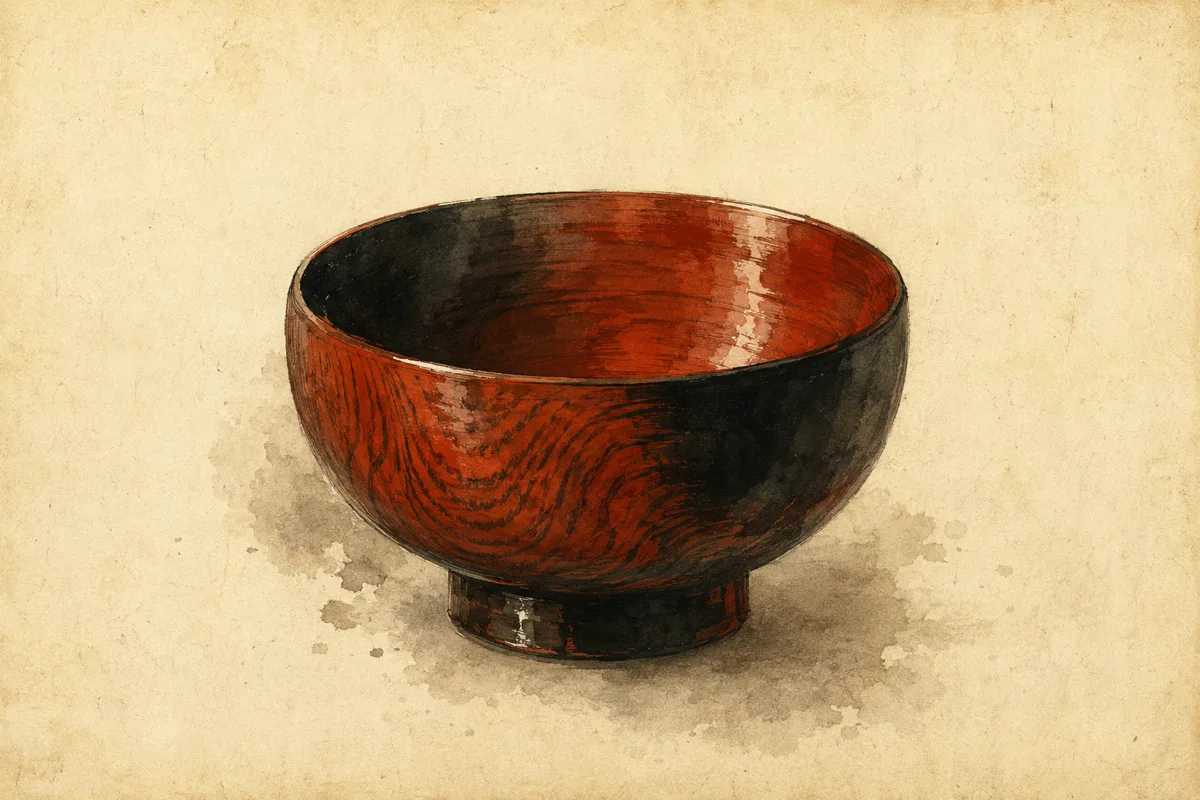
The Japanese Lacquer Soup Bowl (Owan): Why Miso Lives in Wood, and How to Buy One
A $12 set labelled "lacquer soup bowl" sits beside an $80 bowl called a keyaki urushi owan, and nothing on either listing explains the gap. The soup bowl is the piece of Japanese tableware most households own after chopsticks, and the one most often bought without knowing what separates the two prices. Before the buying decision, though, comes a stranger question the listings never answer: why is the bowl made of wood at all, and can you really hold hot miso soup in your bare hand?
The kanji tells you the material
Japanese keeps two words that sound identical. Both read wan, and the radical inside each one names what it is made of. 椀 carries the wood radical and means a wooden, lacquered bowl. 碗 carries the stone radical and means a ceramic one. An owan is wood; a chawan, the rice bowl or the teacup, is ceramic. The split is historical: all early Japanese tableware was wooden, and rice was once eaten from a wooden bowl too. Ceramic arrived from China, and by the end of the Edo period it had taken over rice and tea, while soup stayed in the wooden, lacquered bowl it has kept ever since. Rice to ceramic, soup to wood: the division you still set on the table today.
Miso soup belongs in wood
The reason soup never left the wooden bowl is physical. Wood is a natural insulator. Its cells are full of tiny air pockets, so it carries heat poorly, far more poorly than metal or ceramic. Pour in miso soup at around 80°C and the outside of the bowl stays cool enough to pick up with a bare hand, while the soup itself cools slowly. Ceramic would scald your fingers within seconds.
That matters because of how the soup is drunk. Japanese table manners have you lift the small bowl off the table and bring it to your mouth; miso soup is sipped directly from the rim, with no spoon, the solid pieces lifted out with chopsticks. A vessel you raise to your lips and hold for the length of a meal has to be one you can actually hold, and an insulating wooden bowl sealed with urushi lets you do that. The etiquette and the material fit each other.
There is a sensory half to this too. Lift a lacquer owan of hot soup and you notice it at once: warm but never painful, startlingly light, soft where it meets the lip. It is a mouthfeel ceramic simply cannot produce.
What the urushi does
Wood alone would drink up soup like a sponge. The layers of urushi lacquer seal the porous grain into a hard, waterproof film that shrugs off acid, alkali, salt and alcohol, everything a bowl of miso throws at it. Cured urushi is food-safe; only the maker's raw sap is an irritant, and that never reaches your table. Used and wiped over the years, the surface only deepens in gloss. If you want the fuller story of the sap and how it hardens, see what urushi is.
Real urushi, or a coated resin bowl?
The $12 and the $80 bowls part ways here, and you do not have to trust your eye. Japanese labelling law settles it in two lines. The base (素地) reads either natural wood (天然木) or synthetic resin / wood-flour resin; the surface coating (表面塗装) reads either lacquer (漆) or urethane / cashew coating. Only a piece that is natural wood under genuine urushi may legally be sold as 漆器 (shikki). The cheap "lacquer soup bowl" is almost always molded resin sprayed with urethane.
The fastest check costs nothing: if a bowl is advertised as dishwasher- or microwave-safe, it is synthetic. Real urushi cannot survive a hot drying cycle, so an honest maker can never print that claim on it. For the full method, see how to spot real urushi.
The wood under the lacquer
Once you are looking at genuine bowls, the wood becomes the thing to weigh. The prized material is keyaki (Zelkova serrata), a dense, hard timber (around 620 kg/m³) with a gold-to-red-brown heartwood and a flame-like grain, considered the finest owan wood. It is also increasingly rare and near-threatened, which is why a keyaki bowl costs what it does. Tochi (Japanese horse chestnut) is softer and lighter, milky-toned, prized for its rippling "tiger" figure. A fuki-urushi (wipe-on) finish is meant to show the grain, so these figured woods and that finish go together.
Where the wood is turned matters too. An old craft saying divides the labour, kiji wa Yamanaka, nuri wa Wajima: the woodturning to Yamanaka in Ishikawa, the lacquering to Wajima. Yamanaka has been Japan's turnery centre since woodworkers settled its hot-spring valley around 1580, and remains the heart of turned bowls and wipe-lacquer owan. See how the regions divide the work in our guide to lacquerware by region.
Size, shape and finish
Sizes come in the old units; one sun is about 3.03cm. The traditional soup bowl is 3寸8分, about 11.4cm across, sized to sit in two hands; the Kawatsura workshops standardised 3寸9分 (11.7cm) in the 1950s, and a larger 4寸 (12cm) now suits chunky soups like tonjiru. Most bowls run 10–14cm wide and 6–9cm tall. A hazori bowl with a gently flared rim sits kindly on the lip; a koshidaka bowl with a tall foot is easy to lift. For finish, fuki-urushi shows the grain, while shinnuri, solid and opaque, is the most durable; a red-lacquered interior is the everyday choice because it hides small scratches. Formal, lidded bowls (suimono-wan, and the larger New Year zoni-wan) trap the aroma and hold heat.
What you will pay, and how to make it last
Roughly: entry bowls from around ¥1,540 ($12) are resin under a synthetic coat; a mid bowl of natural wood under real urushi runs about ¥8,000 ($55); a keyaki, wipe-lacquered Yamanaka bowl reaches ¥15,000 and up, with a matched pair around ¥30,000 (~$200). You are paying for the wood and the hand-built lacquer, not a markup.
Care is simple if you skip the machine. Wash by hand in warm water with a soft sponge and a mild, non-bleach detergent, and wipe dry at once. A short soak to loosen dried food is fine; a long one is not. No dishwasher, microwave, oven or open flame, and keep the bowl out of direct sun, which dries and cracks it — in a dry cupboard, a cup of water nearby keeps the air humid enough. The full care routine for lacquerware applies here too, and browsing genuine bowls is easiest in the shop.
The two bowls are not interchangeable. One is a sprayed coat on molded resin that will scald your hand and look the same or peel in ten years; the other is layered sap on turned keyaki: light in the hand, cool on the outside, warm at the lip, and getting better every time you drink from it.