
The Japanese Lacquer Bento Box: What a Shokado Is, and How to Buy One
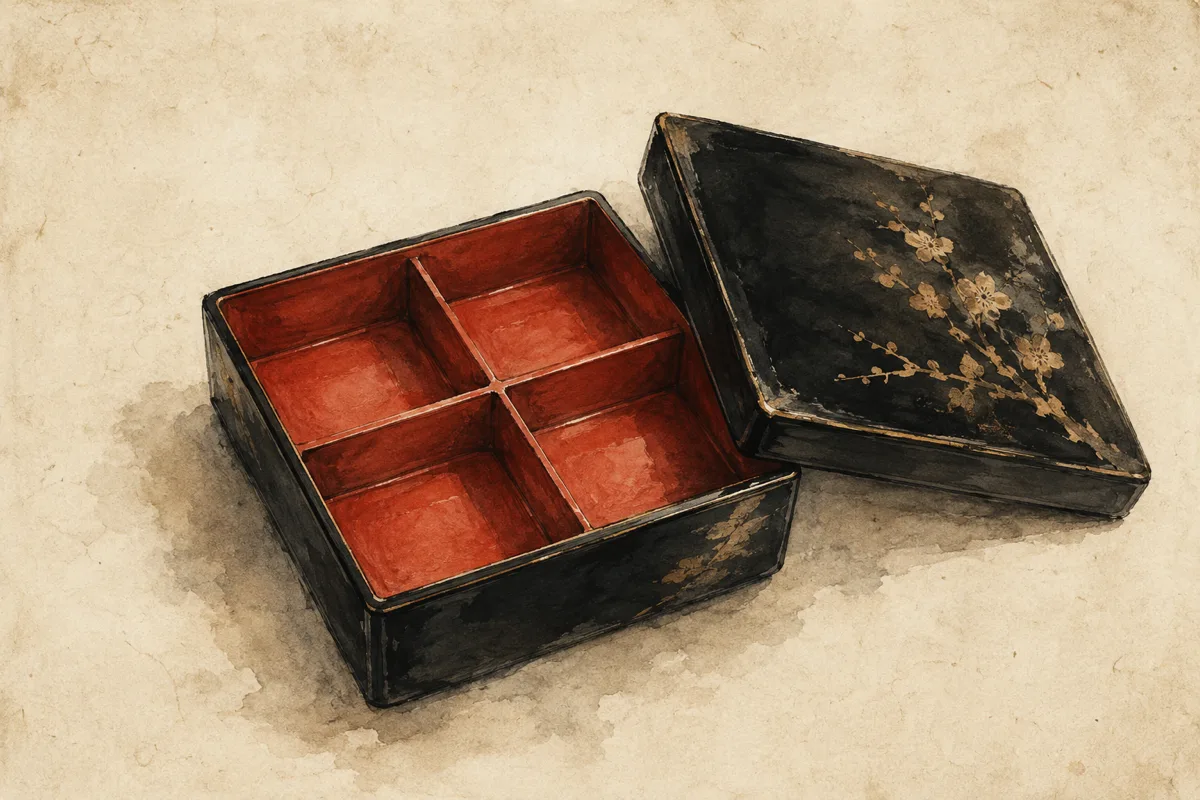
A Japanese lacquer bento box tends to take one shape: a low square box, black outside and glowing red within, its inside split into four neat compartments by a cross. It photographs beautifully, it can cost fifteen dollars, or well over a hundred, and it is not the snap-lid plastic thing most of us pack lunch in. The box has a name, shokado (松花堂), and behind that name are an unlikely origin story and a buying decision worth getting right before you spend.
A seed box, a monk, and a chef
The shokado is named after a person, not a place or a technique. Shokado Shojo (1582/1584–1639) was a monk at Iwashimizu Hachimangu, the great shrine in Yawata, near Kyoto, and one of the most accomplished cultural figures of his day, ranked among the three great calligraphers of the Kan'ei era, and a painter and tea master besides. In 1637 he built a small hermitage in the shrine grounds and named it Shokado; the name of the box traces back to his.
What he actually did was humbler and more charming than "inventing" anything. He noticed a plain box that farmers used to carry seeds, its inside divided into a cross. He borrowed that form for the tea room, as a tobacco tray and a case for painting pigments, brushed it with a thin coat of lacquer, and added his own ink paintings, lifting a farmyard container into a refined object. The original was a shallow, open tray, only a few centimetres deep, nothing yet like a lunch box.
The leap to lunch came nearly three hundred years later. In the early Showa years, 1932–33, Yuki Teiichi, founder of the celebrated restaurant Kitcho, came across one of these boxes at a tea gathering in Yawata. He added a lid, raised the sides a little, and turned it into a vessel for a tea-ceremony kaiseki meal, naming his creation the shokado bento in the monk's honour. So the object you are looking at made a three-part jump: a farmer's seed box, reimagined by a monk as a tea tool, reimagined again by a chef as a lunch.
The divisions, and why they matter
The cross splits the box into four quarters, keeping each dish's flavour and aroma from mixing, so the sashimi does not take on the smell of the simmered vegetables, and it lets a cook arrange four small courses cleanly, each in its own frame. Fill the quarters with something raw, something grilled, something simmered, and rice, and you have served a miniature kaiseki out of a single box. Often the compartments hold small dishes or cups dropped in, which makes swapping courses and washing up easy.
This is also what separates a shokado from the other "Japanese box" you may have met. A jubako stacks, its tiers piling up good fortune for New Year, whereas a shokado is a single lidded layer divided within. And a makunouchi bento, though its contents overlap, comes from a different world entirely: it began as the meal eaten during the maku no uchi, the intermission of a play, and descends from formal honzen dining. What sets a shokado apart is the vessel itself, lidded and lacquered and cross-divided, rather than what goes into it.
Real urushi, synthetic, or plastic
Buyers get lost here, because "lacquer bento box" covers three quite different objects at three very different prices.
| Hon-urushi (real lacquer) | Resin + urethane | ABS plastic | |
|---|---|---|---|
| Body | Natural wood | Wood-powder resin, molded | Molded plastic |
| Coating | Many coats of natural urushi | Sprayed urethane | Sprayed urethane |
| Look | Deep glow, black-and-red | Even surface shine | Even surface shine |
| Dishwasher | Never | Often "yes" | Yes |
| Price | Tens of dollars and up | Mid; around ¥8,000 | Cheapest |
| Use | Serving, guests, gifts | Home use | Restaurants, catering |
One shortcut is worth knowing. If a box is sold as dishwasher-safe or microwave-safe, it is synthetic. Real urushi is lifted by sustained heat and stripped by harsh detergent, so an honest maker cannot print that claim on it; the convenience means the finish is urethane, not lacquer. Beyond that, read the listing for urushi, "natural lacquer," or the Japanese 本漆 / 天然漆, and be wary of vague "lacquer-style" phrasing or a "urushi" box priced too low to contain any. The full method is in our guide to spotting real urushi from a synthetic coat.
One real example shows how the tiers separate. The Kyoto lacquer house Isuke has sold a wooden shokado, 26.3 cm square, with a fixed cross divider, in black or ancient vermilion, for ¥8,250. Solid wood, from an established lacquer maker, at a mid-range price: by those signs it could pass for the real thing. Yet the spec lists the coat as urethane, not urushi. Real wood does not guarantee real lacquer; the body and the finish are two separate questions, and it is the finish that decides whether you are buying urushi. At the bottom of the market sits the industry's workhorse: an 8.5-sun box, about 258 mm square, in heat-resistant ABS, the material behind most restaurant and takeout shokado. None of the three is simply "best." A urethane-coated box that wipes clean is a sensible everyday buy; a hon-urushi box earns its price only if you will hand-wash it.
The case for wood and lacquer
Wood and urushi do things plastic cannot, which is why people pay for them. Wood is a poor conductor of heat, so a wooden box stays comfortable to hold and easy on the lips, and food inside it cools gently rather than sweating against cold plastic, the same reason a lacquered soup bowl is nicer to drink from than a ceramic one. Once cured, urushi is hard, water-resistant, and food-safe, and its depth only grows with years of use. The box's classic dress, black outside and vermilion within, is a piece of lacquer grammar too: black for formality, red for life and celebration, the two canonical urushi colours doing exactly the work they were chosen for.
A real-urushi shokado is a serving vessel, not a commuter box. It does not seal, and it belongs on the table at a restaurant or a guest dinner, not crushed into a bag for the train. That makes it a small lacquered stage for a meal rather than a sealed plastic container for the commute.
The idea travels a long way. When Richard Sapper designed the first IBM ThinkPad in 1992, he wanted an object "like a black cigar box that on the outside shows nothing of what it is," a plain dark case that reveals its contents only when opened. That black exterior hiding an ordered interior is widely said to trace to a Japanese lacquer bento box, the shokado in particular, though Sapper's own quoted phrase stops at "cigar box or bento box," so carry the specific attribution lightly. The resemblance is still hard to unsee: the black box that says nothing, opened onto a divided world within.
If you buy a lacquered one, treat it as you would any fine urushi: a soft dry cloth, a well-wrung damp wipe and immediate drying, no soaking and no dishwasher, per the full care routine. You can see a range of pieces in the shop. Cared for that way, a shokado lasts for years, and it turns an ordinary lunch into a small occasion.