
A finished urushi bowl and a plain wooden one are separated by months of work you cannot see. Pick up a good lacquer bowl and the price and the famous depth seem to come from the glossy black or vermilion surface. But that surface is the least of it. Nearly every piece of Japanese lacquerware, from a plain rice bowl to a stacked New Year box, is built up in thin layers, each hardened by humidity, and most of them you never see. How the wood is shaped, how thick the hidden foundation is, how many coats go on top: that unseen structure is most of the bowl.
The wood core: kiji
Before a drop of urushi is involved, someone makes the bare wooden core, the kiji (木地). And it is usually someone else: the woodturner, the kijishi (木地師), is a different specialist from the lacquerer who coats it. A bowl that looks like one master's work is really the relay of a whole workshop.
The wood is seasoned first, dried a few months to several years, because wood put to use too green will warp and split under the coats years later. How it is then shaped depends on the form wanted, in four families: hikimono (挽物), turned on a lathe (rokuro) for round things (bowls, plates, trays), usually in zelkova, cherry or horse chestnut; magemono (曲物), thin cypress or cedar boards steamed soft and bent into rounds, the way a bentwood lunch box is made; sashimono (指物), boards joined without nails into angular pieces like the tiered jūbako; and kurimono (刳物), hollowed from a solid block. There is even a fifth route with no wood core at all: kanshitsu (乾漆), "dry lacquer," where layers of hemp cloth and urushi are built into a hollow shell. It is a sculptor's technique rather than a bowl-maker's: the serene Ashura at Kōfuku-ji and the seated portrait of the priest Ganjin at Tōshōdai-ji are both dry lacquer, light and strong enough to hold a soft, life-like face.
The invisible foundation: shitaji
This stage decides whether a piece is cheap or serious, and you will never see it. On the raw core the lacquerer first does kiji-katame (木地固め), soaking raw urushi into the wood to seal and stiffen it. Weak points, the rim, foot and joints, are reinforced with nunokise (布着せ): hemp or cotton cloth glued down with urushi thickened by flour or rice paste. Then comes the body of the foundation, urushi mixed with jinoko (地の粉) (a coarse powder of fired diatomaceous earth), troweled on with a spatula, dried, and sanded, coarse grades first. A finer mineral putty called sabi (錆), tonoko powder in raw urushi, goes on last and is polished dead flat.
None of this shows, and it separates the real from the cheap. Most lacquerware skips the cloth and the mineral ground to save time, and those hidden layers give a piece its body and its resistance to chips and cracks. The town that treats the full foundation as non-negotiable is Wajima, where the ground is built and sanded in stages (first, second and third groundings), the reason Wajima-nuri is famously hard to break. Under the shine, most of what you pay for is the layer you cannot see.
The coats: nuri
Only now does the coating you associate with lacquer go on, and it comes in three stages: shita-nuri (下塗り), the undercoat; naka-nuri (中塗り), a purer middle coat, hardened and then sharpened flat with charcoal; and uwa-nuri (上塗り), the final coat, the most carefully filtered urushi, brushed in a dust-free room where a single mote is a flaw. Each coat is brushed thin and hardened, then sanded flat before the next goes on. So much of lacquer work is actually sanding.
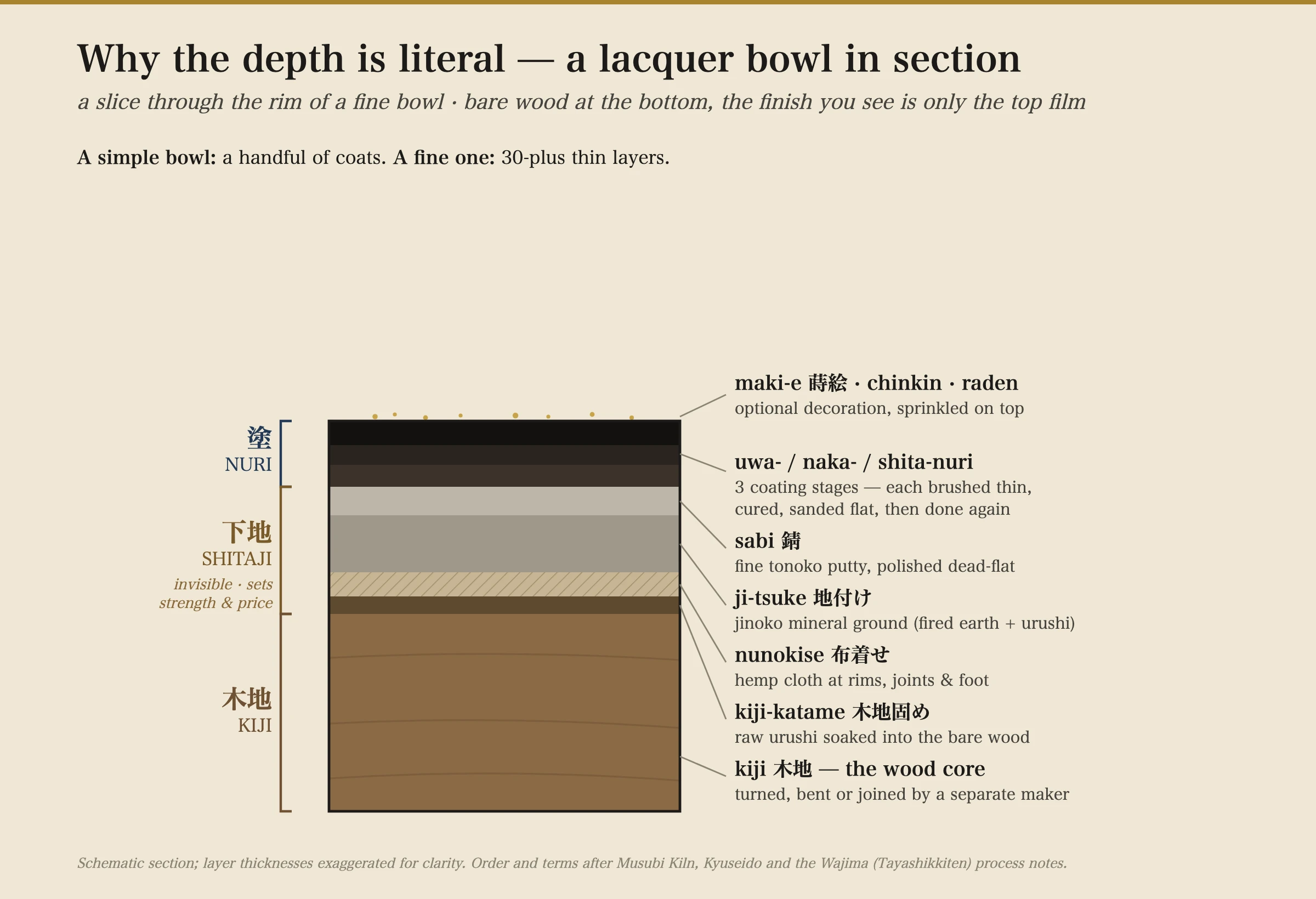
The reason all of this takes so long is that urushi does not dry — it hardens. An enzyme in the sap knits the resin together only in warm, damp air, so each coat is cured in a humidified cabinet, the muro (室), kept 20–30°C and 65–80% humidity. "A muggy day is good for lacquer, a dry one is bad." One thin coat needs roughly one to five days in the muro before the next can go on (the better the piece, the longer the wait), and full hardening runs months. Count the coats and the arithmetic of the price appears: a simple bowl carries only a handful, a fine one over thirty, and elaborate work reaches dozens to a hundred-plus layers. The depth you see in good lacquer is literal. You are looking down through many cured films into the wood.
There are two ways to end. Nuritate (塗立て), also called hana-nuri, leaves the top coat exactly as brushed for a soft, even sheen, with no polishing to hide behind, so it is a nerve-wracking, dust-free one-shot. Roiro-shiage (呂色仕上げ) takes the polished route: the hardened top coat is sharpened with soft charcoal, burnished, rubbed with a trace of raw urushi and wiped, then polished again, until it becomes a mirror. The gloss comes from the polishing, not the coat.
Then, sometimes, the decoration
Everything above makes a plain, finished bowl. Ornament is a separate craft that lands on the cured surface: chinkin (沈金), lines carved and filled with gold; raden (螺鈿), shell inlaid to catch the light; and above all maki-e (蒔絵), pictures drawn in wet urushi and dusted with metal powder before they set: Japan's own invention of sprinkling the gold on rather than mixing it in.
So the making of Japanese lacquerware is layer on layer, most of them hidden, each waiting days to harden in damp air. Urushi is the sap that makes every layer possible, Wajima is the foundation stage taken to its limit, maki-e is the decoration on top, and caring for a piece means respecting all those months of layered work.