
Real Urushi or Plastic? How to Tell Genuine Japanese Lacquer Before You Buy
How can you tell genuine urushi from a synthetic coating wearing its name? Two bowls can both be glossy, black, curved, and described as "Japanese lacquer," yet one costs fifteen dollars and the other two hundred, with nothing on the shelf explaining the gap. You can narrow it down in a few seconds by hand, and settle it with one objective test that most buyer's guides never mention.
What the word "lacquer" covers
The confusion starts with the word. In English, lacquer is an umbrella term. It covers real urushi, the tree sap that hardens in humid air, but also cashew coating and petroleum-based urethane, two synthetics that look almost identical on a shelf. "Lacquer" is not a legal or material distinction, so the product name alone can never tell you what you are holding. Your senses can only get you partway; the deciding evidence has to come from somewhere more precise.
What your hands can tell you
Pick the piece up. Genuine urushi tends to give itself away in five small ways, none decisive alone, but telling together.
| Clue | Real urushi | Synthetic (cashew / urethane) |
|---|---|---|
| Gloss | A soft, deep glow that seems to rise from within | A uniform, surface-level shine or plastic glare |
| Weight | Light — the core is usually wood | Heavier, on a resin or metal core |
| Warmth | Warm to the touch (wood insulates) | Cool, slick |
| Smell (when new) | Faint earthy, woody note | Artificial, faintly chemical, or odourless |
| With age | Sheen mellows; fine scratches become character; it can be re-polished | Chips or peels; never improves |
The gloss is the clearest tell. Real lacquer earns its depth the slow way: coat after thin coat of urushi, each cured in a damp cabinet and sanded flat before the next, so on a good piece you are literally looking down through layers of hardened film. A sprayed synthetic coat has no such depth to look into; its shine sits flat on the top. But note the limits: good cashew and urethane finishes have grown very convincing, and none of these senses is proof on its own. Treat them as a first read, then confirm.
The one label that gives the fake away
One label turns a guess into near-certainty. If a piece is marked dishwasher-safe or microwave-safe, it is almost certainly synthetic. Real urushi cannot survive sustained heat, strong detergent or a hot drying cycle, the very things that ruin a genuine piece, so an honest maker can never print that reassurance on real lacquer. A "worry-free, everyday, dishwasher-OK lacquer bowl" is telling you, in plain sight, that it is urethane.
Japan's labeling law
Anything sold as tableware in Japan falls under the Household Goods Quality Labeling Act, and its rule for "vessels coated with urushi or cashew resin" (item 12 of the miscellaneous-goods regulation, enforced by the Consumer Affairs Agency) makes the label do the work your fingertips cannot: two fields on it settle the question.
The surface coating field can only use fixed legal terms: real lacquer must be written 漆塗装 ("urushi coating"); the synthetics are カシュー塗装 (cashew) and ウレタン塗装 (urethane). The product name 漆器 ("lacquerware") is reserved by law for pieces coated entirely in natural urushi. The regulation states plainly that if any non-urushi coating is used, the piece cannot be called 漆器, so cashew- or urethane-coated goods are labelled "synthetic lacquerware" instead. The second field, substrate, tells you the body: 天然木 (natural wood) versus a molded synthetic resin such as ABS, melamine or phenol. Read both together, because a cheap piece can pair real-ish coating language with a plastic body, or vice versa. These two fields cut cleanly where the English word "lacquer" only blurs.
Cashew is urushi's botanical cousin
The usual stand-in, cashew coating, was developed in Japan around 1950 and named for its raw material, cashew nut shell liquid, or CNSL. Where urushi hardens only through an enzyme reaction in humid air, cashew is given a drier and simply air- or heat-cures: no humid cabinet, no months of waiting, and that shortcut is much of the price difference. Cashew is not really foreign to urushi, though. Both plants belong to the same botanical family, Anacardiaceae, the sumac family, and cashew's anacardic acid is an acid form of urushiol, the very compound that makes lacquer sap sting. So the synthetic can, rarely, cause the same kind of rash the real material is famous for.
That reverses the safety worry many buyers arrive with. Cured urushi is food-safe: raw sap irritates skin, but in a finished piece the urushiol is locked into a stable, inert film. The genuine material is the safe one, and the imitation carries a faint trace of the family allergy.
When there is no label
Souvenir stalls and cross-border listings often carry no Japanese quality label at all, which removes your best evidence. Then ask the seller directly: natural urushi or a synthetic coating? made where? wood or resin body? A confident, specific answer is itself a good sign, ideally one that names a real production region and technique such as Wajima, Aizu, Yamanaka, or work like the built-up groundwork of Wajima-nuri; vagueness is not. Keep price in view as a sanity check. Real urushi is labour measured in months, and a piece priced as though it were not is quietly answering the question for you.
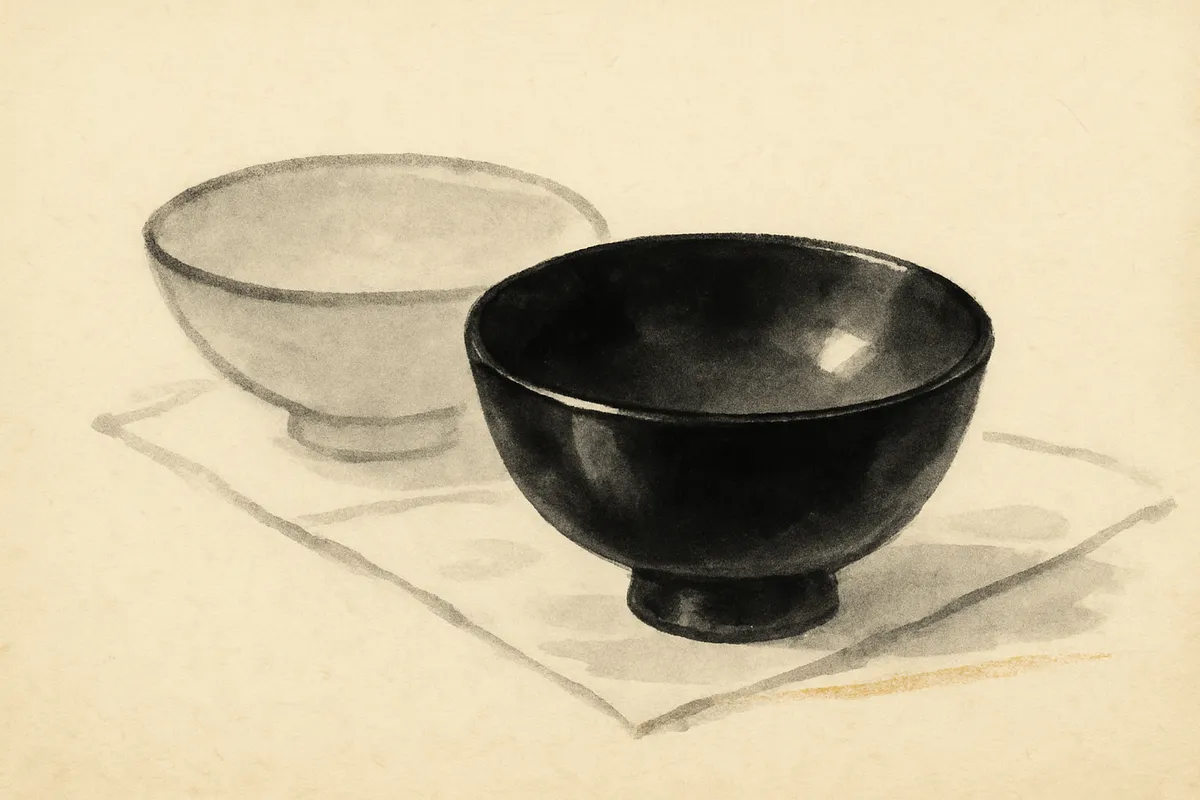
Read this way, the two bowls stop being a mystery. One is a fast synthetic coat that will look the same in ten years or peel. The other is layered sap that hardened in damp air, is safe to eat from, and, used and wiped and used again, will slowly look better than the day you bought it.