
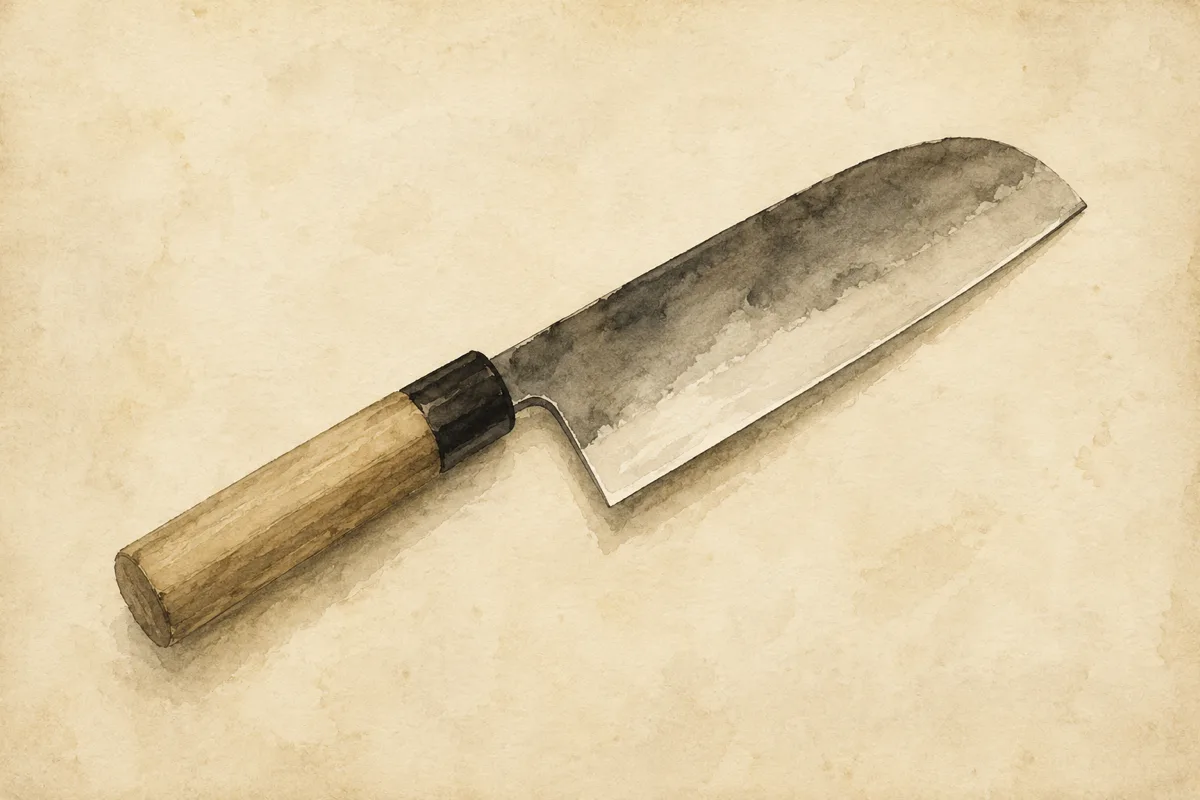
If you own one Japanese knife, it is probably a santoku, and it is younger than your grandparents. For all the mystique around Japanese blades and their sword-smithing lineage, the santoku is a postwar invention. It was born in the 1940s, in the Kansai region, when the American occupation brought Western cooking and beef into Japanese homes. Cooks who had kept separate knives for fish, meat and vegetables wanted one blade that could do everything, and the santoku was the answer. It is a cousin of the gyuto in that sense: both are products of Japan's mid-century Westernization, not descendants of the katana.
Its actual parent is the humble nakiri, the rectangular vegetable cleaver. Makers took a nakiri, clipped off the front corner to create a gentler, more nimble tip, and turned a vegetable-only knife into an all-rounder. Its sibling the bunka came from the same cut, but its tip was left angular and sword-like rather than rounded, and its name, "culture knife," hints at how self-consciously modern and outward-looking 1950s Japan felt. (If that pointed K-tip appeals to you, the kiritsuke and bunka family shares this flat profile with a different tip.)
What "three virtues" means
The name 三徳 (santoku) reads as "three virtues," but even the sources disagree on which three. One reading is the ingredients: meat, fish and vegetables. The other is the tasks: slicing, chopping and mincing. Wikipedia and knife specialists alike hedge with "or," so both are in circulation. Either way, the idea underneath is the same: this is a generalist, not a dedicated deba (for breaking down fish) or yanagiba (for slicing sashimi). It is built to be the one knife you reach for without thinking.
The shape, in numbers
A santoku is short, tall and flat. Blade length runs 165–180mm (6.5–7 inches), with 145mm minis and the occasional longer example, but 170mm sits squarely in the middle. Blade height is a generous 45–50mm, which keeps your knuckles clear of the board, and the whole knife is light, around 100–170g. The defining feature is the tip: a sheep's foot, where the spine curves down toward the point at close to a 60-degree angle. That geometry gives the santoku a blunt, rounded nose rather than the pointed tip of a gyuto.
Almost every santoku you'll meet is a double bevel, ground on both sides like a Western knife, though at a keener 12–15 degrees per side. That puts it firmly in the everyday-knife camp with the gyuto and nakiri, not the single-bevel world of the sushi-counter blades. That distinction changes sharpening and handedness entirely, so it helps to understand: see single bevel vs double bevel.
It wants a chop, not a rock
Most product pages skip this part. Because the santoku's edge is flat, with almost none of the curved "belly" a chef's knife has near the tip, the whole edge lands on the board at once, heel to tip, evenly. That makes it superb at a single downward push-cut: press straight down and slightly forward in one motion, and you get a clean, uncrushed cut every time.
It also means the Western rocking motion, pivoting on a pointed tip and see-sawing the heel up and down, doesn't work. Rocking needs a curved belly to roll along; try it on a flat santoku and the food doesn't separate cleanly: you get ragged "accordion" cuts still joined at the bottom. This isn't a flaw, it's a different technique. If you already rock instinctively, that habit is the single biggest reason to consider a gyuto instead.
Santoku or gyuto?
This is the real decision, and it isn't about quality; both can be your only knife. It turns on cutting style and kitchen.
- Santoku: 165–180mm, flat edge, blunt sheepsfoot tip. Best for a straight up-and-down chop or push cut, everyday vegetable prep, smaller hands, tight kitchens and small boards. Short, light, easy to control.
- Gyuto: 210–240mm, curved belly, pointed tip. Rocks, pushes and pulls; reaches across large items and long slices; the pointed tip helps with precise work. Wants more board and more room to move.
Choose the santoku if you chop and your space is modest; choose the gyuto if you rock, cook in volume, or want the most versatile single blade. (For a wider look at how both sit alongside the nakiri and petty, see santoku vs gyuto vs nakiri vs petty.)
The granton edge: skip the marketing
Many santoku come with a row of oval hollows down the blade, the "granton" or "dimpled" edge, sold as a fix for food sticking to the steel. It isn't a traditional Japanese feature at all: the granton edge was patented in Britain in 1928, and a Sakai-made traditional santoku has no dimples. It also barely helps here. America's Test Kitchen tested santoku with and without the hollows and found them "unnecessary since these blades are short and are already razor-thin," so food releases fine without them. The hollows earn their keep on long carving slicers, not on a compact santoku. Buy the knife for its steel and geometry; treat the dimples as a wash.
How to buy one
Three quick calls once you've settled on a santoku:
- Length: this is the easy one. Unlike the gyuto, the santoku barely varies: 165–180mm is nearly the whole market, with 170mm the safe default and 180mm if you want a touch more reach. A short santoku even fits a 300×200mm board where a 210mm gyuto would overhang. More on sizing in the Japanese knife size guide.
- Steel: the choice between an easy-going stainless (VG-10, AUS-10) and a sharper but higher-maintenance carbon isn't santoku-specific; it's the same decision across all Japanese knives, covered in the steel guide. For a first knife, stainless is the low-stress default.
- Bevel: leave it double. A double-bevel santoku works in either hand and sharpens like a Western knife; the single-bevel path belongs to the specialist blades.
Get those right and the santoku does what it was invented to do eighty years ago: be the one knife on the counter that handles almost everything. Ready to look at blades? Browse the knife shop.