
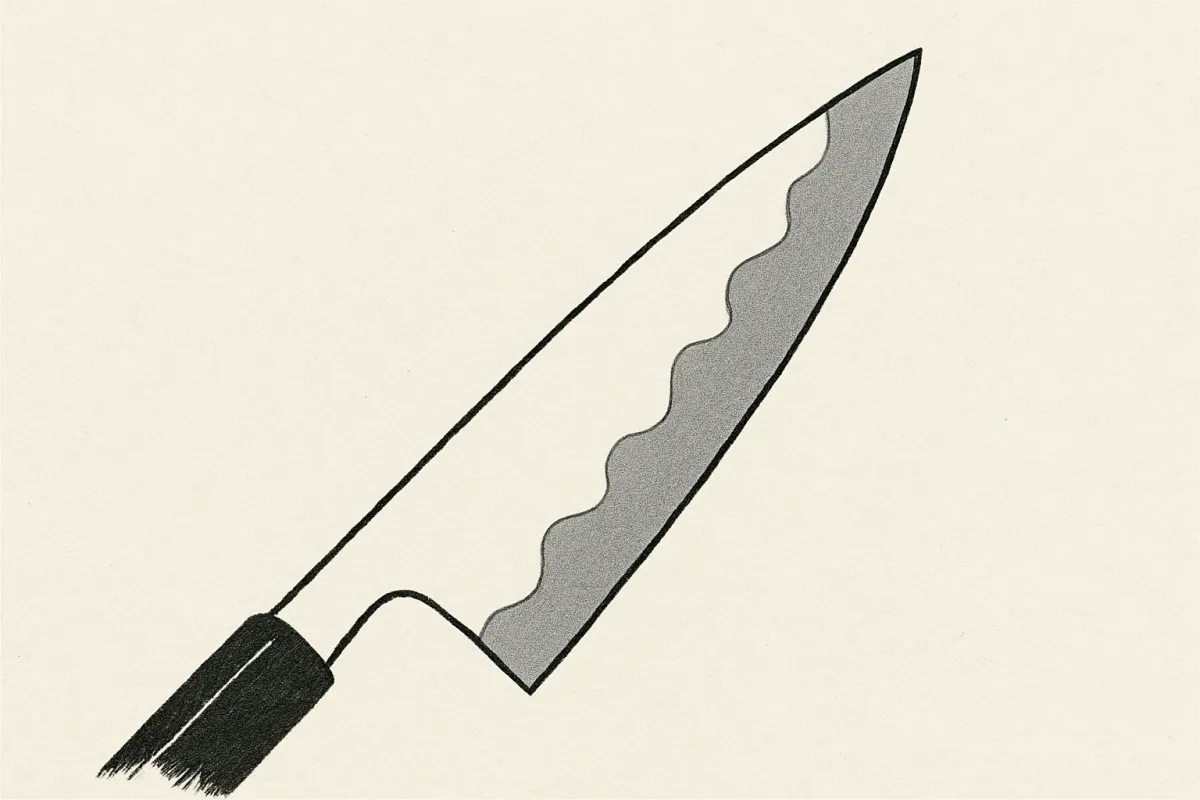
Japanese smiths run their blades harder than most Western cutlery. That is why these knives take a finer edge and hold it longer, and also why some of them rust if you leave a wet tomato on the blade. Once you know which steel family a knife belongs to, you know which trade-off you are buying.
First, what HRC means
Steel hardness is measured on the Rockwell C scale (HRC). A typical German chef's knife sits 56–58 HRC. Japanese kitchen knives commonly run 60–64 HRC, and some powdered steels go higher still.
Harder steel (higher HRC) holds a keener edge longer and can be sharpened to a more acute angle. The cost is brittleness: a 63 HRC edge can chip if you twist it through a chicken bone or chop on glass or stone. Softer steel rolls and dulls faster but forgives abuse and is easy to bring back. The best hardness for you depends on how carefully you will treat the knife.
The carbon steels: Shirogami and Aogami
These are the traditional high-carbon steels that built the reputation of Japanese blades. The famous ones come from the Yasugi Specialty Steel works in Shimane Prefecture, long known as Hitachi Metals and now Proterial, and are sold as graded "paper steels" (the names come from the colored paper the steel was historically wrapped in to tell the grades apart).
Shirogami (白紙, "White paper steel") is the purest of the family: essentially clean iron and carbon, with only trace manganese and silicon and almost nothing else. White #1 carries 1.25–1.35% carbon, White #2 1.05–1.15%; that's the main difference between the grades. That purity is why it takes the sharpest, most refined edge of almost any knife steel and is a joy to sharpen on a whetstone, since there are no hard alloy carbides in it to fight the stone. The catch: with little besides carbon, it has modest wear resistance and dulls relatively quickly, and it is reactive: it will rust and develop a grey-blue patina unless you keep it dry. White steel suits the cook who enjoys sharpening and doesn't mind drying the blade after every use.
Aogami (青紙, "Blue paper steel") is White steel with chromium and tungsten added. Blue #2 carries 0.2–0.5% chromium and 1.0–1.5% tungsten on top of a similar carbon level. Those elements form hard carbides that boost wear resistance and edge retention, so a Blue steel edge lasts noticeably longer between sharpenings. The same carbides make it a touch harder to coax out that last degree of keenness on the stone. Aogami Super pushes things further still, with 1.4–1.5% carbon and more tungsten, and can be hardened higher than any other paper steel. Blue steel is still reactive and will patina; it suits someone who wants carbon-steel cutting but sharpens less often.
Standard White and Blue land around 60–64 HRC; Aogami Super can run higher, into the mid-60s. All of them reward the same care: wipe dry, never leave wet, and a forced patina or a thin film of oil keeps rust at bay.
VG-10 and the stainless options
If "this will rust" is a dealbreaker, you want stainless. The most common premium stainless in Japanese knives is VG-10, designed by Takefu Special Steel in Fukui, the old Echizen cutlery region. It carries about 1% carbon and roughly 15% chromium, plus about 1% molybdenum, 1.5% cobalt, and a little vanadium; the cobalt is unusual and helps it resist softening during heat treatment. It hardens to roughly 60–61 HRC and offers an excellent all-round balance: takes a good edge, holds it well, resists corrosion, and is everywhere, so it's easy to buy and easy to replace. It's also the steel you most often see at the core of those rippled Damascus-clad blades, where the wavy pattern is decorative cladding wrapped around a plain VG-10 cutting core.
Other stainless steels worth knowing:
- Ginsan / Silver-3 (銀三): another Hitachi/Proterial steel, deliberately kept pure (essentially iron, ~1% carbon, ~13–14.5% chromium and little else). That purity makes it sharpen and feel remarkably like White carbon steel, and at around 61 HRC it gives smiths carbon-steel behavior without the rust.
- SG2 / R2: a powdered (sintered) stainless from Takefu, sold as R2 in identical composition by Kobelco. High in molybdenum and vanadium and made by atomizing the steel into fine powder before pressing, it hardens to about 63–64 HRC with outstanding edge retention. It holds an edge for ages but is unforgiving on the stones, so it rewards good sharpening technique.
- AUS-8, AUS-10: solid, affordable stainless steels common on entry-level Japanese knives; softer and easier to maintain, with less edge retention than the premium grades.
Choosing, and caring for, your steel
A simple way to decide:
- You enjoy maintenance and want the sharpest possible edge: Shirogami (White) carbon steel.
- You want carbon performance but sharpen less often: Aogami (Blue) carbon steel.
- You want low fuss and no rust anxiety: VG-10 or Ginsan stainless.
- You want maximum edge retention and will sharpen properly: SG2/R2 powdered stainless.
Whatever you choose, the universal rules are the same. Hand-wash and dry immediately — the dishwasher is where good knives go to die. Cut on wood or soft plastic, never glass, stone, or ceramic. Avoid bones and frozen food with thin, hard edges. With carbon steel, expect and embrace the patina; it is the steel protecting itself. Treat the blade like the hardened, thin instrument it is, and any of these steels will hold up.