
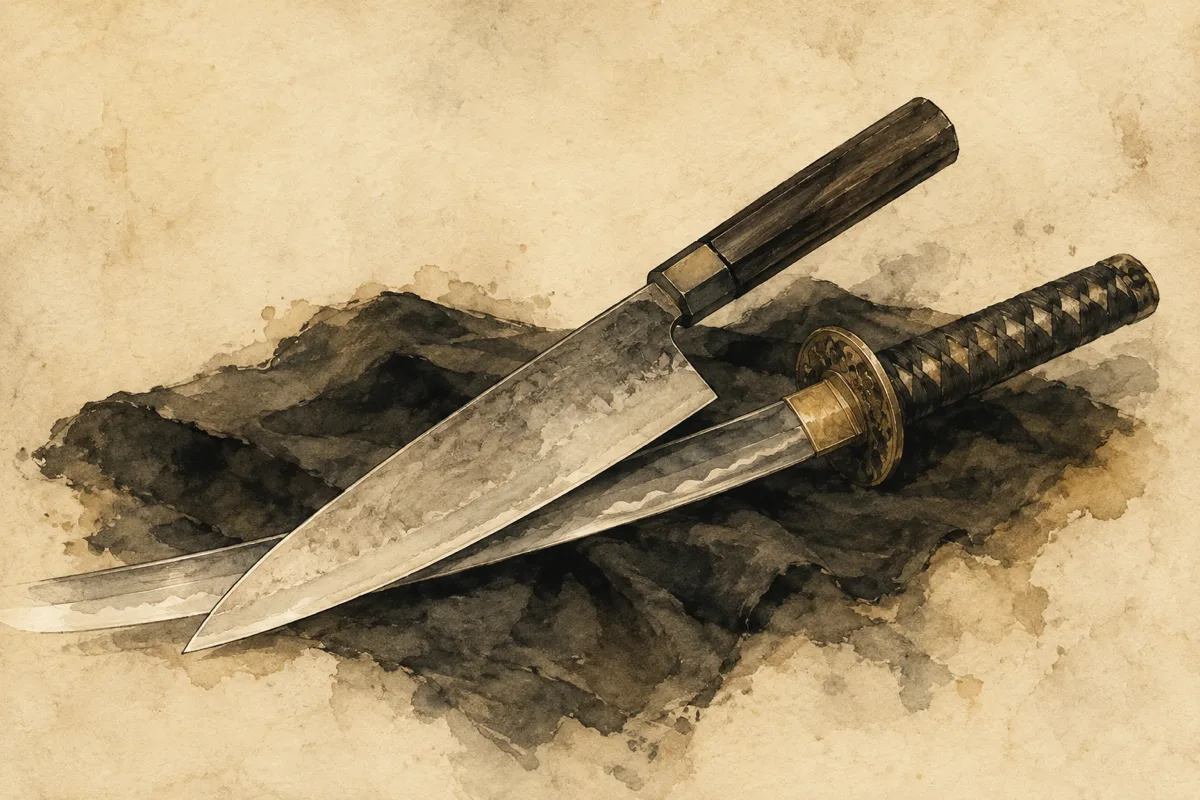
In 1876 Japan banned the sword, and its swordsmiths, the slogan goes, turned samurai steel into chef's knives overnight. You meet this claim in shop copy and documentaries, often over footage of a smith painting clay along a blade and plunging it into water: forged like a katana.
It's a good story, and about half true. The sword ban is real, and it really did drive smiths into cutlery. But the knife you slice sashimi with is older than the ban, and the knife you dice onions with isn't a descendant of the sword at all. The timeline runs like this.
The knives came first
The deba, the thick, single-bevel fish knife, "first appeared during the Edo period in Sakai," the blade city south of Osaka. That's the window from 1603 to 1868, and specialists date the deba to around the Genroku era, the late 1600s. The single-bevel wa-bocho family — deba for breaking down fish, yanagiba for slicing sashimi, usuba for vegetables — was a mature professional craft a century and more before anyone banned a sword.
Sakai had backed into blades from the side. Its smiths made swords and tools, then locked onto kitchen work through an unlikely product: the tobacco knife. After Portuguese traders introduced tobacco in the 16th century, Sakai's blacksmiths made the blades that shredded the leaf, and the Tokugawa shogunate stamped certified Sakai blades with the "Sakai Kiwame" seal. On that foundation the fish and vegetable knives grew. So when the sword ban arrived, Sakai wasn't waiting to be rescued; it had been making kitchen knives for generations.
What the sword ban did
The event itself is precise. On 28 March 1876, the Meiji government's council of state passed the Haitō Edict, the sword-abolishment order, barring everyone except former lords, the military and the police from carrying swords in public. Coming on top of the loss of samurai stipends, it erased the sword's everyday role in a stroke. As Wikipedia puts it, "swords lost their utilitarian role, and many swordsmiths were forced to turn to the production of farming implements and kitchen cutlery to survive." The disruption was total enough to help trigger samurai revolts, including the 1877 Satsuma Rebellion.
The ban's real effect wasn't creating the kitchen knife. It was redirecting a whole population of blade smiths into it. That pressure landed hardest not on Sakai, which already had its market, but on the pure sword towns.
Seki: the town that fits the story
If any place earns the "sword to kitchen" headline, it's Seki, in Gifu. Its blade craft began "about 800 years ago during the Kamakura period," when a swordsmith from Yamato Province moved to what was then Mino and helped found the Mino-den, one of the five great schools of Japanese swordmaking, whose blades were said to "not break, not bend, and cut well." More than 300 swordsmiths worked there in feudal times.
Seki's decline had actually started earlier: the long peace of the Edo period thinned sword demand, and many smiths already worked as nokaji, field smiths turning out everyday tools. The 1876 ban finished the job. Rather than let the skills die, Seki's smiths pointed their hardening and grinding know-how at scissors, farm implements and, above all, kitchen knives. It worked. Today Seki stands "alongside Solingen, Germany, and Sheffield, England, as one of the world's three major cutlery producing areas," and accounts for about half of all Japanese cutlery exports, the mass-production counterweight to Sakai's hand-finished professional blades.
The gyuto is a different bloodline
The knife most Western cooks actually reach for, the tall, pointed, curved gyuto, is not a repurposed sword either. It's a Meiji-era import.
The trigger was meat. For centuries Japan had largely avoided it; the Meiji government lifted that taboo in 1871, and in 1872 newspapers reported that Emperor Meiji himself had eaten beef, a deliberate signal that the new Japan would eat like the West. Western kitchens came with the multipurpose chef's knife, and Japanese smiths copied and refined the French design into the gyuto. Its double bevel and curved edge, built for rocking and push-cutting through Western ingredients, are a clean break from the flat, single-bevel geometry of the traditional wa-bocho, and from the santoku that later split the difference.
Even the name misleads. Gyuto (牛刀) reads literally as "beef knife," and because 刀 is the character for a sword, English speakers love to translate it "cow sword." The Sakai maker Ichimonji calls this "one of the best examples of a cultural misnomer"; the word really means "Western-cuisine knife." No cows, no swords.
What the sword really passed down
The katana romance is earned in the metallurgy, not the shape of any knife. The techniques that make a fine Japanese knife are the sword smith's techniques: forge-welding a hard, high-carbon edge steel to a soft iron body; hardening the blade by differential heat treatment; and finishing it on water stones. This inheritance is most visible in the honyaki knife, forged from a single hard steel and clay-quenched so a wavy hamon, the same temper line prized on a sword, surfaces along the edge. That, and the broader forging and cladding process, is the true thread from the sword to your kitchen.
The slogan holds, within limits. "Forged like a katana" is accurate about the fire, the clay and the steel. It overstates things the moment it implies your gyuto is a shrunken sword, or that one 1876 edict conjured the Japanese kitchen knife into being. The real history is better than the myth: an old knife-making craft in Sakai, a jobless sword town in Seki that reinvented itself, and a Western blade renamed for beef, three separate stories that a single clay-and-fire tradition happens to run straight through.