
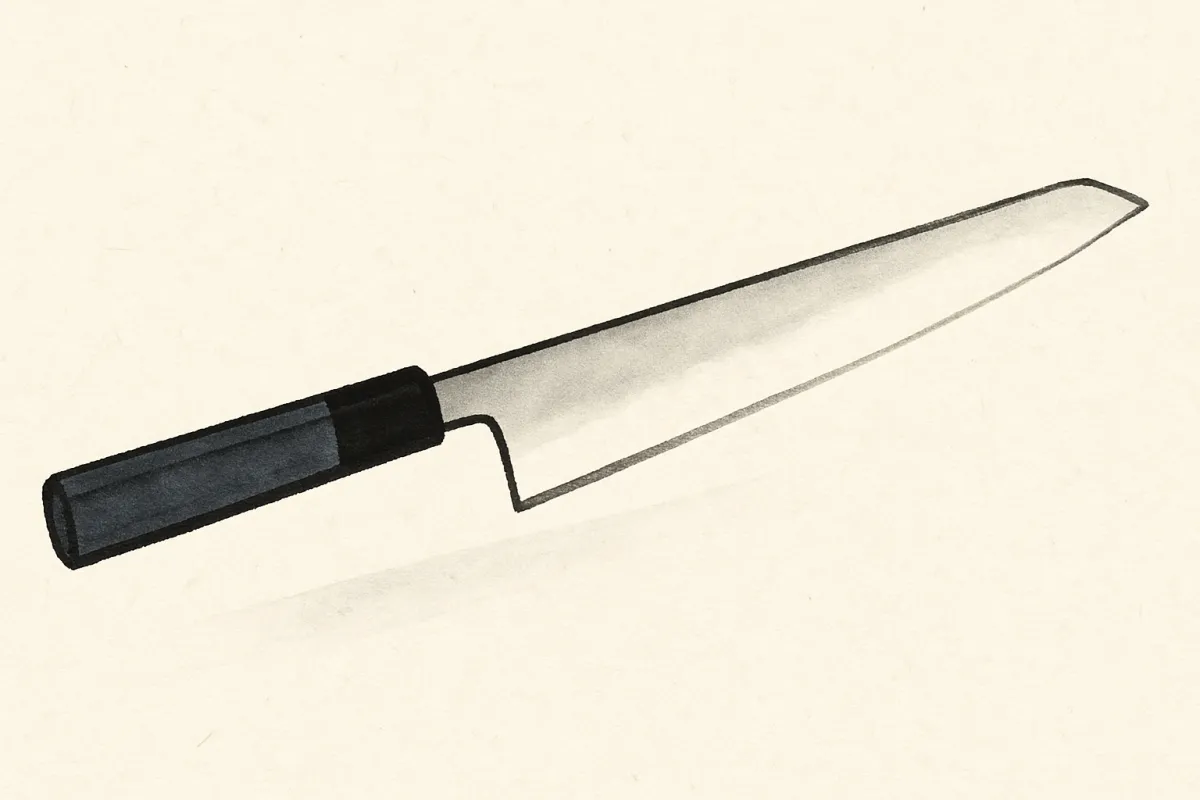
Search "kiritsuke knife" and the results contradict each other. One listing shows a $1,500 hand-forged blade described as the master chef's slicer; the next shows a $150 knife that looks like a chef's knife with a slanted tip, and both are called kiritsuke. That isn't a scam or a mislabel. It's the single most important thing to understand before you buy one: the word "kiritsuke" names two structurally different knives. Once you know which is which, the rest follows: the price, the difficulty, whether you can even use it.
What a kiritsuke is
The look is unmistakable: a long blade with a flat, straight edge line ending in an angled, clipped tip, squared off on the diagonal rather than curving to a point. That tip is the K-tip, short for kiritsuke-tip, borrowed from sword language and sometimes called a reverse tanto. It's neither the pointed tip of a yanagiba nor the gentle drop tip of a gyuto. That profile is the one thing both versions share. Almost everything else about them is different.
Two knives, one name
| Traditional kiritsuke | Modern "K-tip gyuto" | |
|---|---|---|
| Bevel | Single (chisel, hollow back) | Double (symmetric or 70/30) |
| Edge line | Long and flat | Keeps a gyuto's curved belly |
| Origin | Merges the yanagiba + usuba | Gyuto with a K-tip; trended ~2020–2021 |
| Cutting | Push / pull only | Rock, push, or pull |
| Handedness | Right-handed by default | Ambidextrous |
| For | Experts / itamae level | Beginner to advanced |
| Price | $300–2,000 specialist | Ordinary gyuto range |
"I want a kiritsuke" is really two different shopping trips. Figure out whether you're after the formal single-bevel slicer or the everyday K-tip workhorse before you compare models, or you'll end up reading spec sheets for the wrong knife.
The traditional one: two knives in one
The classic kiritsuke is a single-bevel blade, ground on one face with a flat, hollow back, the same chisel geometry that makes single-bevel knives so precise and so demanding (the physics of that is laid out in single bevel vs double bevel). What makes it special is that it merges two specialist knives into one. It takes the length of the yanagiba, the long single-bevel sashimi slicer, and the taller blade height of the usuba, the vegetable knife. Traditional blades run 240–300mm long (9.5–12 inches, long for a Japanese kitchen knife) with a blade height of 50–57mm. One knife, meant to both slice fish like a yanagiba and handle vegetable work like an usuba.
That combination is why it carries its reputation. Handling a knife that does two experts' jobs demands real skill, so the single-bevel kiritsuke became the itamae's blade, a symbol of the head chef's status and seniority.
The katana myth
You'll read that only the head chef is allowed to use one, as if it were a sacred object no junior cook may touch. Take that with salt. As the retailer Knifewear puts it, the rumor that they're "reserved for only the head chef" is "completely untrue." The status association is real, and the knife was long regarded as the master's blade, but the strict prohibition is folklore, not a rule. Anyone can buy one. The real gatekeeper isn't tradition; it's that the knife is hard to use.
Cutting with the flat edge
Buyers who expect a fancy chef's knife hit this first: a flat edge cannot rock-chop. On a curved Western knife you keep the tip down and rock through an onion; do that on a kiritsuke's straight edge and you get what Kasumi Japan calls "accordion cuts," slices that stay joined instead of falling free. The flat edge is built for push and pull cuts: one clean forward or backward stroke. Add the length, which magnifies any wobble out at the tip, and a spine that tapers from 2.0–3.3mm at the heel down to under 1mm at that thin K-tip (precise for scoring fish skin, but chip-prone under sideways force), and you have a knife that punishes Western habits.
The modern one: a workhorse in disguise
Around 2020–2021 the K-tip look went mainstream, and makers answered with the double-bevel "K-tip gyuto": an ordinary chef's knife that keeps its curved belly (so you can rock) but wears the dramatic angled tip. It's really a member of the gyuto family (see santoku vs gyuto vs nakiri vs petty), sharpened like any Western knife, usable in either hand, in steels from VG10 to powdered SG2 at HRC 58–65. This is the version most beginners want: the look, without the single-bevel learning curve.
The premium over a plain gyuto
Even the double-bevel version tends to carry a premium: Kasumi cites 15–30%, LeeKnives 20–30% over a gyuto at the same steel spec. The reason is that thin, angled tip: it "requires more precise grinding than a standard pointed tip — the angle must be exact, or the tip becomes either too fragile or too blunt." The single-bevel version, hand-finished on one face, climbs into $300–2,000 specialist territory, the single-bevel tax the whole category pays, unpacked in why Japanese knives are expensive.
Which one should you buy?
Decide what you actually want. If it's the look and the versatility for everyday cooking, get a double-bevel K-tip gyuto: forgiving, ambidextrous, a fine main knife. If it's the formal single-bevel slicer, treat it as an expert's second or third knife and expect to relearn how you cut and how you sharpen. And know the K-tip has relatives: the bunka is a santoku with a K-tip at a compact 165–180mm, and the hakata is a showier cousin. Whichever way you lean, buy on which of the two knives you're after, not on the shared name. The shop is where to start.