
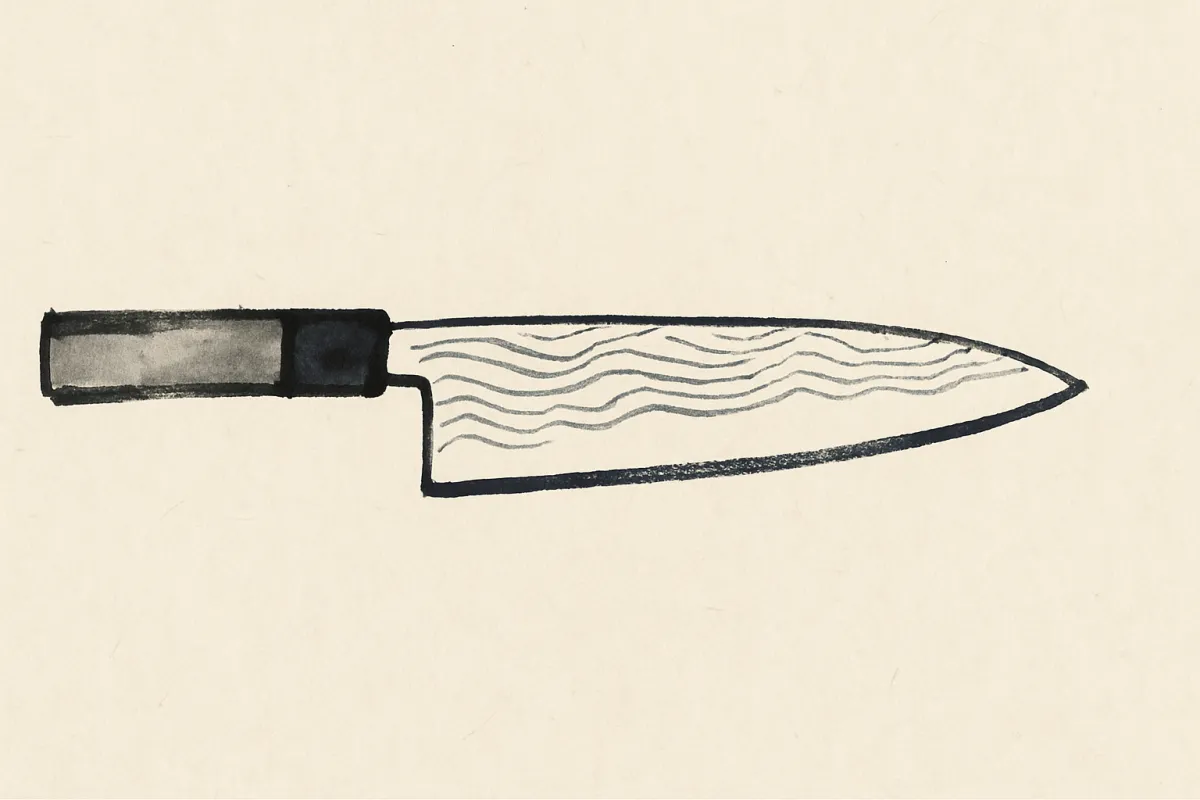
Put two gyutos side by side on a shop page. One is a plain, matte VG-10 blade. The other is a rippling, tide-marked "67-layer Damascus" (same brand, same shape, the same edge steel on the spec sheet), and it costs roughly double. The obvious question is the right one: is that pattern buying you a knife that cuts better, or a knife that photographs better?
Short answer: almost always the second. This guide shows why, and how to read the price tag without the mystique.
Two different questions hide in one knife
Every Japanese knife answers two separate questions, and product pages love to blur them together:
- Composition — which steel it's made of (White, Blue, VG-10, SG2; carbon or stainless). That's the job of the steel guide and the carbon-vs-stainless fork.
- Construction — how that steel is assembled into a blade. This is what "Damascus" and "san-mai" actually name.
Damascus is not a steel at all. It's a construction: a way of stacking layers around a core. So the swirl on the label tells you nothing about composition, and composition does the cutting.
Three constructions on one line
There are three buyer-facing ways to build the blade, and they sit on a single line:
| Construction | What it is | The edge is… |
|---|---|---|
| Monosteel | One steel, edge to spine | that steel |
| San-mai (三枚) | A hard core sandwiched between two soft outer layers | the hard core |
| Damascus | A san-mai whose cladding is many pattern-welded layers | the hard core |
Read down that last column. On a san-mai or Damascus kitchen knife, the cutting edge is the hard core steel, typically run to around 60–65 HRC and ground down to the apex. The soft cladding (roughly 40–55 HRC) sits on the wide flats of the blade and never touches the food. Those "67 layers" count the cladding; none of them reach the edge.
So a plain VG-10 gyuto, a VG-10 san-mai, and a VG-10 "67-layer Damascus" all cut with the same steel. A VG-10 Damascus cuts like VG-10. The pattern lives on the outer jacket, which the onion never touches.
What the pattern is (and isn't)
Two more corrections stack on top, because "Damascus" is doing a lot of misleading work as a single word.
It isn't the historic stuff. True "Damascus steel" was wootz, a crucible steel from India and Sri Lanka whose watery mottling came from carbide banding in one homogeneous ingot. Its production died out around 1900, and the recipe was lost. What sits in your cart today is pattern welding: two contrasting steels forge-welded, drawn out, folded, and re-stacked into a symmetric jacket around the core (hence the odd marketed counts of 33, 67, or 101, an even cladding stack plus the single core line). It only got called "Damascus" in 1973, when the bladesmith William F. Moran unveiled his pattern-welded knives under that name. The two processes have nothing in common beyond the borrowed word.
The pattern is a surface effect. The layers are invisible until the blade is bathed in ferric acid, which darkens the plain-carbon layers while the nickel-bearing layers stay silvery. That contrast is the whole light-and-dark ripple. As the smith Tsukasa Hinoura puts it: "The pattern does not affect how the knife cuts, but… beautiful knives make people enjoy using them, and also make people want to use the knives more." The etch is cosmetic, not a hardening step.
What cladding does genuinely buy you
"All cosmetic" would be too glib, though. Lamination itself, the san-mai sandwich whether it's Damascus or not, earns real and non-decorative benefits:
- Toughness. The soft jacket absorbs shock that would microchip an all-hard blade.
- Easier upkeep. When you thin the knife you're grinding mostly soft iron, not glass-hard steel.
- A corrosion buffer. Stainless cladding over a reactive carbon core keeps the body stain-free while the edge stays high-carbon.
- Material economy. Less of the expensive core steel is needed, one reason a clad blade can undercut a solid-hard honyaki.
But notice: a plain, non-Damascus san-mai already has every one of these. The many-layer Damascus pattern adds none of them beyond what its cladding was already doing. What the pattern adds is cost, for the look alone.
The metallurgist's verdict
And when a pattern-welded steel does reach the edge, as on some Western and custom blades, does the layering finally help the cut? The PhD metallurgist Larrin Thomas ran the tests. In controlled CATRA cutting, pattern-welded steel "behaves as a composite material; the edge retention is essentially right in between the two monosteels." It came out as a weakest-link average of its ingredients, no sharper and no longer-lasting. The old "the soft and hard layers wear into micro-teeth" idea fails chemically too: at forge-welding heat, carbon diffuses between adjacent layers in seconds, so thin layers equalize in carbon and don't behave as alternating hard/soft teeth.
The honest hedge: with a deliberate ladder pattern and a soft/hard steel pairing, you can coax a small slicing gain out of micro-serration under specific conditions, so "the pattern never does anything" is an overstatement. But "the pattern is why it cuts well, and why it's worth double" is the actual myth. Performance is set by the component steels, the heat treat, and the geometry, never by the swirl.
How to read the price
That lets you decode the tag. A Damascus knife's price splits into three parts:
- Core steel: the only part that meets food, and the only part that reliably tracks how it cuts.
- Construction labor: forge-welding a clean clad billet and grinding to expose a straight core line. Real work; a san-mai honestly costs more to build than a plain blade.
- Pattern premium: the folding and the acid etch. This is aesthetic labor. It pays for how the knife looks and adds nothing to the cut.
Pay the pattern premium only if you want the look. Judge the cut by the core steel alone. And one buyer-beware: some cheap "Damascus" is a laser-etched fake with no real lamination underneath, so on bargain blades the construction claim itself deserves a second look.
A beautiful knife you enjoy picking up is a completely legitimate thing to buy; that's Hinoura's whole point. Buy it for the look if you like it, and judge the cut by the core steel. To see where that core steel comes from, the how-a-knife-is-made walkthrough and the what-you're-actually-paying-for breakdown are the next stops, and when you're ready, the shop.