
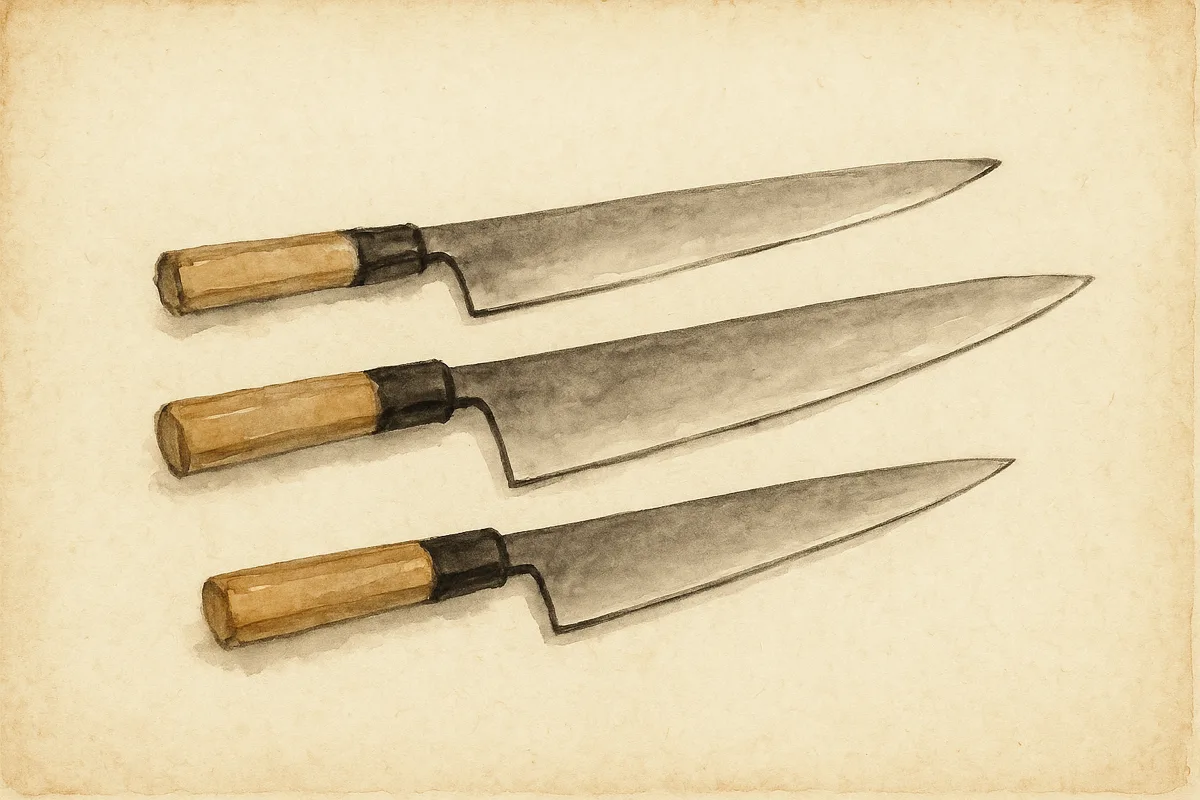
The same gyuto usually comes in three lengths: 180mm, 210mm, and 240mm, sometimes at one price. Once you've picked the shape, that number is the last thing between you and checkout. It's also where a lot of buyers freeze, picturing a long blade crowding a small counter. Length isn't a matter of taste. It follows what you can measure: how wide your cutting board is, how far your hand spreads, and how much you cut at once.
Three things set the length
The specialist size guides converge on the same three factors. Blade length is set by:
- Your cutting board's interior width, the hard ceiling. A blade too long for the board leaves no room for food and pushes the tip and heel off the edge, which is dangerous and awkward. The working rule: a blade should be 50–75% of the board's interior cutting width. Shops phrase the same thing another way: leave about three inches of board beyond the blade in each direction.
- The spread of your hand: how far the tip of your thumb reaches to the tip of your little finger, which tracks how securely you can hold the blade in a pinch grip.
- How much you cut at once: the more you batch, and the bigger the ingredients, the more a longer blade earns its keep by finishing a cut in one stroke.
Priority matters here. The board is the binding constraint: you can't choose a length that won't fit it, no matter how big your hands are or how much you cook. Within what the board allows, your hand and your batch size settle the rest.
The default, and when to leave it
Start from the answer most people land on: the 210mm gyuto. It's the most-sold size in the world, and roughly 70% of first-time buyers choose it. The reason isn't shop pressure; it fits a standard home board (around 380×250mm) and an average adult hand at the same time. If you do nothing else, buy this and you'll rarely be wrong.
You leave 210mm only when one of the three variables pulls you off it:
| Length | ≈ inches | Made for | Struggles with | Board it needs (interior width) |
|---|---|---|---|---|
| 180mm | 7" | Small kitchens, small hands, light or precise prep — tomatoes, garlic, herbs, half onions, fillets | Big jobs: whole watermelon, large squash, a daikon over 18cm, carving a roast | Works even on a small 300×200mm board |
| 210mm | 8.3" | The universal home default — everyday everything, without strain | Feels lost on a very small board | ≥280mm (a 14×18in board is comfortable) |
| 240mm | 9.5" | Bulk prep and big ingredients in one stroke, from reach and leverage | Overkill for a small kitchen or a small hand | ≥320mm (440×300mm or larger) |
The gyuto family runs from roughly 180mm to 300mm, but 210 and 240 are where almost everyone lives. Length isn't the only thing that changes how a knife behaves. Heel height (typically 45–54mm) and spine thickness (2.0–3.0mm) mean two blades of the same length can feel quite different in the hand. Length is the variable you buy first; it just isn't the only one.
The hand-spread test
Your hand settles most of what the board leaves open. Measure it like this.
Spread your dominant hand flat and measure from the tip of your thumb to the tip of your little finger:
| Hand spread | Points to |
|---|---|
| Under 17cm | 180mm |
| 17–19cm | 210mm (the universal fit) |
| 19–22cm | 210mm or 240mm — let your board decide |
| 22cm and over | 240mm |
This beats sizing by job title because control lives in the grip: "A 240mm in a 16cm hand is genuinely uncomfortable; a 180mm in a 22cm hand feels like a paring knife."
A couple of qualifications. There's a second, older way to size by hand: measure wrist crease to fingertip, then round up. By that method the average adult hand length of about 19.3cm (193mm) also lands on 210mm, so the two approaches broadly agree. And at least one respected shop argues the opposite emphasis, that size should follow what you cut and where you cut it, with the hand as a secondary check. Treat the spread numbers as a strong starting point rather than a fixed verdict.
Santoku is a shorter conversation
If you chose a santoku instead, the decision is nearly made for you: 165–180mm, with 170mm the common middle. The santoku's flat profile turns awkward if stretched long, so unlike the gyuto there's little to agonise over. Pick something in that band that suits your hand and move on. (If you're still weighing santoku against gyuto, that's a question of shape rather than size: see santoku vs gyuto vs nakiri vs petty.)
A word on weight
You'll notice weights quoted all over the map, and it's tempting to sort by grams. Don't lean on a single number. Weight depends far more on construction than on length: the same 210mm can be a 135g "laser" or a 250g-plus workhorse, easily a 100g gap on identical length, with even ordinary builds varying by 50–100g. Longer does trend heavier, but a difference of 50–80g is something you feel as fatigue over 30–60 minutes of continuous prep rather than something you read off a spec sheet. If you cook in long stretches, favour the lighter build; if you want the blade to do the work, a little heft helps.
Putting it together
Measure your board, spread your hand, and be honest about how much you cut. If your board's interior is at least 320mm, your hand spreads past 22cm, and you cook in batches, buy the 240mm. If your kitchen is tight, your hand is small, or you mostly do light prep, buy the 180mm. Everyone else, which is most people, buys the 210mm and never thinks about it again.
Still unsure whether you even want a gyuto as your first knife? Start with your first Japanese knife, or see how these blades differ from a Western chef's knife in Japanese vs German knives. When you've named your length, our knife shop is the place to find it.