
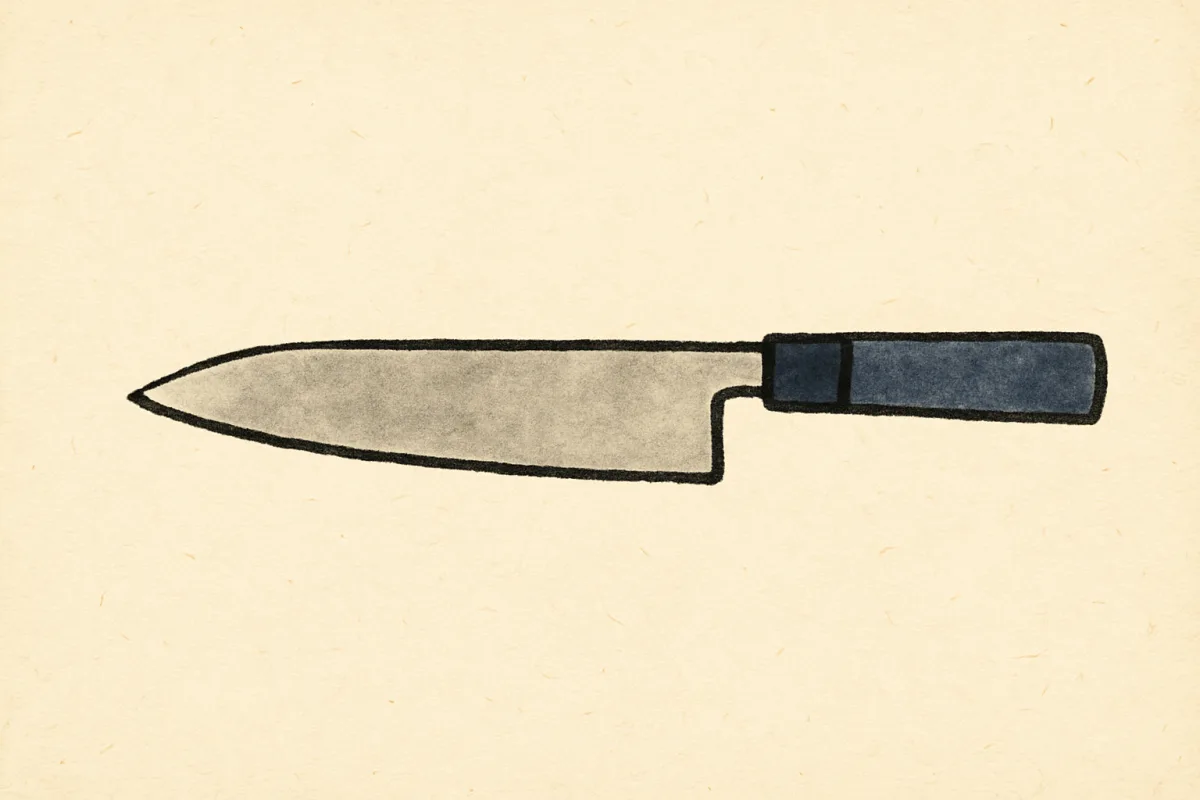
Every shop presents a different flagship, a wall of shapes, three steels and a price range from $60 to $600. It looks like a research project. It's simpler than that. The specialists who sell these knives for a living, makers in Sakai and education-first retailers in Tokyo, converge on almost the same first knife.
The one-sentence answer
Buy a double-bevel, stainless-steel gyuto (210mm) or santoku (165–180mm), and spend $80–150. That's it. One knife in that description does nearly everything a home cook needs, tolerates imperfect care, and is precisely where Kasumi Japan, Zahocho and Sakai's JIKKO all point beginners. Kasumi reports that more than 60% of their beginner customers walk out with the 210mm gyuto. That is real sales data, not a marketing hunch.
This is the default because it folds four separate decisions (shape, steel, budget, care) into a single safe choice. Below is each one, briefly, with a pointer to the deep dive if you want it.
Shape: gyuto or santoku, and how to pick
Both are double-bevel knives, sharpened on both sides like a Western chef's knife, so they cut the same whether you're left- or right-handed. That already rules out the single-bevel knives (yanagiba, deba, usuba) as a first purchase. More on that below.
Between the two:
- Gyuto (210mm): the Japanese chef's knife. A gently curved belly lets you rock, a pointed tip does detail work, and the length reaches across a cutting board or a whole chicken. It's the most versatile shape and the one to buy if you're unsure. 210mm (about a Western 8") is the standard entry length.
- Santoku (165–180mm): shorter, lighter, with a flat edge and a rounded "sheep's foot" tip. That flat profile wants a straight push-cut: press down and forward, not a rocking motion. It shines for vegetable-heavy cooking, small kitchens, and anyone who wants an easy-to-control blade.
There's a third name you'll see, the bunka, santoku-length but with a sharp reverse-tanto tip. It's tempting because it looks the most versatile, but its even flatter profile rewards a practiced push-cut, which makes it a middling first choice rather than a beginner default. Note it for later. If you want the full shape-by-shape breakdown, that's a separate piece: santoku vs gyuto vs nakiri vs petty.
Steel: stainless first, carbon later
Beginners talk themselves into pain at exactly this step. Carbon steel (Shirogami "white," Aogami "blue") takes a scary-sharp edge and is what the romance is about. But it rusts if you so much as leave it wet on the board, so it needs drying after every use and a film of camellia oil before it's put away. That's a lot to ask of your first week.
Start on stainless. The beginner-friendly names to look for: VG-10 (from Takefu, sharp and rust-resistant), Ginsan / Silver Steel #3 (a stainless that sharpens like carbon), and AUS-8 / AUS-10 (easygoing, low-maintenance). There's a clever middle ground, a carbon core clad in stainless (san-mai), but the very edge is still exposed carbon, so it isn't fully carefree. The full trade-off lives in carbon vs stainless steel, and the alloy families are broken down in the steel guide.
Budget: $80–150 is the sweet spot
You do not need to spend a fortune to get a knife that outperforms anything in a supermarket. The entry band runs roughly $50–200, and $80–150 is the sweet spot for a knife you'll happily use for years. Above $300 you're paying for finish, rarity and heirloom construction, a reward for experienced hands rather than a requirement for a first knife. Skip the block set entirely; it bundles blades you'll never use to justify the price. Why good knives cost what they do is its own story: why Japanese knives are expensive.
Care: the one rule that saves your knife
Stainless keeps day-to-day maintenance light: hand-wash, dry, don't leave it in the sink. But there's a single mistake that undoes everything: never run a Japanese knife through a pull-through or electric sharpener. They grind away far too much metal at a fixed angle that doesn't match your blade's geometry, and their ceramic wheels chip thin Japanese steel; on a single-bevel knife the damage is permanent. A $20 gadget can take years off a $150 blade in one pass.
The right tools are a whetstone (a #1000 and a #3000 will cover a hard, HRC 58+ Japanese knife), or, if you'd rather not learn stones, professional sharpening twice a year plus a ceramic honing rod to keep the edge aligned between visits. Start with drying, storage and rust in how to care for a Japanese knife and the whetstone sharpening guide.
The four mistakes to skip
- Carbon steel as your first knife: save the rust management for when the habits are automatic.
- A single-bevel knife as your everyday blade: yanagiba, deba and usuba are specialist tools, sharpened on one side, locked to your handedness and hard to maintain. See why single- and double-bevel matter.
- A pull-through or electric sharpener: the single fastest way to destroy a good edge.
- Overspending on an heirloom-grade knife: a $120 stainless gyuto teaches you more than a $400 showpiece you're afraid to use.
Get the boring, correct first knife. Cook with it for a year, learn to sharpen it, and then chase the carbon steel and the hand-forged patina. You'll appreciate them far more. When you're ready to buy, our knife shop is a good place to start.