
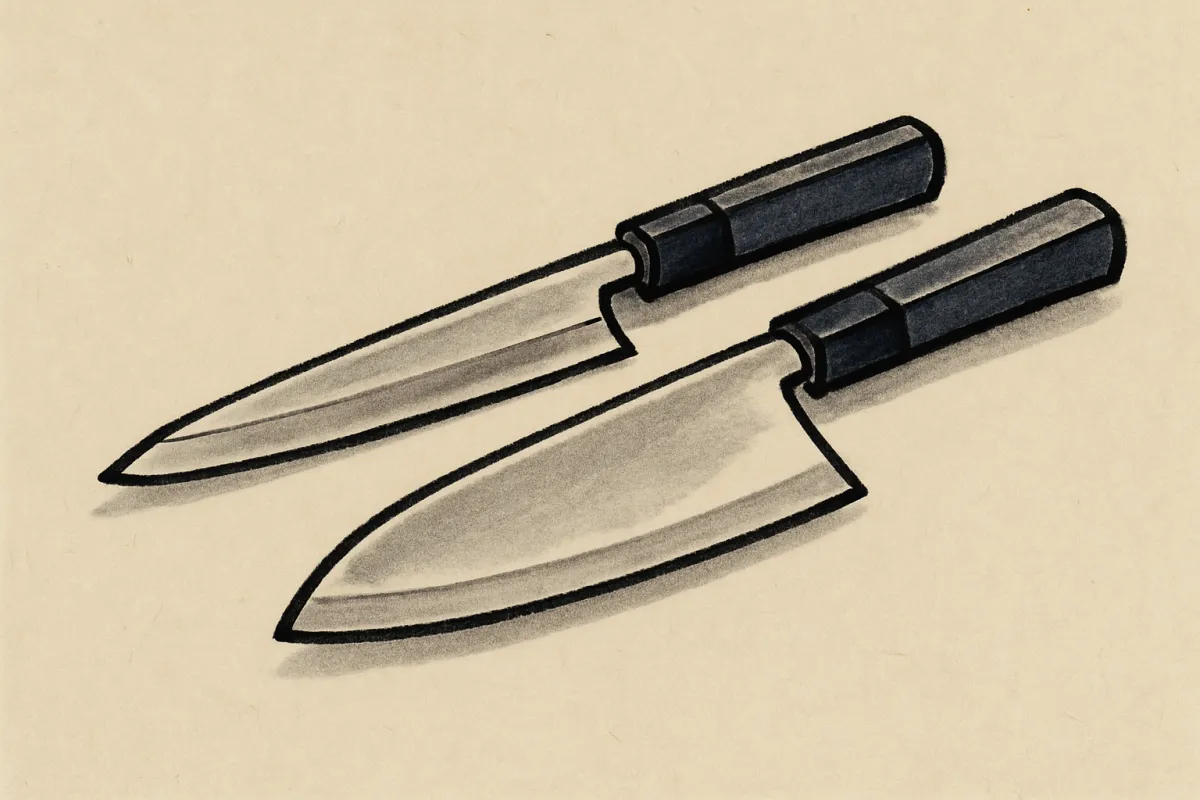
Almost everything confusing about Japanese knives resolves into one question: is the blade ground on one side or both? That single choice, single bevel (片刃 kataba) versus double bevel (両刃 ryoba), decides how sharp the edge gets, whether the knife is locked to your dominant hand, whether food falls off the blade or clings to it, which knives you'd reach for, and how you're supposed to sharpen it. The bevel decides all of those at once.
The geometry: a chisel versus a wedge
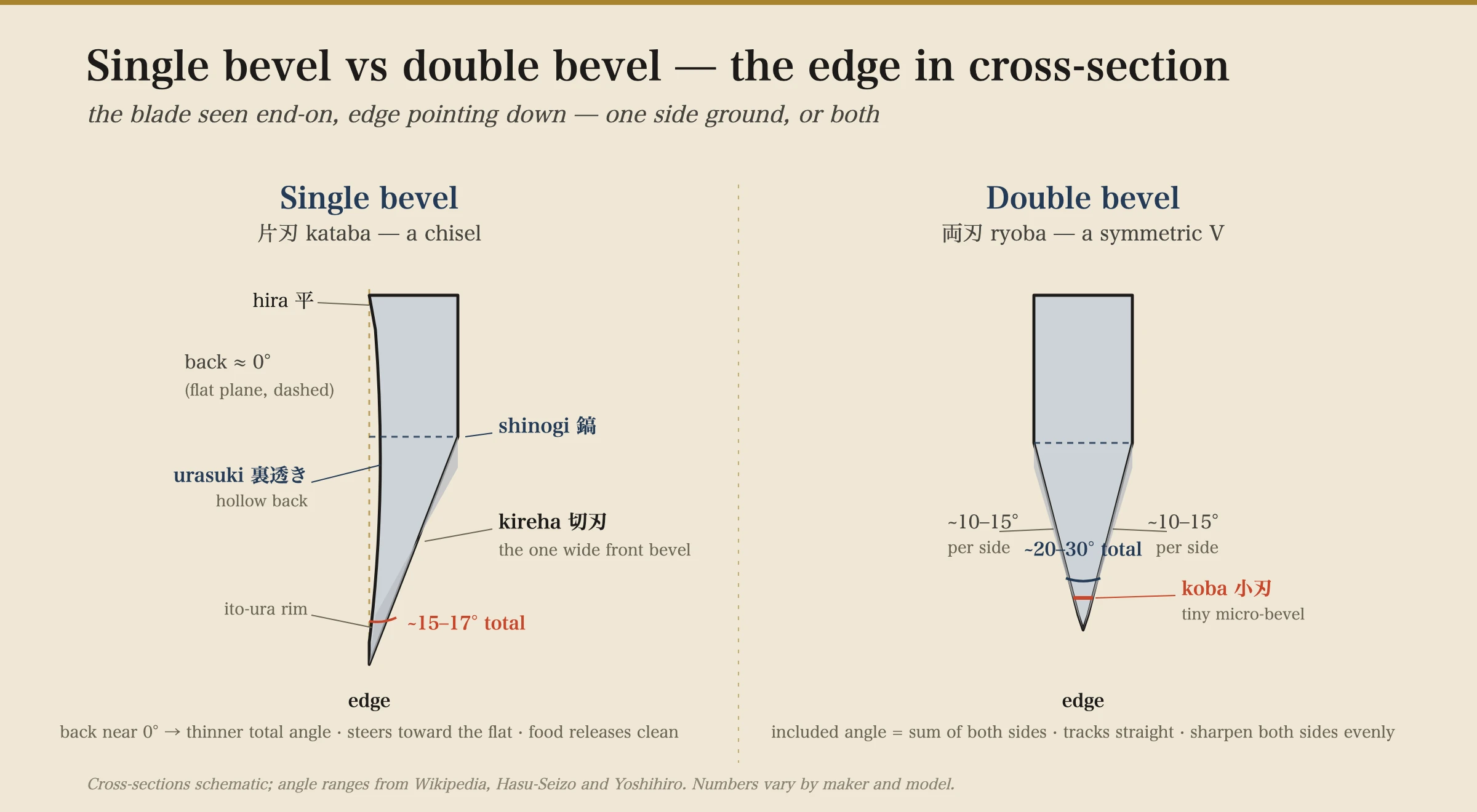
A double bevel tapers symmetrically to the edge on each side, a little V, exactly like a Western knife. Japanese home doubles are typically ground 10–15° per side, which yields a ~20–30° included edge, already more acute than a typical Western ~40°. Many finish with a tiny secondary micro-bevel (小刃 koba) for durability.
A single bevel is a true chisel: one wide primary bevel, the 切刃 kireha, runs from a ridgeline called the shinogi (鎬) down to the edge on the front, while the back (裏 ura) stays flat. Only the front is angled. Single bevels get called sharper because the back stays at roughly 0°, so the total included angle is close to the front bevel alone (often quoted around 15–17°), whereas a double bevel's included angle is the sum of both sides. Sharpening only one face also lets a maker grind thinner and more acute than they'd dare on two.
This is not academic. In a side-by-side test, the Sakai maker Jikko found the single bevel cut into a tomato "more easily and smoothly," with "a more stable, gliding cut." The advantage flipped on denser work: through thick pumpkin the double bevel "moved straight and smoothly," and only on katsuramuki-style rotary peeling did the single glide again while the double "had a slight dragging sensation." Each grind wins a different task: single excels at long drawing slices, double at straight downward cuts.
Steering, and food that won't stick
Because a single bevel is an asymmetric wedge, the beveled face shoves food sideways while the flat back rides along the fresh cut. The net sideways push makes the blade steer toward the flat side. For a straight rectilinear cut you correct that push with technique; in Japanese practice it becomes useful. An usuba peeling daikon in 桂剥き katsuramuki, unrolling a whole radish into one paper-thin continuous sheet, works with that natural curve.
The back isn't just flat. It carries a shallow concave hollow, the 裏透き urasuki, hammered in by hand. The hollow shrinks the steel-to-food contact to a thin strip and, decisively for sashimi, leaves a tiny air pocket so the slice releases cleanly and the cut face stays glossy instead of torn. A double bevel wedges symmetrically, tracks dead straight, and is easy to steer with, but its two flat faces have no such relief, so starchy food (potato, cucumber) tends to stick.
Two knife worlds
The split maps onto two families of knives. Single-bevel professionals: the yanagiba and takohiki for slicing sashimi, the thick-spined deba for breaking down fish, the usuba for vegetables (plus mukimono and honesuki). Their traditional home is Sakai (堺) in Osaka. Double-bevel everyday: the gyuto, santoku, nakiri, petty and sujihiki — exactly the home-kitchen four covered in santoku vs gyuto vs nakiri vs petty. The nakiri, in fact, is just the double-bevel, ambidextrous cousin of the single-bevel usuba.
Sharpening: the back changes everything
A double bevel is forgiving: alternate both sides, raise and chase a burr, done, the way the whetstone guide describes. A single bevel is a different discipline. You work the whole kireha until a burr forms, which is most of the job, then flip and briefly deburr the back. That back step is 裏押し uraoshi, and because of the urasuki hollow only a thin flat rim touches the stone. Keep that rim under about 2mm: grind it wider and you're removing the very edge steel and shortening the knife's life. As you sharpen, the shinogi line has to migrate up the blade at the same rate steel comes off the edge, so the kireha stays the same width. The cardinal sin is sharpening a single bevel from both sides like a Western knife: the soft back cladding can't hold an edge, and you can ruin the blade for good.
The handedness tax
A chisel only works in the hand it was ground for. Standard single bevels are right-handed (bevel on the right, flat back toward the piece you're keeping). A left-hander can't just flip one; they need a mirror knife, usually made to order at 30–50% more (some shops charge up to 50% extra, a few advertise no upcharge as a selling point). The clean workaround: stay double-bevel. Most modern Japanese doubles sold to the Western market are 50/50 and genuinely ambidextrous. Note that many quality doubles are ground a touch asymmetric, around 70/30 in favor of the right hand, so even the "easy" family has a mild handedness nuance.
How to read the bevel before you buy
- Spec says double bevel / 50/50 / ryoba → all-round, ambidextrous, forgiving to sharpen. The right first knife, and the safe choice for left-handers. This is your gyuto/santoku/nakiri/petty.
- Spec says single bevel / kataba → specialist, sharper on a draw cut, food releases cleanly, but it's handed, needs the uraoshi back step, and is a right-handed purchase unless you order (and pay for) a left-handed mirror. This is the yanagiba/deba/usuba world.
The rest of a knife's behavior follows from that one grind choice.