
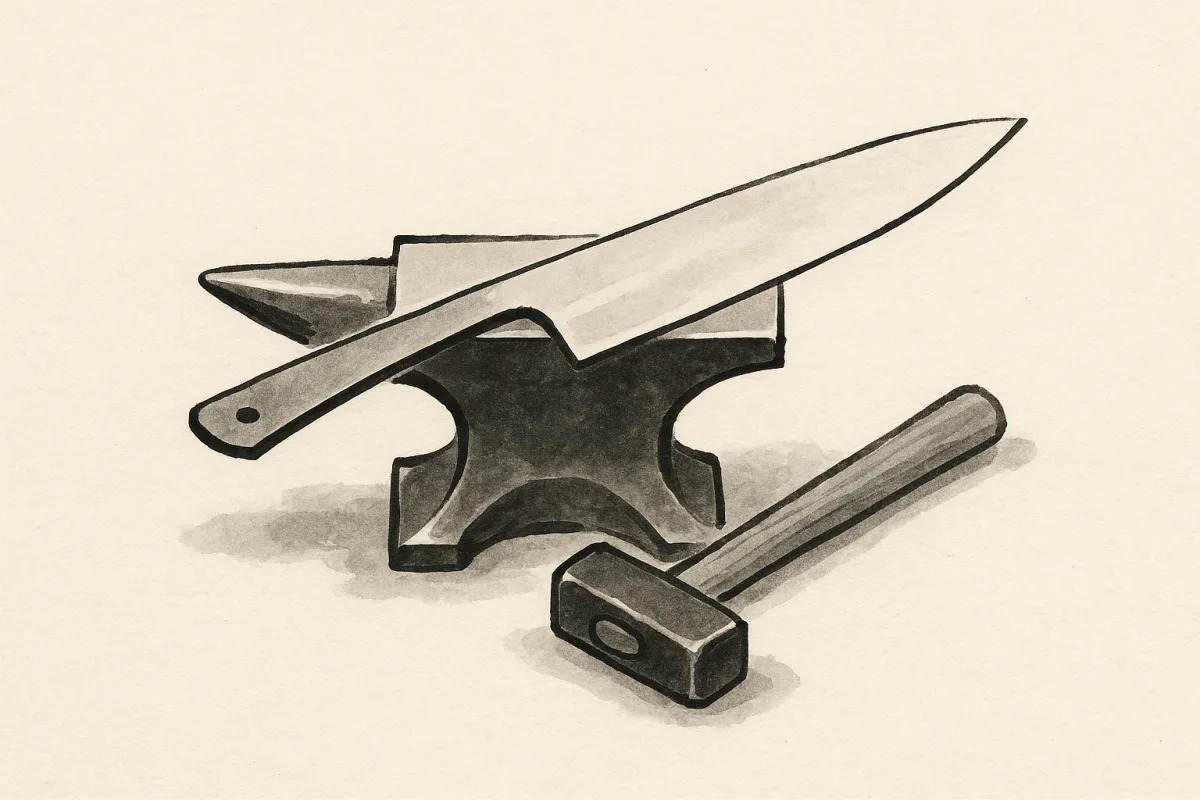
A finished Japanese knife looks like a single sliver of steel, but it almost never is. Pick up a clad santoku and you are usually holding two metals fused into one blade: a thin ribbon of hard, brittle cutting steel buried inside a thicker jacket of soft iron. That construction is called cladding, or 合わせ awase.
Cladding: a hard steel wrapped in soft iron
A good kitchen knife wants two things that fight each other. The edge needs to be hard: high-carbon steel that takes a keen edge and holds it. But hard steel is brittle, rusts readily, and is a misery to grind. The body of the blade needs to be tough: soft steel that shrugs off knocks and sharpens quickly, though on its own it won't hold an edge for a minute.
Japanese smiths settled the argument physically rather than chemically: put a strip of hard steel exactly where you cut, and wrap everything else in soft iron. The hard core is hagane (鋼); the soft jacket is jigane (地金) or nan-tetsu, which one Sakai maker describes flatly as "dead soft iron." Weld the two together and you get a blade that is sharp where it matters and forgiving everywhere else. As the Sakai house Ichimonji notes, it needs "less core steel," so it costs less to make. This is why the great majority of Japanese knives are laminated rather than solid.
The way those two metals are stacked is what the construction vocabulary names:
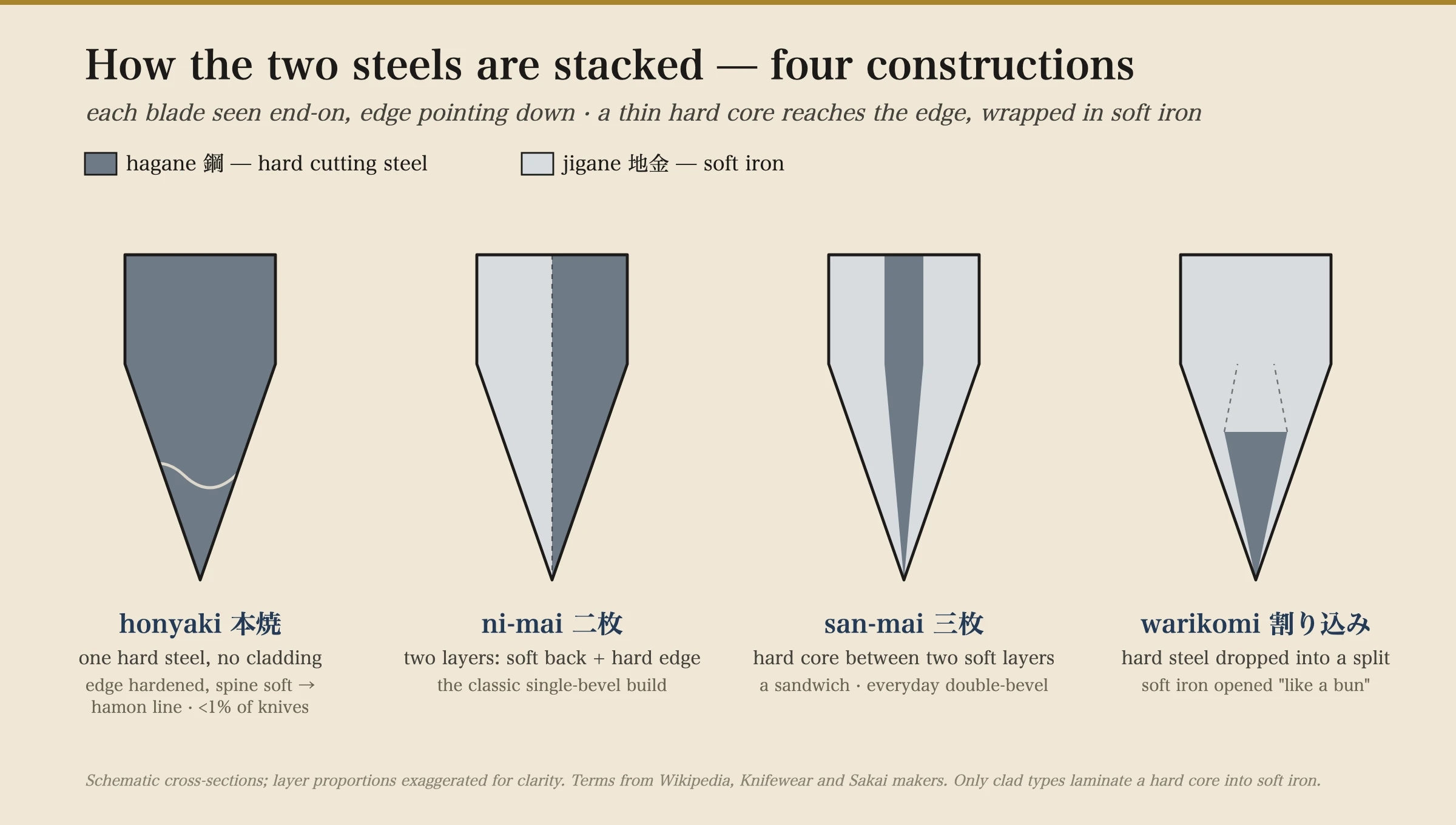
- ni-mai (二枚): two layers, a soft back joined to a hard edge; the classic single-bevel build.
- san-mai (三枚): a hard core sandwiched between two soft outer layers; the everyday double-bevel build. Knifewear likens it to a sandwich, with the hard cutting steel showing at the edge like "a slice of ham hanging over the edge."
- warikomi (割り込み): the soft iron is heated and split "like a hot-dog bun," and a bar of hard steel is dropped into the slot and forge-welded shut.
Walking the line, steel to edge
Now watch a blade get built. Traditionally each stage below belongs to a different specialist (more on that shortly), but the sequence holds everywhere.
1. Forge-welding the clad. The hagane strip is heated red-hot, dusted with borax and iron powder, a flux that cleans the mating faces and lowers the welding point, then laid against the jigane and reheated in a kiln at around 1000°C until the two fuse into a single billet.
2. Forging and shaping (seikei). That billet is heated and hammered out, over and over, drawn toward the blade's dimensions while the repeated working refines the steel's grain. On single-bevel knives the shallow hollow on the back (the urasuki that makes those blades cut and release so cleanly) is forged in at this stage. The geometry is in single bevel vs double bevel.
3. Hardening (yaki-ire). The shaped blade is heated to about 750–800°C and quenched in water, which locks the steel into its hard state. Water is faster and harsher than oil: maximum hardness, but a real risk of cracking. A clean water quench is the mark of the most demanding work.
4. Tempering (yaki-modoshi). Straight out of the quench the edge would be glass-hard and chip on the first carrot. So the blade is gently reheated to 150–200°C and left to cool, trading a sliver of hardness back for toughness, what the makers call "tenacity."
5. Sharpening (hatsuke). A hardened blank is not yet a knife; it has no edge. Grinding one on is a craft of its own, run in stages: aratogi (rough) → hiratogi (flat) → hontogi (fine) → buffing. This step cuts the bevel, brings up the misty kasumi finish, and is the one you'd later repeat on a whetstone.
6. Handle (etsuke). Finally the nakago (tang) is heated and driven into a wooden wa-handle. Because all that heating and hammering warps a thin blade, the last step is straightening out the distortions by hand.
One steel or two: honyaki vs kasumi
Everything above assumes cladding. There is a rarer path where the smith uses no soft jacket at all: a single hard steel, edge to spine. This is honyaki (本焼), the summit of the craft. To keep a fully-hard blade from shattering, the maker hardens it differentially: only the edge is quenched hard, while the spine stays softer and shock-absorbing, classically by coating the spine in clay before a water quench (mizu-honyaki). The boundary between hardened and unhardened steel then surfaces as a wavy line down the blade: the hamon (刃文), the very same temper line prized on Japanese swords.
Honyaki is punishing to make: water-quenching a hard mono-steel cracks blades routinely, so a master might finish only around 30 a year, and Knifewear reckons honyaki is "less than 1%" of the knives Japan produces. The clad knife, called kasumi (霞), "misty," after the hazy look where soft iron meets bright steel, or awase, "joined," surrenders a little of honyaki's ultimate edge and longevity for being tougher, cheaper, and far easier to sharpen. For everyone short of a handful of collectors and professionals, that trade is why cladding dominates.
Three hands, one blade
Here is the part outsiders rarely expect: in Sakai, the historic heart of professional knives, no single person makes the whole thing. The work is split among specialists. A blacksmith (kajiya) forges and hardens the blade; a sharpener (togishi) grinds the bevels and sets the edge; a handle maker (tsukashi) fits the wa-handle. Every knife, as the Sakai house Hasu-Seizo describes it, passes through the hands of at least three specialized craftsmen, each of whom has spent a career on one stage. Sharpening in particular is held to be no less prestigious than forging; the person who forged your blade almost certainly did not sharpen it.
That division is old. Sakai's blade skill grew out of sword-smithing, and the turn came in the 16th century, when tobacco arrived with Portuguese traders and Sakai smiths began making knives to shred the leaf. Their tobacco knives beat the imports; the Tokugawa shogunate granted certified Sakai blades a "Sakai Kiwame" (堺極) stamp of quality, and the reputation spread across Japan. Many Sakai artisans working today are the fourth, fifth, or sixth generation of their line.
Putting it together
So a Japanese knife is a small argument settled in steel: hard where it cuts, soft where it's held, hardened enough to bite and tempered enough to survive, then ground and handled by separate pairs of hands. The other choices each sit somewhere on that line: which steel fills the core, how the bevel is ground, which shape you reach for. It is all one blade, built up in stages.