
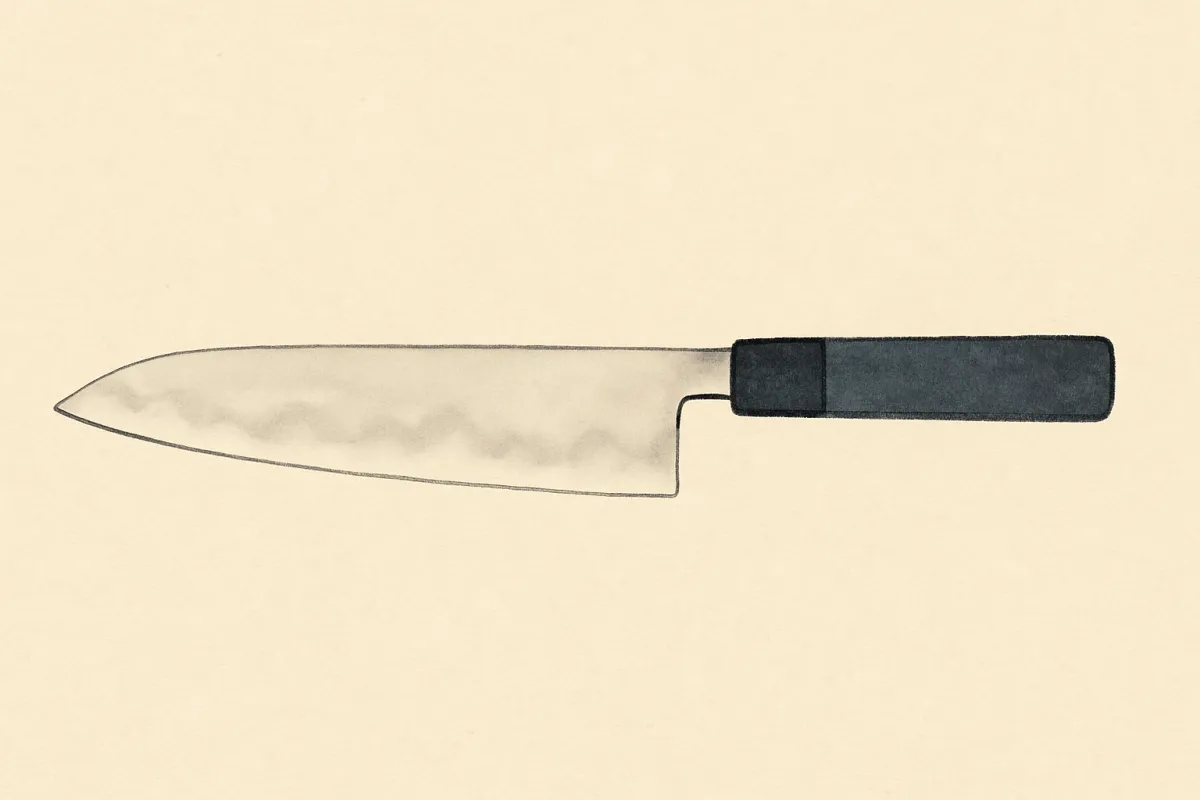
Nearly every Japanese knife you'll ever hold is a clever cheat. A thin ribbon of brutally hard steel is wrapped in soft iron, so the blade can be glass-hard where it cuts and forgiving everywhere else. That is the clad construction called kasumi that makes up more than 99% of production. Then, priced at three, five, ten times as much, sits a knife with no cheat at all. One steel, all the way through, hard enough to cut and hard enough to shatter, tamed by nothing but fire, clay, and the smith's nerve. That is honyaki (本焼), and the cloudy, wave-like line drifting along its edge is the same one prized on a Japanese sword.
One steel, no jacket
The defining fact of honyaki is what it lacks. A clad knife solves a contradiction physically: a blade wants an edge hard enough to get truly sharp (high-carbon steel, but brittle and rust-prone) and a body that survives knocks (soft steel, but it can't hold an edge). Cladding puts the hard hagane exactly where you cut and wraps the rest in tough, cheap jigane, hiding the contradiction.
Honyaki hides nothing. It's a single high-carbon steel from spine to edge, no soft jacket to absorb shock. Quench a steel that hard everywhere and it would be superbly sharp and then crack in half. The honyaki smith has to build the hard/soft split into the one steel itself, and the tool for that is differential hardening.
Clay, fire, and the hamon
Before the quench, the smith paints the blade with a clay slurry: thin (or none) along the cutting edge, thick along the spine and body. This step, tsuchioki (土置き), has roots in feudal-era swordsmithing. The clay coating is a thermal timer: when the heated blade (kitchen carbon steels run 750–800 °C) hits the quench, the bare edge dumps its heat fast and locks into martensite, a structure "nearly as hard and brittle as glass." The clay-covered spine can't shed heat quickly enough to freeze, so it relaxes into soft, tough pearlite. A gentle temper afterward (~150–200 °C) buys back just enough toughness that the edge won't chip.
The hamon (刃文) is the visible boundary between those two structures, the fossilized line where hard martensite meets soft pearlite. Because the smith draws the clay line by hand, no two are identical, and the sword world reads its wave as a maker's signature. The romance deserves one precise caveat: as Wikipedia puts it, that hard/soft difference "is the objective of the process; the appearance is purely a side effect." The hamon is evidence of real differential hardening. Since a wavy line can also be etched on for looks on lesser work, it is evidence of the real thing, not proof of it.
"Kitchen katana" is an honest metaphor for exactly one thing: the heat treatment. A honyaki knife and a sword share the same mono-steel, clay-resist hardening, and resulting hamon. They don't share purpose or construction. A sword is a folded weapon built to survive shock; a honyaki is a food tool built for a keen push-cut. What they have in common is the fire, not the whole object.
Water or oil: mizu vs abura
Honyaki forks again at the quench itself:
| Mizu-honyaki (水本焼) — water | Abura-honyaki (油本焼) — oil | |
|---|---|---|
| Hardness / edge | Harder, stiffer, sharper, longer-holding | Marginally less hard, tougher |
| Sharpening | More difficult | Easier |
| Risk in the making | Highest (water cools violently) | Lower (oil cools gently) |
| Hamon look | Tends to appear blurred, subtle | More defined, sharp |
| Price / rarity | Higher; the rarer | More common of the two |
Water cools so violently that it wrings the most hardness out of the steel, and cracks the most blades doing it, which is why mizu commands the higher price. Oil cools more gently, "lowering the risk of fractures while still achieving consistent hardness." In actual cutting the two are hard to tell apart. The real gaps are top-end hardness, failure risk, and price, not what you'll feel on an onion.
The price of a honyaki
The price of honyaki is, mostly, the price of failure. With one hard steel and nowhere to hide, "even the best knifemakers lose many to cracks and breaks," and one retailer quantifies mizu-honyaki as several blades out of every ten cracking during production. Every cracked blade still cost time and steel, and that cost is baked into the survivors, so "the rarity of the honyaki knives increases with every broken blade."
The economics also pushes smiths away from making it at all. Clad blades can be heat-treated in batches and turned around fast, while a honyaki is essentially one blade at a time, slowly. Almost nobody makes it: Knifewear reckons honyaki is under 1% of Japanese production, and for mizu-honyaki specifically, one Sakai maker counts just three active blacksmiths forging them in Japan, "with Nakagawa Satoshi being by far the youngest."
Scarcity sets the price. Live 2026 listings run from an abura White #3 yanagiba around $799 up to a White #2 honyaki yanagiba at ~$2,499, with mizu gyutos $1,000–1,200, a working band of roughly $800–$2,500, single-bevel sushi blades at the top. Guides put true honyaki at "$1,000+," or "three to five times the price" of a comparable non-honyaki. (This is the extreme end of the four costs that set any knife's price, the tier where money detaches from cutting and buys difficulty, rarity, and the hamon. Prices drift with steel, maker, and exchange rate; the figures are approximate.)
Living with one, and who it's for
Owning a honyaki is a commitment. The high hardness makes it "significantly more difficult to sharpen," and a full session "can take up to an hour of continued and careful swiping on a specialized whetstone." No power sharpeners, no honing rods. With no soft cladding to absorb shock, honyaki chip more easily in use and are unusually sensitive to hard surfaces, and "one drop from the counter or slam in the drawer could crack or even break these knives in two." It's a carbon steel too, so it wants immediate drying and gentle storage.
The verdict is straightforward. Buy honyaki if you already sharpen freehand well, you want the finest push-cut or the historical object or the hamon, you'll treat it gently, ideally on a single task like slicing sashimi, often on a single-bevel yanagiba, and the price reads to you as art-plus-tool. Skip it, or wait, if you want an everyday workhorse, you're still learning to sharpen, or you want value per cut: a clad kasumi gyuto in good carbon or VG-10 delivers ~the same edge with far more toughness, far easier upkeep, and a third to a tenth of the price. Clad is the sane default for almost everyone, and that is no consolation prize.
Honyaki is the oldest of the old school: one steel, clay, fire, and a line that a swordsmith would recognize. It's a masterpiece to aspire to, just not the sensible first, or only, knife. When you want to see one in person, the shop is the place to start.