
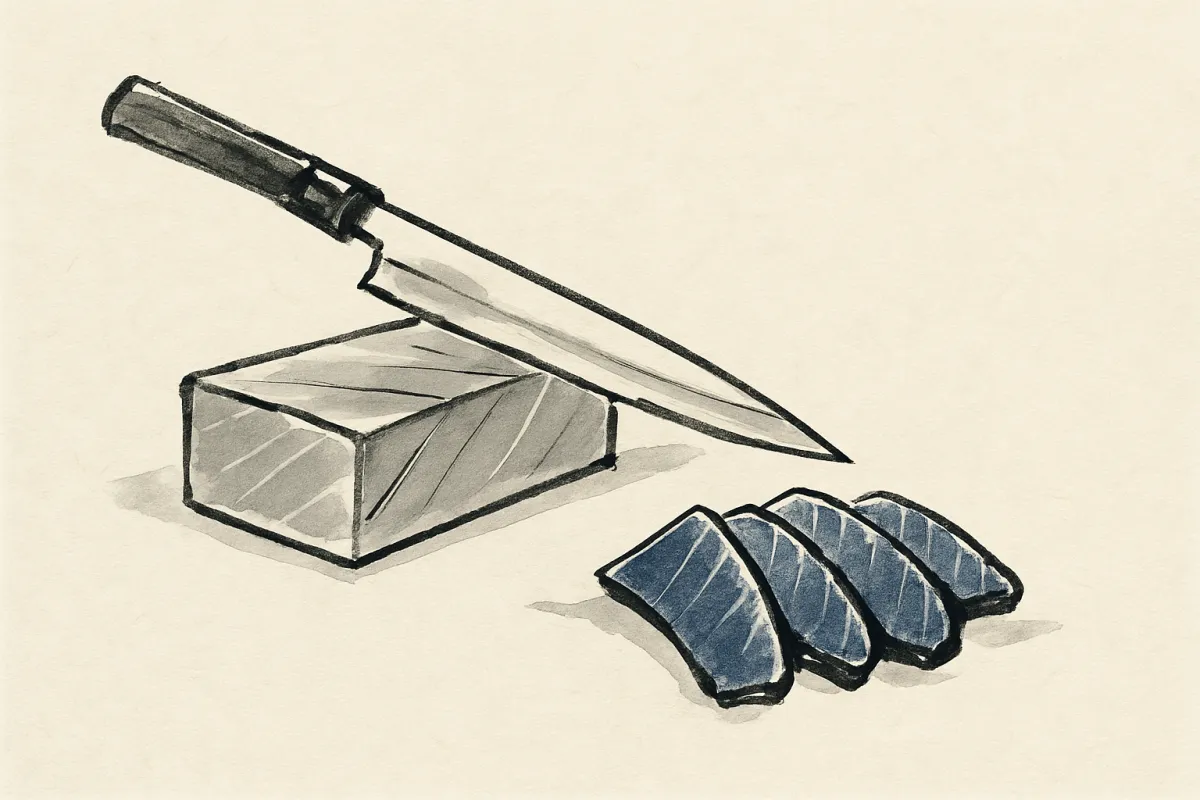
A yanagiba doesn't look like a kitchen knife. It's long, often longer than your forearm, narrow, and ground to a chisel edge on one side only. It isn't built to chop, mince, or break anything down. It has exactly one job: to take a block of fish that's already been filleted and turn it into sashimi, laying down one mirror-faced slice per stroke. Three things about the blade trace back to that job: it's long, it's single-bevel, and you pull it.
The one-stroke cut
The technique is 引き切り hikigiri, a pull cut. You set the heel of the blade against the far edge of the fillet and draw the knife toward you in one continuous motion so the edge runs all the way out through the tip. You do not saw back and forth, and you don't press down. Just one long pull.
Sawing drags the same face across the flesh again and again, rupturing cell walls, bleeding out moisture, and leaving a dull, ragged surface. The sheen of good sashimi dies instantly. A single clean pass with a long, sharp edge separates the muscle fibers cleanly, and the cut face stays smooth and reflective, almost glassy. To finish that pass in one motion, the blade has to be longer than the fillet is wide. Hence the numbers: yanagiba run roughly 240–330mm, with 270mm the professional standard, 240mm the common recommendation for a home kitchen, and sushi counters often reaching 300–330mm. The length is the minimum needed to finish the pull in one pass instead of sawing.
Grinding one side makes it glossier
A yanagiba is 単刃 kataba, a true single bevel. The front face (the omote) is ground at a shallow angle, commonly around 10–15°, while the back stays flat. Because only one side is angled, the maker can grind an extremely thin, acute edge, far thinner than a symmetric V. A thinner edge parts the flesh with less force, and that again keeps the cut face bright. This is the practical, hands-on side of the geometry laid out in single bevel vs double bevel.
The back isn't just flat, either. It carries a shallow concave hollow, the 裏透き urasuki, which leaves a tiny air pocket between steel and fish so each finished slice releases cleanly instead of clinging to the blade, which matters when a torn or stuck face ruins the plate. The cost of all this is handedness: a chisel grind only works in the hand it was made for. A standard yanagiba is right-handed; a left-hander needs a mirror-ground blade, typically made to order at a premium (retailers commonly cite 10% to 50% more). (If that's a dealbreaker, the double-bevel sujihiki is the ambidextrous slicer to look at instead.)
A finisher, not a butcher
The most common beginner mistake is treating a yanagiba as a do-everything fish knife. That's not what it is. The old rule is "deba to break down, sashimi knife to slice." You use the thick, heavy, single-bevel deba to take the head, split bone, and lift the fillets, work that would chip a yanagiba's thin edge in seconds. Only then do you reach for the yanagiba to slice those fillets into neta. A whole fish, start to finish, wants both knives. They're the same single-bevel family built to opposite specs: one to wedge through bone by mass, one to whisper through flesh by thinness.
The sashimi-knife family
"Yanagiba" is the pointed-tip standard, but it has regional cousins, and telling them apart helps you read a listing. These are measured specs for a 300mm blade from a Sakai maker:
| Knife | Region | Tip | Spine / weight (300mm) | Made for |
|---|---|---|---|---|
| Yanagiba 柳刃 | Kansai (Osaka) | Pointed | 3.4mm / 220g | Sashimi and sushi generally, now the national standard |
| Takobiki 蛸引き | Kantō (Tokyo) | Squared / flat | 2.7mm / 160g | Octopus, squid; thinner and lighter, wants more skill |
| Fuguhiki 河豚引き | — | Yanagiba-like | 2.1mm / 140g | Pufferfish sliced paper-thin (fugu is licence-only) |
The east–west split is real history: western Japan favored the pointed yanagiba, eastern Japan the flat-tipped takobiki, and the more versatile pointed tip eventually won out nationwide. (You'll see the squared takobiki tip explained as a courtesy so a chef never points a blade at a guest across the counter. That's a nice story, but not one the authoritative sources actually confirm, so take it as folklore.)
The three cuts
Length and thinness only pay off if you cut the right way for the fish. Three basic 造り zukuri:
- 平造り hira-zukuri, the everyday rectangular slice, about 10mm thick, for meaty fish like tuna, yellowtail, and salmon. Set the edge at the top of the block and pull once.
- 薄造り usu-zukuri, paper-thin slices for firm white fish like flounder and fugu, thin enough to see the plate through them. The hardest cut, and the one that most rewards a truly sharp, thin edge.
- そぎ造り sogi-zukuri, an angled slice, laying the blade down and cutting on the diagonal for a wider face, used on firm white fish like snapper.
Choosing one
Buy a yanagiba as a second or third knife, not your first; it's a specialist that assumes you already own an everyday gyuto or santoku. Start at 240–270mm for a home kitchen; go longer only if you regularly slice big blocks. Confirm it matches your handedness before you pay. And know that most yanagiba are carbon steel that will rust if left wet, so they want the immediate drying and careful storage covered in caring for a Japanese knife, plus the very different single-bevel sharpening approach where you work the front to a burr and only lightly deburr the back. Treated right, it's the knife that finally makes your sashimi look like the counter's. When you want to see one in the hand, the shop is where to start.