
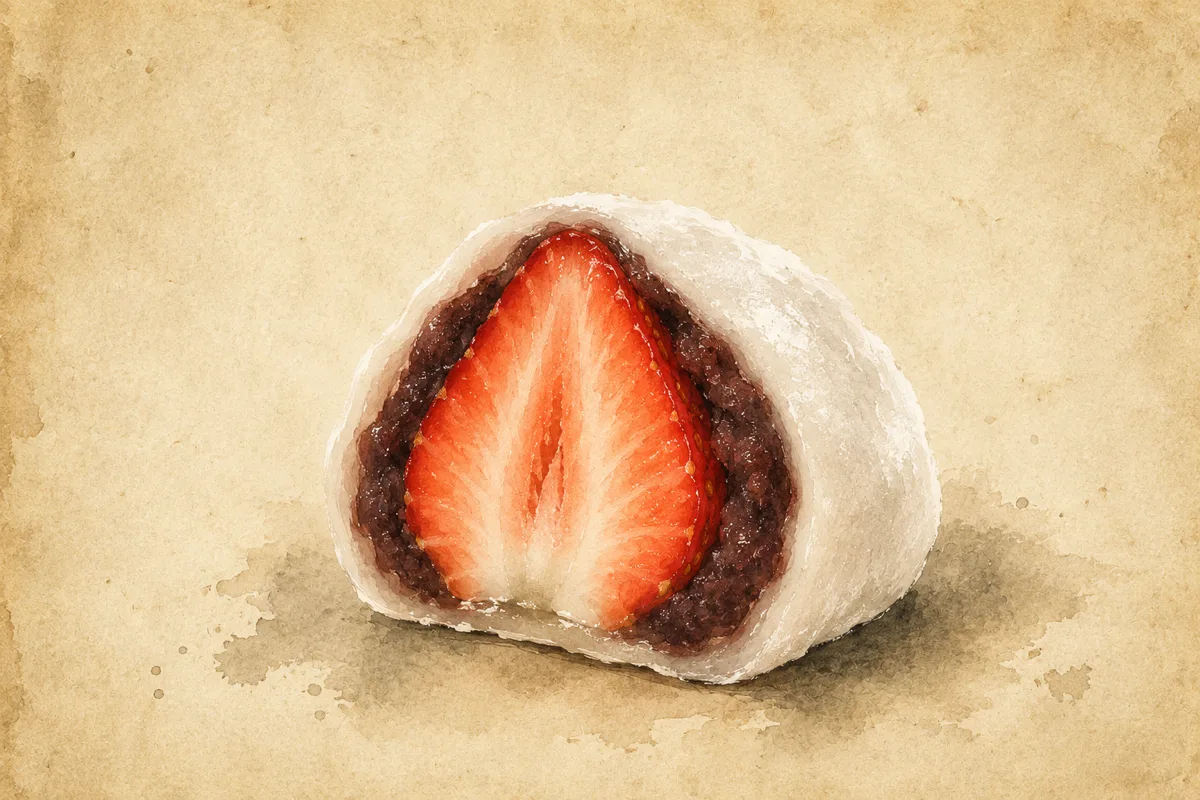
Strawberry mochi looks timeless: a whole berry in a ring of dark bean paste, wrapped in pale round mochi, a sweet a kimono-clad artisan might have made at the same teahouse for four hundred years. The strawberry version is younger than the fax machine.
Daifuku, the mochi-and-bean-paste sweet underneath, really is old. But dropping a whole fresh strawberry inside it is a 1980s idea, and its real inspiration wasn't a temple or a tea ceremony. It was Western strawberry shortcake.
First, what you're eating
Strawberry mochi is the English nickname for ichigo daifuku (いちご大福, literally "strawberry great-luck"). Strip away the berry and you have plain daifuku: a ball of soft, chewy mochi wrapped around a core of sweet red bean paste. Ichigo daifuku simply adds a whole fresh strawberry to that core, for three textures in one bite: chewy skin, sweet paste, tart juice.
So the confusion is understandable. The wrapper genuinely is a centuries-old wagashi. It's only the strawberry that's new.
Daifuku's Edo roots
Daifuku descends from a Muromachi-era sweet called uzura mochi ("quail mochi"), a big, filling ball of pounded rice around bean paste. Because it was large enough to fill your belly, it also got called daifuku mochi, but written with the character for belly (腹, fuku), not luck. Back then the paste was salted, not sweet; sugar was expensive.
The version we'd recognize appears in 1770s Edo. A woman remembered as Otama, in the Koishikawa district, started selling a smaller mochi filled with sugared bean paste, a sweet, hand-sized snack she called harabuto mochi. Since fuku meaning "belly" (腹) sounds identical to fuku meaning "luck" (福), the name got quietly upgraded to the auspicious daifuku (大福), "great luck." A sweet named after a full stomach became a sweet named after good fortune, purely because the two words rhyme. By the end of the 1700s, vendors were griddling them warm and selling them on the street. Daifuku was Edo fast food.
Over time the fillings branched: mame daifuku studded with salted red peas, salted daifuku, mugwort daifuku. All old, all traditional. None of them contain fruit.
1985: a shop chasing the future
The strawberry arrives about two hundred years later. The most widely credited origin is Osumi Tamaya, a Tokyo wagashi shop founded in 1912, whose third-generation owner Wahei Osumi released an "ichigo mame daifuku" around 1985.
The motive makes it memorable. Osumi had reportedly read a newspaper piece predicting that the age of Western pastry was ending and the age of wagashi was returning, and he went looking for a signature product. His inspiration was the thing Western pastry did best at the time: strawberry shortcake, then Japan's most beloved cake. Putting raw fruit inside a traditional sweet was, at the time, borderline heresy, and some customers found it off-putting. What Osumi made was a wagashi reverse-engineered from a European cake. The most "traditional-looking" sweet online is a piece of Japanese pastry doing an impression of a sponge cake.
Osumi Tamaya built it on their mame daifuku base: Miyagi miyakogane glutinous rice, salted red peas, smooth paste made from premium Hokkaido azuki, and a whole domestic strawberry. Television did the rest; the sweet is widely said to have hit the mainstream after a 1987 TV appearance, and by the bubble years it was everywhere.
Who really invented it? Nobody can say for sure
Honest history serves the reader better than a tidy origin story here. Osumi Tamaya is the most-credited originator, holds a production patent, and owns the "ichigo mame daifuku" trademark, but it is not the only claimant. A shop called Ichifuji, in Tokyo's Itabashi ward, filed a utility-model registration for strawberry daifuku in 1986. Others across Japan also claim to be first: a shop in Tsu (Mie), one in Maebashi (Gunma), one in Osaka. The likeliest truth is that "put a strawberry in a daifuku" occurred to several makers around the same moment, because the idea was in the air along with the strawberry shortcake it copied. A 1980s invention, several plausible parents, no single genius. That ambiguity is the accurate answer, not a cop-out.
The bean paste is a real decision
The design challenge of ichigo daifuku is that a ripe strawberry is loud and the mochi and paste are quiet. Get it wrong and the berry bulldozes everything. Makers solve it two ways, and you can taste which one you've got.
Koshian, smooth red bean paste, makes a dark ring against the red berry and is often pushed slightly sweeter and stronger so it can stand up to the fruit's acidity and keep the strawberry a partner rather than a soloist. Shiroan, pale white-bean paste, goes the other way: milder and lighter, it lets the strawberry's tartness and its bright red cross-section come through unmuddied. Neither is more correct; they're two philosophies about how much spotlight the berry gets.
Strawberries are a winter sweet here
Strawberry mochi reads like a spring or summer treat. Not really: Japanese strawberries peak from December to March, a winter fruit grown in heated, lit greenhouses that force the spring crop early. The reason is Christmas cake. The strawberry-shortcake-on-Christmas-Eve custom created enormous cold-season demand for berries, and greenhouse growers rearranged the calendar to meet it.
So the loop closes. Ichigo daifuku is a winter-to-early-spring sweet, eaten from New Year through Hina-matsuri in March. Its parent is strawberry shortcake. And the very reason strawberries are available in a Japanese winter at all is also strawberry shortcake, via Christmas. The "ancient" sweet, its inspiration, and its off-season fruit all trace back to the same modern, Western-influenced dessert culture.
None of which makes it less delicious, or less Japanese. It makes it a good reminder that wagashi isn't a sealed museum. It's a living craft that saw a strawberry shortcake, thought we can do that with mochi, and turned out to be right.