
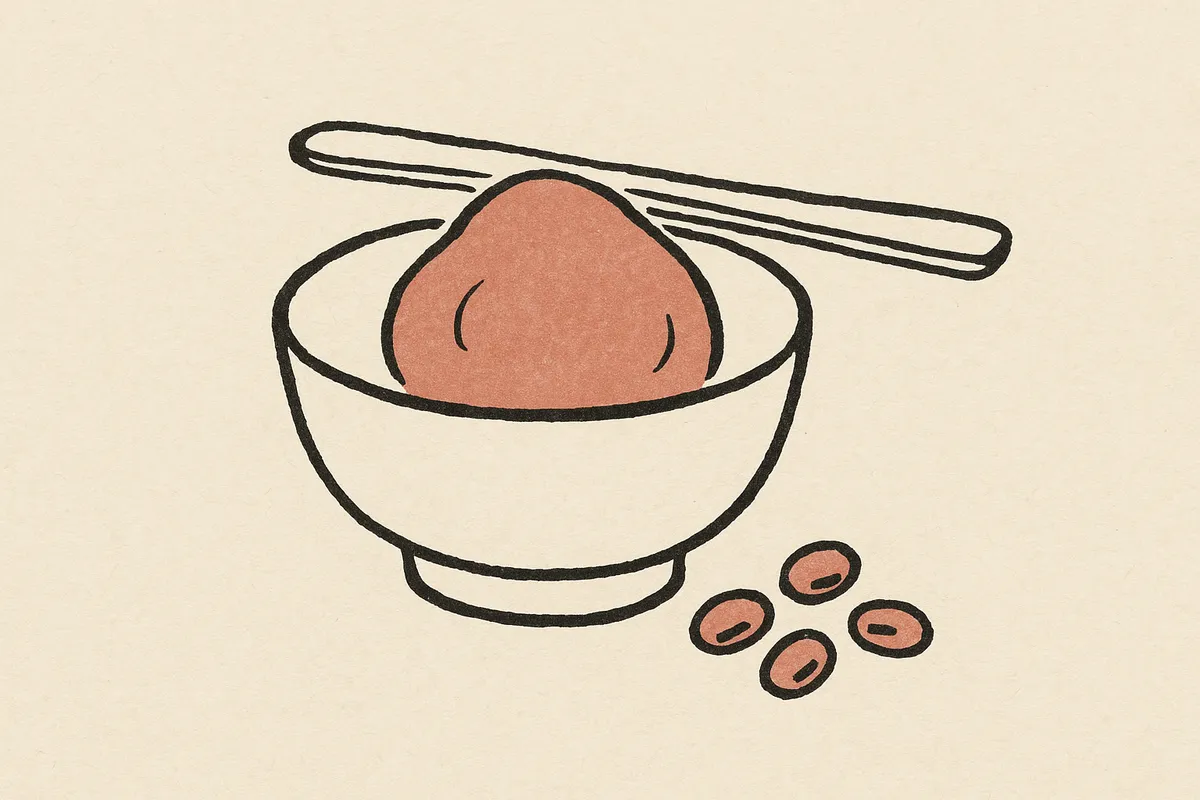
Anko (餡) is the sweet bean paste at the base of most Japanese sweets. Inside a daifuku, a dorayaki, or a manju is the same dense, faintly glossy paste the color of dark chocolate, and on the first taste it turns out to be sweet beans. The filling is beans, and the beans are dessert. Anko is the single ingredient nearly every wagashi is built around, so it underpins the whole craft.
At its core anko is just beans and sugar, plus a pinch of salt. The beans, almost always azuki (the small red adzuki bean), are boiled until soft, mashed, and simmered down with sugar into a thick paste. That's it. The reason it works as a sweet, where a can of sugared kidney beans would not, is in the bean itself. Azuki is starchy rather than oily, and when it boils, each cooked-and-crushed cell holds together as a tiny particle. The sugar sweetens the water around those particles instead of dissolving them, so the paste tastes like "sweet beans" with a clean, grainy body, not a purée. Azuki matters enough in Japan to be the second-most-eaten legume after the soybean, grown mostly in Hokkaido; its sweet paste is roughly what chocolate is to Western confection.
How a bean became dessert
The answer is historical. The word an didn't start out sweet. It came from China as a savory filling, a stuffing of meat and vegetables for steamed buns. What turned it toward beans was religion: Buddhism's prohibition on eating meat pushed Japanese monks and cooks to fill their buns with beans instead of flesh. Only later, as sugar slowly became available, did the bean filling get sweetened. For most of that history sugar was a luxury, treated closer to medicine than to a pantry staple, and it took the Edo period (1603–1868), when Dutch traders were importing sugar regularly, for sweet anko to become something ordinary people could afford. So Japan's iconic sweet filling is a bean for reasons that are half religious rule and half trade history, not a matter of taste.
That history also explains a flavor Western eaters often notice: wagashi are less sweet than the desserts they're used to. The paste is meant to taste of the bean, and, especially in the tea ceremony, to balance the bitterness of matcha rather than bury it. This is also why there is a pinch of salt. A little salt near the end of cooking suppresses bitterness and lifts the bean's natural sweetness, so a shop can use less sugar for the same effect. You salt anko to make it taste sweeter.
Tsubuan, koshian, and what happens to the skin
When a recipe or a menu makes you choose "koshian or tsubuan," it's asking how much of the bean's skin and shape you want left in. Texture, color, and which sweet it belongs in all follow from that. The main types:
| Type | What it is | Texture | You'll find it in |
|---|---|---|---|
| Tsubuan (粒餡) | Whole beans boiled with sugar, left intact | Chunky, rustic, deep red | Daifuku, dorayaki, taiyaki |
| Tsubushian (潰し餡) | Mashed after boiling, skins left on | Semi-smooth middle ground | Everyday home-style sweets |
| Koshian (漉し餡) | Sieved to remove the skins, then sweetened | Silky, uniform, lighter | Manju, fine jonamagashi |
| Ogura-an (小倉餡) | Smooth koshian studded with whole Dainagon beans | Silk with intact glossy beans | Monaka, Ogura toast |
| Shiroan (白餡) | Made from white beans, not azuki | Pale, mild, always smooth | Nerikiri, flavored fillings |
The paste's dark red comes from the husk, so sieving the skins out for koshian also lightens the color; smooth and pale signals the more refined, higher-grade paste, and fine sweets lean on it. Tsubuan keeps a coarser bite and a hearty depth. Ogura-an blends koshian with whole Dainagon azuki, the premium grade prized for a skin that famously doesn't split when cooked. (The name plays on a court rank so senior it was, the story goes, exempt from ritual beheading, a bean that "keeps its head.") Its most everyday form is Ogura toast, buttered toast under a heap of anko, a Nagoya specialty.
The odd one out is shiroan, which trips up most English sources. It's white bean paste, but made from white beans, not azuki, usually white kidney-bean varieties like tebo or shiro-ingen. Because it's pale and neutral, shiroan is the canvas the delicate sweets start from: tinted and flavored, it becomes matcha-an, sakura-an, and the hand-sculpted seasonal nerikiri. If you see a pastel sweet, you're almost certainly looking at shiroan, not azuki.
How it's made
The gap between home anko and a wagashi shop's is four moves a recipe tends to gloss. First, shibukiri (渋切り): bring the beans to a boil and then throw the first water away to cut the astringency. Shops repeat this one to three or more times: more repeats mean a cleaner, paler, milder paste, fewer mean deeper flavor and color. Then a slow simmer, 60 to 90 minutes, until a bean crushes easily between your fingers. Only after the beans are soft does the sugar go in, in stages; added too early, it stops the beans from softening. The classic ratio is about 1:1 sugar to beans by weight. Finally comes neri (煉り), cooking the sweetened mash down while stirring until you can drag a spatula across the pot bottom and the exposed line holds for a beat. That line is the endpoint, judged by feel rather than temperature, and reading it is the skill. It's said to take a cook a decade to master anko.
One last detail shows how deeply the bean runs through these sweets. Botamochi and ohagi are the same rice-and-anko sweet under two names, peony for spring and bush clover for autumn, offered to ancestors at the equinox. Traditionally autumn ohagi uses chunky tsubuan and spring botamochi uses smooth koshian, and the reason is the bean: freshly harvested autumn azuki has tender skins you can leave in, while by spring the stored beans' skins have toughened and get strained out. The season is literally inside the ingredient. Once you notice it, the same paste of sweetened beans, azuki and sugar strained smooth or left whole, sits inside nearly every wagashi you'll meet.