
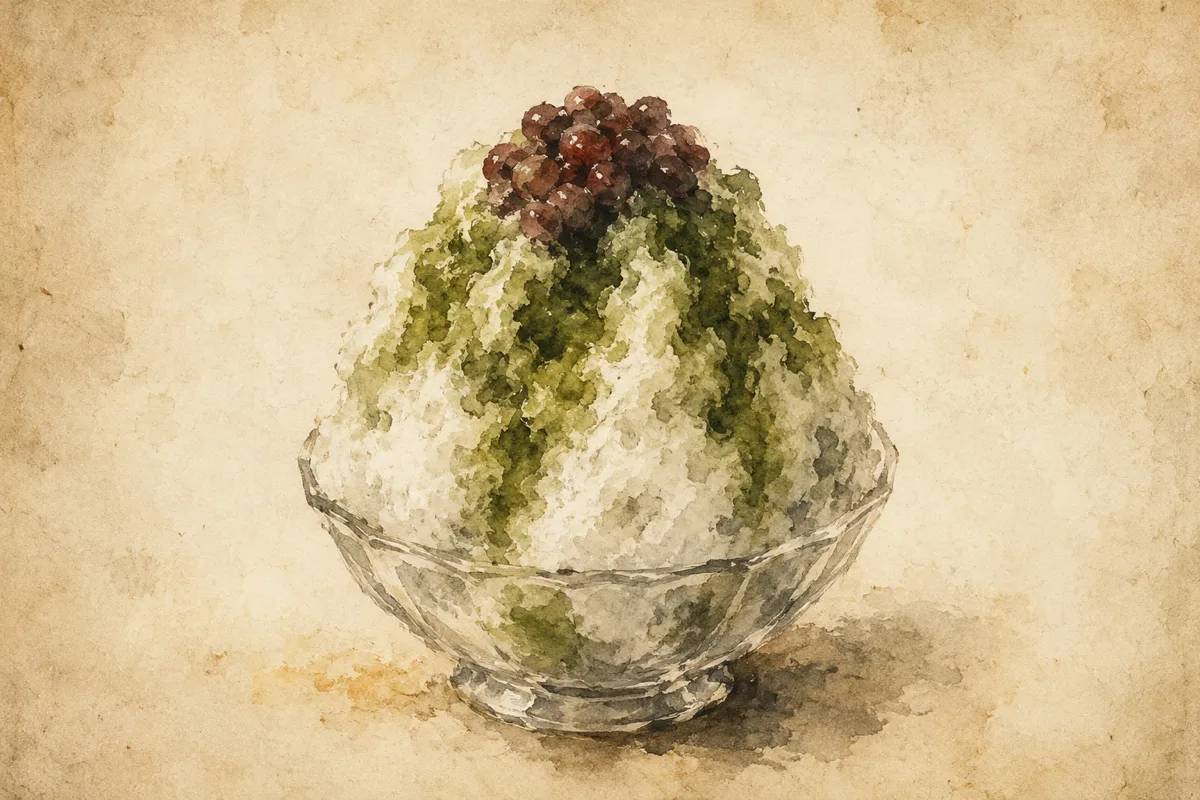
Most people meet it in a photograph first: a bowl heaped impossibly high with ice, so soft it looks piped rather than scooped, maybe crowned with green matcha syrup and a spill of red beans. It does not look like the shaved ice you grew up with. It is not a snow cone. It is kakigōri, and two facts explain almost everything interesting about it. One is about physics. The other is about a woman writing a thousand years ago.
It's shaved, not crushed
Start with the tongue. Bite a snow cone and you get hard little pellets that crunch, stay stubbornly cold, and, if you leave the cup a while, fuse back into one solid lump. Kakigōri does none of that: it collapses. It melts the instant it touches your mouth and folds into the syrup instead of fighting it. Because the flakes melt on contact rather than sitting icy in your mouth, you can eat kakigōri fast without the sharp headache that crushed ice brings on.
That texture is engineered, and it starts with the blade. A kakigōri machine works, as Nippon.com nicely puts it, "somewhat like a carpenter's plane": a thin steel blade set against a spinning block of ice, peeling off slivers rather than smashing them. Old shops still do it by hand crank. The finer and thinner the shaving, the more it behaves like fresh powder snow.
But the blade is only half of it. The other half is the ice itself. Look closely at the block in a serious kakigōri shop and you'll notice it is glass-clear, not the cloudy white of a home freezer. Cloudy ice is full of trapped air bubbles and small, disordered crystals; it shatters into coarse grit. Clear, dense ice is made of larger, cleaner crystals, and a large crystal gives the blade a smooth surface to peel, so the flakes come off thinner and more even. Clear ice melts; cloudy ice crunches.
A dessert from the Heian court
Now the older fact. Shaved ice in Japan is no modern craze; it is one of the oldest recorded desserts we know of. Around the year 1002, a court lady named Sei Shōnagon, who served the empress consort Teishi, finished a book of lists and observations we now call The Pillow Book (Makura no Sōshi). In a passage on "elegant things," she describes shaved ice, kezurihi, dressed with a sweet syrup called amazura and served in a new metal bowl.
This is no legend. It is a written, first-hand note by a specific person, and it is why kakigōri can fairly claim a thousand-plus years of history. Amazura was a sweetener boiled down from vine sap, one of Japan's old sugars from the age before refined sugar arrived. And the ice was the real luxury: in a world with no freezers, ice was cut in winter and buried in insulated pits called himuro, "ice houses," to survive until summer. A bowl of shaved ice was something only the court could afford: a small, cold miracle of storage and status.
It stayed that way for centuries. Kakigōri only reached ordinary people in the Meiji era, once ice became a commodity: the first shop selling syrup-topped shaved ice opened in 1869 on Bashamichi, a street in Yokohama. In 1887 an ice merchant named Murakami Hanzaburō patented an ice-shaving machine, and by the early 20th century the crank machine had spread across the country. (Japan even keeps July 25 as "kakigōri day.")
Natural ice, and the flavors to know
The Heian instinct, that the ice is the point, survives in one small, stubborn corner of the craft: natural ice, tennen-gōri. Instead of a freezer, makers draw mountain spring water into shallow stone-lined ponds in the dead of winter and let it freeze in the open air, roughly a centimeter a day, layer over layer, over the coldest weeks. Frozen slowly like this, the block turns out extraordinarily clear and hard. One Nikkō maker describes seeing distinct layers in the cut face, "one day, one layer at a time." The finished ice is sawn out by hand and stored in a himuro under a blanket of sawdust, no refrigeration at all.
Almost nobody does this anymore. By recent counts only five natural-ice makers remain in all of Japan: three of them in Nikkō, in Tochigi, and the others around Chichibu and Karuizawa. Shops that serve their ice tend to draw summer queues for a single bowl.
As for what goes on top, the flavors map the country and the calendar. The classics are simple: strawberry, melon, lemon, or plain mizore with clear syrup. The standout is Uji kintoki: matcha syrup over the ice, sweet azuki paste, chewy shiratama dumplings, often a pour of condensed milk. "Uji" is the celebrated tea district near Kyoto and "kintoki" is the red-bean topping; despite the name, the matcha needn't actually be from Uji. If you want to understand why matcha and red bean anchor so many Japanese sweets, it helps to know a little about what anko really is and about the tea regions that gave Uji its name.
The next time a mountain of soft ice arrives at your table, you'll know what you're looking at: a thin blade, a block of unusually clear ice, and a habit the Japanese court has kept, in one form or another, since the summer Sei Shōnagon thought it elegant enough to write down. It is, in the fullest sense, a sweet for the season.