
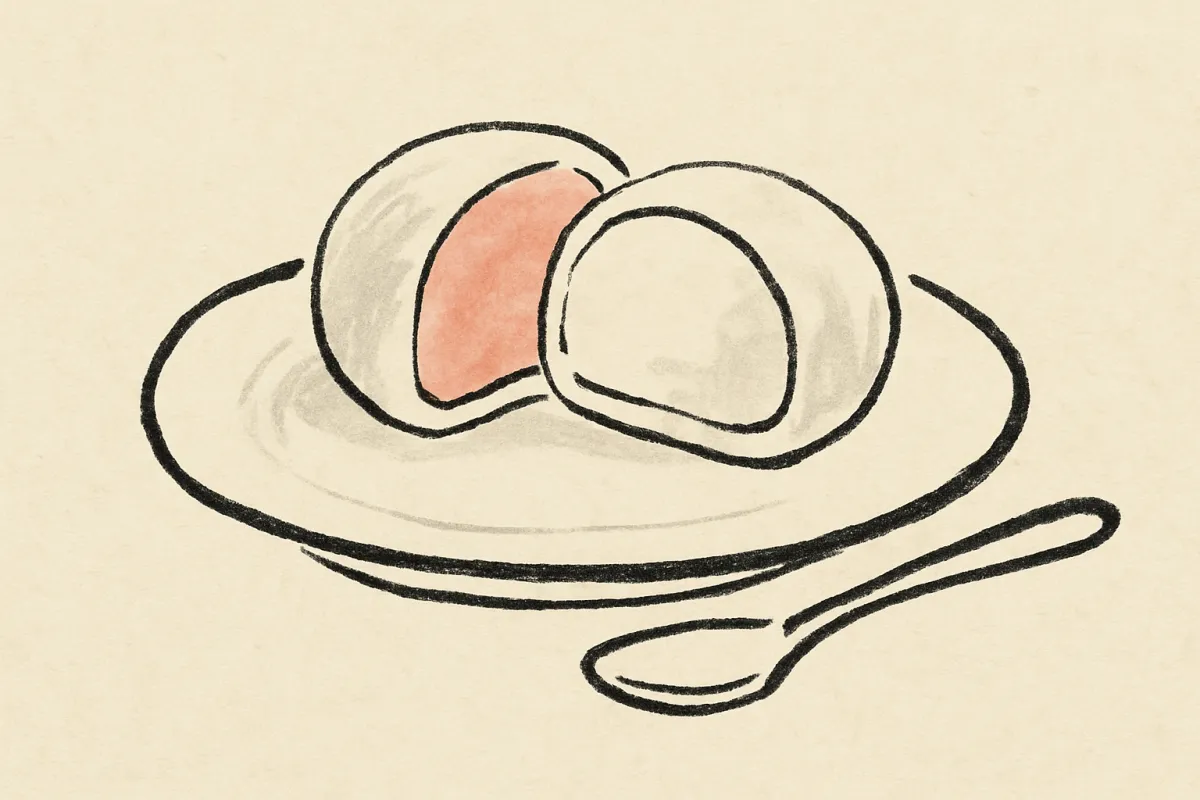
Mochi ice cream from the supermarket freezer raises a small question: is this actually Japanese, or did someone invent it in America? The answer is both, in a precise, dateable way. It's Japanese by birth, but the version on a US shelf is the product of a second story that happened in Los Angeles.
The roots: it's a frozen daifuku
Start with the part that's unambiguously Japanese. Long before any freezer was involved, there was daifuku (大福), a round of soft mochi wrapped around a sweet filling, classically anko, sweetened red-bean paste. That soft-skin-around-a-soft-center structure is centuries old. Mochi ice cream is that exact idea with one substitution: take out the bean paste, put in a scoop of ice cream. The concept of mochi wrapping a filling is traditional wagashi. Only the cold center is new.
So when someone says mochi ice cream "isn't real Japanese food," they're half right and half wrong. The wrapper-and-filling form is real and old; the frozen filling is a modern idea. And that modern idea, it turns out, was also Japanese.
Chapter one: Lotte invents it in Japan, 1981
The ice-cream version came from a food conglomerate, not an artisan. Lotte launched Yukimi Daifuku (雪見だいふく, "snow-viewing daifuku") in Japan in October 1981, the country's first domestically made mochi ice cream. A year before, in 1980, Lotte had sold Watabōshi, a bite-size ice cream wrapped not in mochi but in marshmallow. Marshmallow lost. Mochi was more popular in Japan, but it only won once Lotte solved a genuinely hard engineering problem.
That problem is the one every home cook hits: mochi goes hard when it's cold. Plain pounded mochi stales within a day and turns brittle in the fridge, let alone the freezer. Lotte spent until 1981 perfecting a way to keep mochi soft at freezing temperature, and that solution defines the product. The wrapper on mochi ice cream isn't pounded rice cake at all. It's a gyūhi-style dough made from glutinous-rice flour cooked with sugar, and the sugar acts as a humectant that holds moisture so the skin stays pliable below freezing. (Reportedly a fine flour called habutae-ko, in small batches to keep the stretch.) It's the same trick that lets a soft daifuku stay soft for days: most "mochi" sweets are cooked from rice flour, not pounded. Lotte even pitched Yukimi Daifuku as ice cream to eat indoors in a warm room in winter, inverting the summer-only ice-cream habit now that Japanese homes had heating.
Chapter two: Frances Hashimoto brings it to America, 1993
The mochi ice cream in a US supermarket comes from a separate origin about a decade later. Mikawaya was a Japanese sweets shop founded in 1910 in Little Tokyo, Los Angeles. By 1970 it was run by Frances Hashimoto, a Japanese-American woman who had been born in the Poston internment camp during World War II, earned a USC degree, and taught third grade before taking over the family business at age 27.
In the early 1990s her husband, Joel Friedman, had the idea of coating balls of ice cream in a thin skin of sweet mochi. Hashimoto turned the idea into a product, introducing mochi ice cream to American consumers around 1993 and test-marketing it in Honolulu in 1994 with flavors like strawberry, mango, vanilla, green tea, and coffee. It was an immediate hit, reportedly taking about 15% of the novelty frozen-treat market in its first four months, and spread to Trader Joe's, Whole Foods, Ralphs, Safeway, and beyond. (Mikawaya's later mass-market brand is My/Mochi.) Hashimoto wasn't only a dessert entrepreneur; she led the Little Tokyo Business Association from 1994 to 2008. She died of lung cancer in 2012.
Two clarifications. Lotte, not Mikawaya, made the first ice-cream-filled mochi, so calling Hashimoto "the inventor" over-flattens a ten-year, one-ocean gap. And within Mikawaya, Joel Friedman is credited with the idea and Frances Hashimoto with realizing and championing it. The fairest description: Lotte invented it in Japan; Hashimoto made it American.
So, is it Japanese?
Yes, with an asterisk. The lineage is Japanese (daifuku). The invention is Japanese (Lotte, 1981). And the supermarket form you bought was shaped by a Japanese-American who scaled it in Los Angeles (Mikawaya, 1993). Nothing about it is a fake "traditional" sweet, and nothing about it is a purely American knockoff. It's Japanese-born, then re-made and spread by the Japanese diaspora: two parallel origins that meet in your freezer.
If the cold version hooked you, the room-temperature original is right next door. A real daifuku, that same soft mochi skin around anko instead of ice cream, is where it all started, one stop on a much larger map of wagashi.