
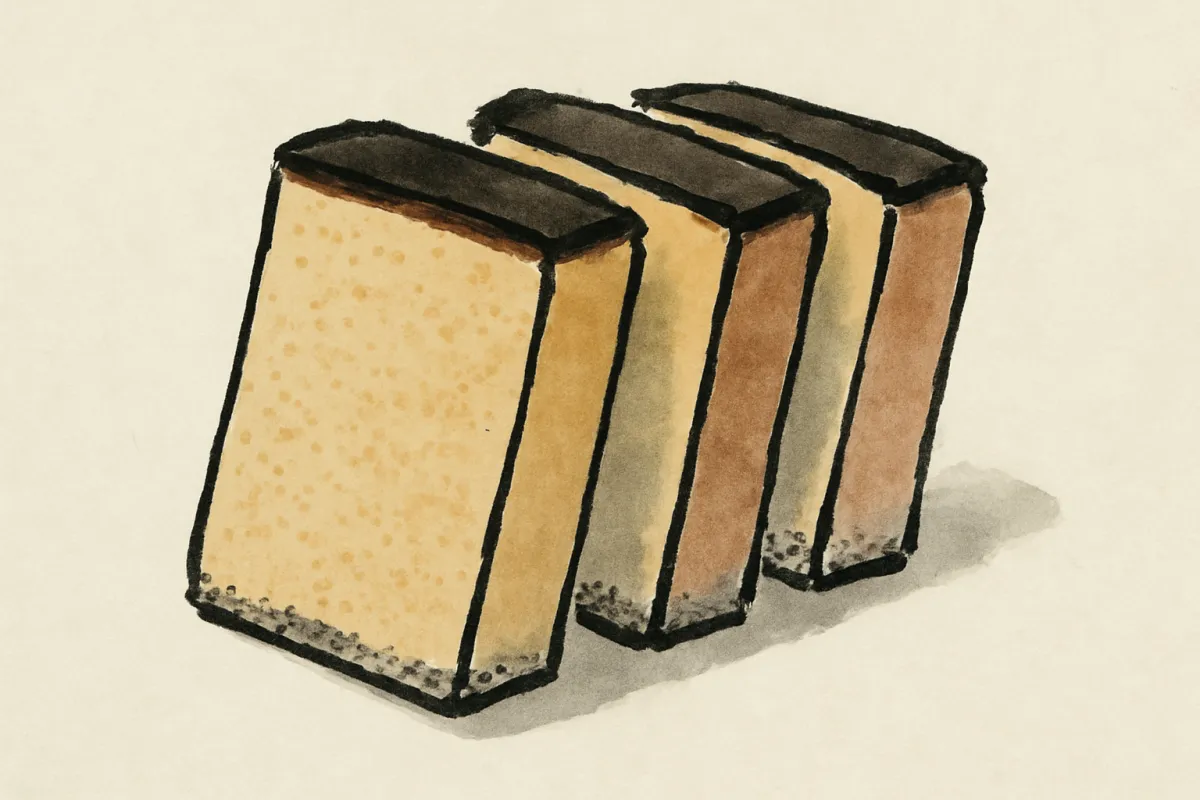
You've probably met it without knowing its story: a moist, honey-gold square of sponge, fine-grained and faintly damp, sold in a long box with a scatter of sugar crystals crunching along the bottom. It tastes like the most Japanese thing imaginable, a fixture of souvenir counters and the three-o'clock tea break. Yet castella is Portuguese. It arrived in Nagasaki in the 16th century, its name is a Japanese rendering of the Portuguese Bolo de Castela ("cake from Castile"), and its nearest living cousin is the Portuguese sponge pão de ló. What made it Japanese was four centuries of steady subtraction, of things Japan gradually took out.
A cake from Castile, carried by ship
Castella came in with the nanban-gashi (南蛮菓子, "southern-barbarian sweets"), the confections Portuguese and Spanish traders introduced through the Nanban trade at Nagasaki, alongside konpeitō and a handful of other sugar novelties. In the 1500s that was radical stuff: sweets built on wheat flour, eggs, and above all refined sugar, which entered Japan as a rare imported near-medicine. A cake this sweet was a prestige object, not a snack.
The name is the giveaway. Bolo de Castela means "cake from Castile," the north-central kingdom of Spain, and castella is simply Japan's branch of the wide European sponge-cake family: the same tree that gives Italy pan di Spagna ("bread of Spain") and Portugal pão de ló. (You'll also hear a charming folk story that the name comes from bakers shouting "castelo!" (castle) as they beat the egg foam into tall peaks. It's repeated everywhere but unproven; the Castile derivation is the solid one.) One practical virtue explains why it traveled at all: castella kept for months at sea, so it spread inland once it landed.
What makes it "Japanese" is subtraction
Modern Western sponge and pound cakes lean on butter for richness and moisture. Castella predates that convention in Japan and never adopted it. It has four ingredients: eggs, sugar, flour, and a syrup (mizuame, usually with honey), and, pointedly, three absences: no butter, no dairy or oil, and no baking powder or soda. The rise comes entirely from a whipped-egg foam that quadruples in volume; the flour is folded in gently so the trapped air, not a leavener, does the lifting.
That signature damp, tender crumb, with no fat in the batter, comes from syrup. Honey and mizuame (水飴, "water candy," a thick clear starch syrup) are hygroscopic: they grab and hold water, locking in a supple, almost wet crumb that resists going stale. A European sponge tends to dry out; castella stays moist. That damp crumb is Japan's own addition to the recipe.
The counter-intuitive part is the flour. Authentic castella uses strong bread flour, not cake flour. The higher gluten gives the cake an elastic, bouncy, faintly chewy pull, unlike a crumbly Victoria sponge. This is also the cleanest line separating Japanese castella from the modern "Taiwanese castella," a jigglier, oil-added, cake-flour cake baked in a water bath that borrows the name for a lighter, wobblier thing entirely. And that gritty crust on the base? Real sugar: zarame (coarse sugar) sown on the pan bottom, which sinks and partly survives the bake to leave a crunchy sweet floor. It's a defining mark of Nagasaki castella.
Whipped by hand, and meant to be aged
Two old hand skills still define the good stuff. Betsu-date (別立て, "separate beating") whips the whites and yolks apart, meringue-style, for a finer, more uniform crumb than beating whole eggs. Awakiri (泡切り, "bubble cutting") means stirring and cutting the batter with a spatula in the first minutes of baking to pop oversized bubbles and even the heat, so the cake rises flat and fine without cracks or holes. Traditional Nagasaki bakers used charcoal kilns and ran bamboo picks through the batter to chase out air pockets.
Then comes the least intuitive instruction of all: castella is not meant to be eaten fresh. It's deliberately rested, wrapped and left a day or more after baking, so the crumb settles into its fine, moist, melting texture. A home recipe (per small loaf: 100 g bread flour, 3 eggs, 100 g sugar, honey, a spoon of mizuame, a scatter of zarame) bakes at around 180°C, then gets wrapped and chilled overnight before it's at its best. It's a cake engineered for patience.
The houses that kept the cake
The most Japanese thing about castella may be its makers. Nagasaki's castella houses are startlingly old and still trading. Fukusaya (福砂屋) dates to 1624 and trademarks itself Castella Honke ("the originator"), still baking entirely by hand, one artisan cracking, whipping, mixing, and baking a whole batch, its logo a Chinese good-luck bat. Shooken followed in 1681, Iwanaga Baijuken in 1830, and Bunmeidō in 1900, the house that turned a regional souvenir into a national teatime staple after the war, on the back of a can-can-dancing-bears TV jingle that nearly everyone in Japan can still sing: "Kasutera ichiban, denwa wa niban…" ("Castella is No. 1, the telephone is No. 2, and the three-o'clock snack is Bunmeidō").
And there is a deeper paradox here. The Portuguese who brought it were expelled: Christianity was banned, the traders barred by 1639, the country sealed. The missionaries were gone; the cake stayed, and Japan kept it. Over four centuries it married the local pantry so thoroughly that a Taishō-era hybrid called "Siberia" (two slabs of castella sandwiching a layer of yōkan, the firm azuki-bean jelly) folds this Portuguese sponge straight into Japan's own red-bean tradition. That's the real lesson hiding in a souvenir box: wagashi is not a sealed set of ancient recipes; it's a living culture that absorbs, subtracts, and naturalizes. You can still taste that history in a slab of Fukusaya, cracked, whipped, and baked by a single pair of hands as it has been since 1624.