
You've seen it stretch: a glossy white blob pulled into long ropes, the pillowy dough around a strawberry, the block on a New Year grill that puffs up like a balloon. Mochi looks engineered, a texture you'd expect from gums and stabilizers. Yet classic mochi is made of one ingredient: rice. No flour, no gelatin, no additive, just a special glutinous rice, steamed and pounded until it becomes a single elastic body. Where anko is the sweet paste at the center of wagashi, mochi (餅) is the chewy body around it, the material behind daifuku, kusamochi, sakuramochi, the New Year soup, and the stacked altar cake. It is the other half of the craft.
How one ingredient stretches like that
The rice is mochigome (もち米), a short-grain glutinous rice. It isn't a different plant from ordinary Japanese rice (both are Oryza sativa japonica), but it's a waxy variant with a completely different starch make-up. That single difference is why it's so chewy.
Rice starch comes in two molecules: amylose, which forms long straight chains, and amylopectin, which forms big, highly branched chains. Ordinary table rice (uruchimai) runs about 16–20% amylose; glutinous mochigome is roughly 99% amylopectin with under 2% amylose, effectively none. Amylose makes cooked grains stay firm and fall apart into separate kernels. With it nearly absent, the branched amylopectin swells, traps water, and tangles into a cohesive, elastic network instead of setting up firm, so the rice cooks into one sticky mass and pounds into a smooth, stretchable body. You can even see it dry: mochigome grains are opaque white, while table rice is faintly translucent. This is also why you can't fake mochi with sushi rice: the amylose won't allow it.
"Glutinous" does not mean "gluten": the word is from the Latin for glue-like and describes the stickiness. Rice contains no gluten whatsoever, so plain mochi is naturally gluten-free. One more quirk explains a lot downstream: amylose-poor starch still eventually firms up, so plain pounded mochi goes hard within a day, the same staling chemistry that turns day-old rice dry.
The pounding, and why it belongs to New Year
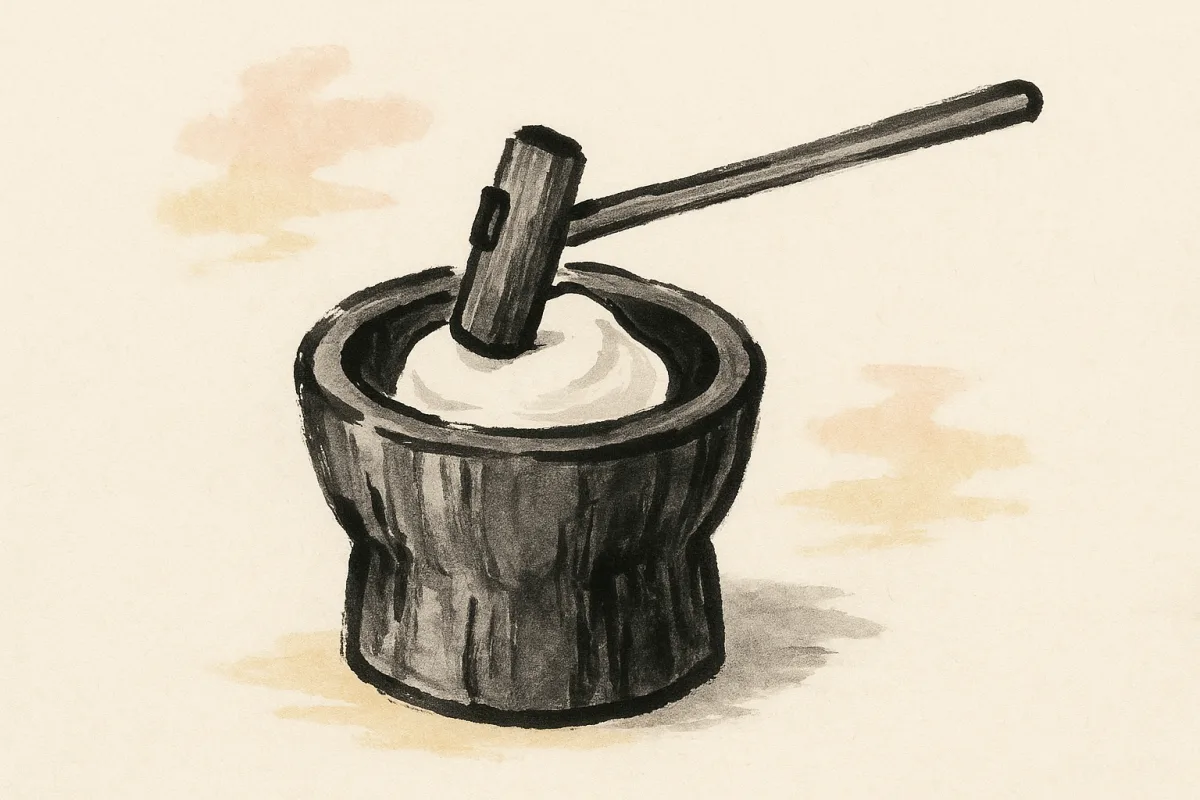
Making true mochi is mochitsuki (餅つき), a ceremony as much as a cooking step. Glutinous rice is soaked overnight, steamed, then pounded while hot in a heavy mortar, the usu (臼), with a long wooden mallet, the kine (杵). Crucially it's a two-person job: one person swings the kine down, and a partner darts a wet hand in between strikes to fold and turn the mass so it pounds evenly. The rhythm is the safety system, not decoration. Miss a beat and you put a hand under a descending mallet. That call-and-response tempo is why mochitsuki became a communal village-and-temple event rather than a private chore.
It carries the whole weight of the Japanese New Year. Some of the mochi is shaped into kagami mochi (鏡餅), two round cakes stacked small-on-large, topped with a daidai bitter orange, and set on the household altar as the resting seat of the toshigami, the deity of the incoming year. The name means "mirror mochi," after the round bronze mirrors that are sacred Shinto objects, and the custom is recorded from the Muromachi period (14th–16th c.). When it's finally eaten in January, the ritual is called kagami biraki, "opening the mirror." You break it by hand or mallet, never cut it with a knife: a blade would summon the imagery of seppuku and of severing the year's fortune. The taboo runs deep enough that judo's founder, Kanō Jigorō, folded kagami biraki into the dojo in 1884; martial-arts schools still "open the mirror" every January.
One name, many things, and much of it isn't pounded
"Mochi" covers a whole family. Plain pounded blocks are cut into rectangles (kirimochi) or rolled into rounds (marumochi) and grilled until they puff, or dropped into zōni, the New Year soup. There's a real regional fault line here: western Japan favors round hand-formed mochi, eastern Japan favors cut squares, and it shows up in the soup bowl, round-boiled-in-white-miso in the Kansai west versus square-grilled-in-dashi in the Kantō east. Then come the confections: daifuku (mochi stuffed with anko), the herbal green kusamochi and the leaf-wrapped seasonal sweets.
Not everything called "mochi" is pounded rice. There are two roads to a mochi texture: pound whole steamed mochigome, or hydrate and cook rice flour. Much of what you eat takes the flour road, and which flour is used is precisely what tells one sweet from another:
| Route / flour | Rice | How it's made | Texture | Shows up in |
|---|---|---|---|---|
| Pounded mochi | Glutinous (whole) | Steamed, then pounded | The true stretchy cake | Kirimochi, zōni, kagami mochi |
| Mochiko (餅粉) | Glutinous | Dry-milled fine flour | Doughy | Daifuku, mochi ice cream, dango |
| Shiratamako (白玉粉) | Glutinous | Wet-milled coarse granules | Springy, smooth | Shiratama dango, daifuku |
| Joshinko (上新粉) | Non-glutinous | Dry-milled | Firmer, chewy bite | Dango, kashiwamochi, kusamochi |
| Domyojiko (道明寺粉) | Glutinous | Steamed, dried, cracked | Grainy, pebbly | Kansai-style sakuramochi |
| Gyūhi (求肥) | Rice flour + sugar + water | Cooked and kneaded | Stays soft for days | Mochi ice cream, daifuku, nerikiri |
Gyūhi solves the staling problem: adding sugar holds water in the starch as a humectant, so gyūhi stays soft and pliable for days, even soft when frozen, which is why it wraps mochi ice cream. It carries a great piece of etymology, too. Gyūhi arrived from China in the Heian period written 牛皮, "ox-hide" (early brown-sugar versions were brown and leather-like); as the Buddhist taboo on meat spread, the characters were swapped to the homophone 求肥 to strip the animal reference, the same savory-to-sweet Buddhist arc that renamed anko. Even sakuramochi proves the point: the eastern version is a thin pan-cooked crêpe (originally of wheat), the western a grainy domyoji shell: identical in name and season, opposite in starch, and neither one pounded.
The choking risk
Mochi's virtue is also its danger. The dense, clinging stickiness that makes it wonderful also makes it hard to swallow, and it is a real, recurring cause of death. A peer-reviewed study counted 52,366 food-choking deaths in Japan over 2006–2016, about 4,000 a year, on the same order as the national traffic toll. Rice cake is the single most-cited culprit, put at around a quarter (24.5%) of food chokings. The victims are overwhelmingly elderly (median age 82; nearly three-quarters aged 75+), and the deaths spike at New Year: the study logged 782, 611, and 502 deaths on January 1, 2, and 3, the exact days multi-generational households put large, hot, sticky pieces in front of the highest-risk eaters. Every New Year still brings the headlines; in early 2026, seven elderly people were hospitalized and one woman in her eighties died after choking on daifuku in the first three days of the year. None of this makes mochi something to avoid. It makes it something to respect. Cut it into small pieces, chew slowly and fully, wet the throat with tea or soup first, and never let the very old or very young eat it unwatched. It's a food staged as sacred, made of a single grain, and worth eating with the attention that implies.