
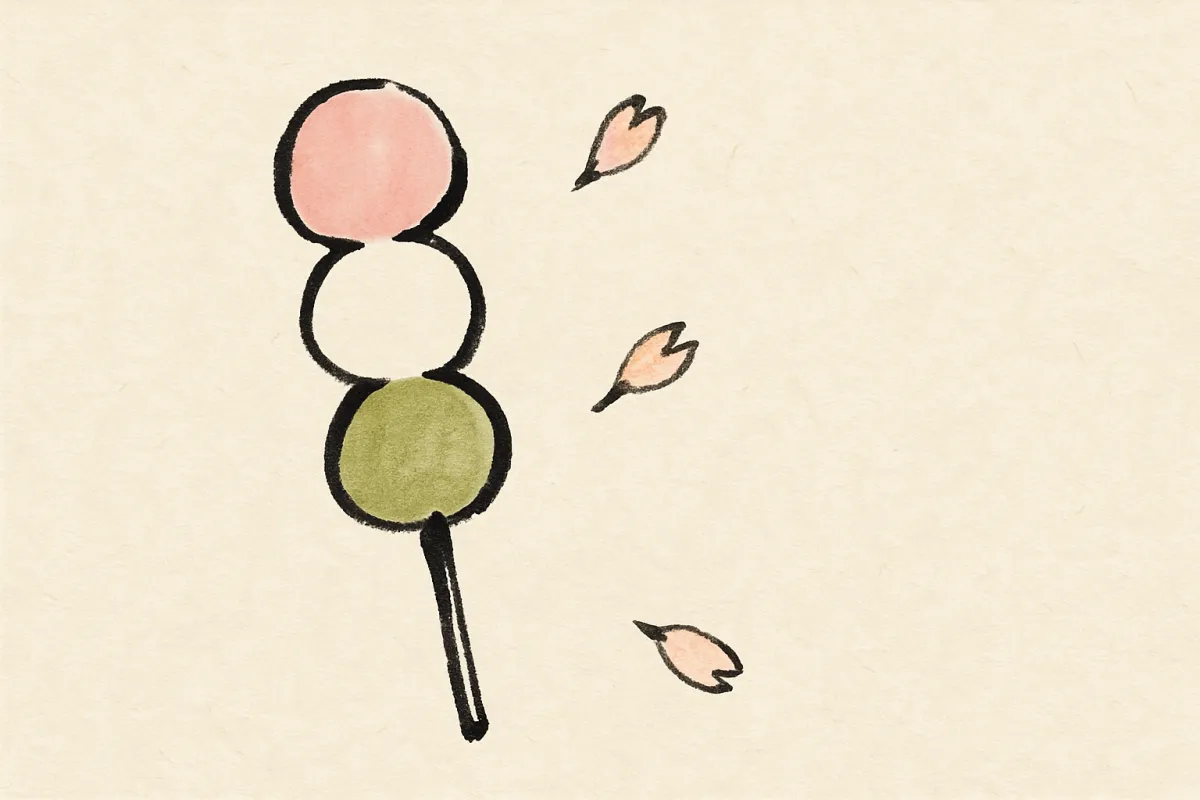
Dango is a small Japanese rice dumpling: rice flour mixed with hot water, kneaded, rolled into balls, and boiled until it floats, then usually skewered and glazed or grilled. It turns up on a bamboo stick in anime, as a pink-white-green trio in cherry-blossom photos, and glazed-and-grilled at festival stalls, and it looks enough like mochi that the first question is almost always the same: is this just mochi on a stick? No. Dango belongs to the same chewy-rice family, but a completely different process makes it. Once you see that difference, the whole skewer makes sense.
Dango vs mochi: pound the grain, or cook the flour
Mochi is whole steamed glutinous rice pounded into a single sticky mass. Dango is rice flour mixed with hot water, kneaded to the softness of an earlobe, rolled into balls, and boiled until they float, then often grilled. Same "chewy rice," two different starch technologies: pound the whole grain, or cook the milled flour.
That process gap changes the texture. Dango is usually made with joshinko (上新粉), a flour milled from non-glutinous rice, which carries a bit of amylose, the straight-chain starch that glutinous rice almost entirely lacks. So dango sets up firmer, less sticky, and able to hold a clean ball shape, and that lets it sit on a skewer without slumping. (Sometimes glutinous shiratamako is blended in for spring; the two flours together give bite plus a smooth chew. Which flour makes which sweet is its own story, and the reason not everything called "mochi" is pounded at all.) Because dango is firmer and less clingy than pounded mochi, it makes a gentler bite, though any sticky rice sweet still deserves care.
The skewer, and the coin that fixed it at four
Skewered grilled dumplings, kushi-dango (串団子), go back to the Muromachi period (1333–1568); the broader dango lineage descends from a Tang-dynasty sweet carried over centuries earlier. Traditionally a skewer held five balls. Today you'll count four in eastern Japan (Kantō) and five in the west (Kansai), and the split has a wonderfully specific cause.
In Edo-period Tokyo, a skewer carried five dumplings and sold for five mon, one mon per ball. Then in 1768, the chamberlain Tanuma Okitsugu commissioned a new brass four-mon coin (the Kan'ei Tsūhō, its reverse stamped with waves). Suddenly a single coin was worth four mon, and a five-ball skewer no longer matched a single coin in a crowded festival. The stopgap fix: eastern vendors dropped the skewer from five balls to four so one coin bought one skewer. That Kantō fix stuck; Kansai kept the older five. The four-dango skewer you see in Tokyo today is, quite literally, a frozen 18th-century currency reform.
Reading the three headline kinds
Mitarashi (みたらし) is the glossy, grilled, sweet-savory one: dango brushed with a glaze of soy sauce, sugar, and starch (kudzu or potato), then charred so it caramelizes. The name is the mitarashi (御手洗), the font of purifying water at a shrine entrance. It's tied to the Shimogamo area of Kyoto and its summer purification festival, where worshippers wade barefoot through the sacred pond. That's why the classic skewer sets one ball at the tip, a gap, then four below: one story says it mirrors the pond throwing up one bubble, then four more; another says the five dumplings imitate a body, a head plus four limbs. Both are folk explanations; take your pick. Either way, "mitarashi" now simply means that glaze.
Hanami / sanshoku dango (三色団子) is the three-color spring skewer, pink, white, green, eaten under the cherry blossoms. The colors are read two ways, both about spring: the cherry's life cycle (pink buds, white full bloom, green leaves after the petals drop), or the season's scenery (pink blossom, white lingering snow, green new shoots). Pink comes from sakura or dye, green from matcha or yomogi (mugwort). The custom is popularly credited to Toyotomi Hideyoshi, who is said to have served pretty, sweet dango at his lavish Daigo no Hanami blossom party in Kyoto in 1598. The attribution is soft, but the skewer became the taste of cherry-blossom season.
Tsukimi dango (月見団子) is the autumn one: plain round white dumplings stacked in a pyramid and offered to the harvest moon on jūgoya, the 15th night of the 8th lunar month, beside a spray of susuki (pampas grass). Regional split again: Kantō piles round white balls; Kansai shapes them like taro and wraps them in anko, an echo of an older custom of offering taro to the moon, which is even nicknamed the "taro moon."
Flowers, or the dumpling
Dango has quietly worked its way deep into the language. 花より団子 (hana yori dango), "dumplings rather than flowers," is the proverb for choosing substance over spectacle: at a blossom party, you care more about the food than the view. And the modern kibi dango of Okayama shows how these stories get built. Sold as the dumpling the folk hero Momotarō used to hire his dog, monkey, and pheasant, it's mostly a marketing tie forged from the 1890s rather than an ancient link, and the "kibi" (millet) name now trades on a pun with Kibi Province. The humble skewer even earned its own 🍡 emoji in 2010, drawn as the pink-white-green hanami trio.