
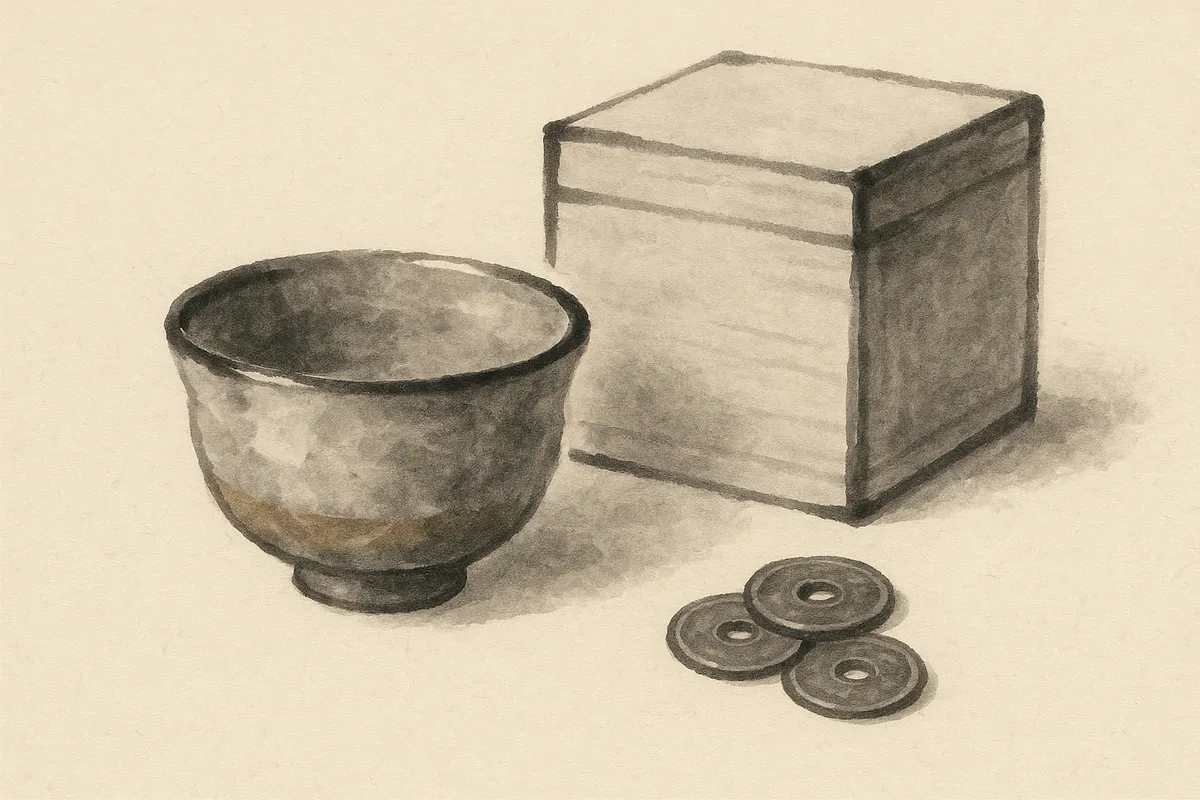
A plain tea bowl from a named potter can cost forty or fifty thousand yen. On the next shelf sits a machine-made cup in almost the same shape, with almost the same blue pattern, for a few hundred. Nothing about them explains the gap at a glance. That is why "why is Japanese pottery so expensive" is the question everyone asks before buying. The answer is not "fine craftsmanship" but five specific things, and once you can see them, you can decide which ones you actually want to pay for.
1. The hours of handwork
The first thing you buy is time. A handmade piece is thrown on the wheel (rokuro) or built by hand one at a time, dried, then trimmed, the foot and walls pared down with a metal blade, before it ever meets fire. Painted decoration is placed by brush, stroke by stroke. Depending on the ware, a single piece can absorb a few hours to several days of skilled labour. (The full sequence is laid out in how Japanese pottery is made.)
A factory removes those hours on purpose. The clearest example is slip casting: liquid clay is poured into a plaster mould, the plaster's capillary pull draws out the water, and a solid wall forms against the mould. One mould can turn out hundreds of identical pieces a day. That is what the cheap "same-looking" cup skips: not quality of idea, but human time.
Laid side by side, what the cheap piece leaves out is easy to see:
| Step | Mass-produced | Handmade / traditional |
|---|---|---|
| Forming | Slip-cast or machine-pressed in a mould, hundreds a day | Thrown or hand-built one at a time |
| Decoration | Printed transfer (doban tensha / decal) copies one design endlessly | Hand-painted by brush, each piece slightly different |
| Firing | Controlled electric or gas kiln, repeatable | Often wood-fired, days long, results vary |
| Typical result | Uniform, low cost, some porosity | Individual, higher cost, dense |
That blue-and-white pattern is the giveaway. Traditional underglaze blue (sometsuke) is drawn freehand with a cobalt brush; the mass-market version is a transfer print, a technique that has let makers copy a fine design onto a curved surface, handles and all, since the late nineteenth century. If the pattern is flawlessly identical piece to piece, a machine put it there.
2. Kiln loss and the one-of-a-kind
The second thing you pay for is risk. Much of the most valued pottery, including Bizen, Shigaraki, and Iga, is fired in a wood kiln that burns for two days, sometimes well over a week, burning a great deal of pine around the clock. Flying ash lands on the pots and, above about 1,200°C, melts into a natural glaze; where each piece stands in the kiln decides its surface. That variability is the appeal of these wares, but it also means the maker cannot control the outcome, and pieces come out of the kiln cracked, warped, or simply wrong. Those losses are real, and the survivors carry their cost. A wood-fired Bizen jar is priced as a single event that can't be repeated; a factory kiln's entire virtue is that piece two matches piece one.
3. The name on the box
The third factor is authorship, and it comes with two myths, both wrong. Japan formally certifies certain masters as Holders of an Important Intangible Cultural Property, the status the media nicknamed Living National Treasure (Ningen Kokuhō). The state pays each holder about ¥2 million a year; because the total budget has been fixed since 2002, only around 116 can hold the title at once, and a place opens only when one dies. The first craft designation went to the potter Hamada Shōji in 1955. That certification works as a credibility guarantee, and the name becomes a multiplier on price.
Authorship also travels in a box. A tomobako (共箱) is a paulownia-wood box signed and inscribed by the maker; for studio and tea wares, the pot and its box are considered complete only together, and the box is central evidence of provenance. But most shops won't say the obvious: a box alone guarantees neither authenticity nor value. The real test is to match the mark on the foot of the piece against the signature on the box, and even a genuine name does not make every one of that maker's pieces expensive, since condition, period, and exhibition history all move the number.
4. The stone and the ground
Fourth is the raw material. Porcelain is not made from ordinary clay but from crushed pottery stone, and Japan's supply is dominated by one source: Amakusa stone in Kumamoto, which accounts for roughly 80% of the country's porcelain-stone output and is unusual in that it sinters into porcelain almost unaided. Named clays and particular deposits carry their own cost and character, one reason stoneware and porcelain differ so much in both behaviour and price.
5. A culture that made vessels into art
The last factor is the least tangible and, arguably, the reason the other four command any premium at all. In the tea ceremony, over the generations of Murata Jukō, Takeno Jōō, and Sen no Rikyū, a whole aesthetic, wabi-sabi, was deliberately built around rough, plain, native wares as a rebuke to imported Chinese luxury. Tea treated the bowl as the centrepiece of an art form, not tableware. That inheritance is why, in Japan, a modest-looking tea bowl can outprice a flawless machine-made one without contradiction: the culture long ago decided a vessel could be a work of art.
What should you pay?
Match the spend to the purpose. For everyday use, a well-made stoneware or porcelain piece in the low thousands of yen is durable and honest, and the maker's name adds nothing here. For a gift, a hand-painted or wood-fired piece from a known workshop buys character the recipient can see. For collecting, pay for the name, the documented box, and the one-of-a-kind surface, but verify the box against the mark, and don't assume a signature sets the price by itself. The premium never buys a better cup of tea; it buys the labour and risk behind the object.