
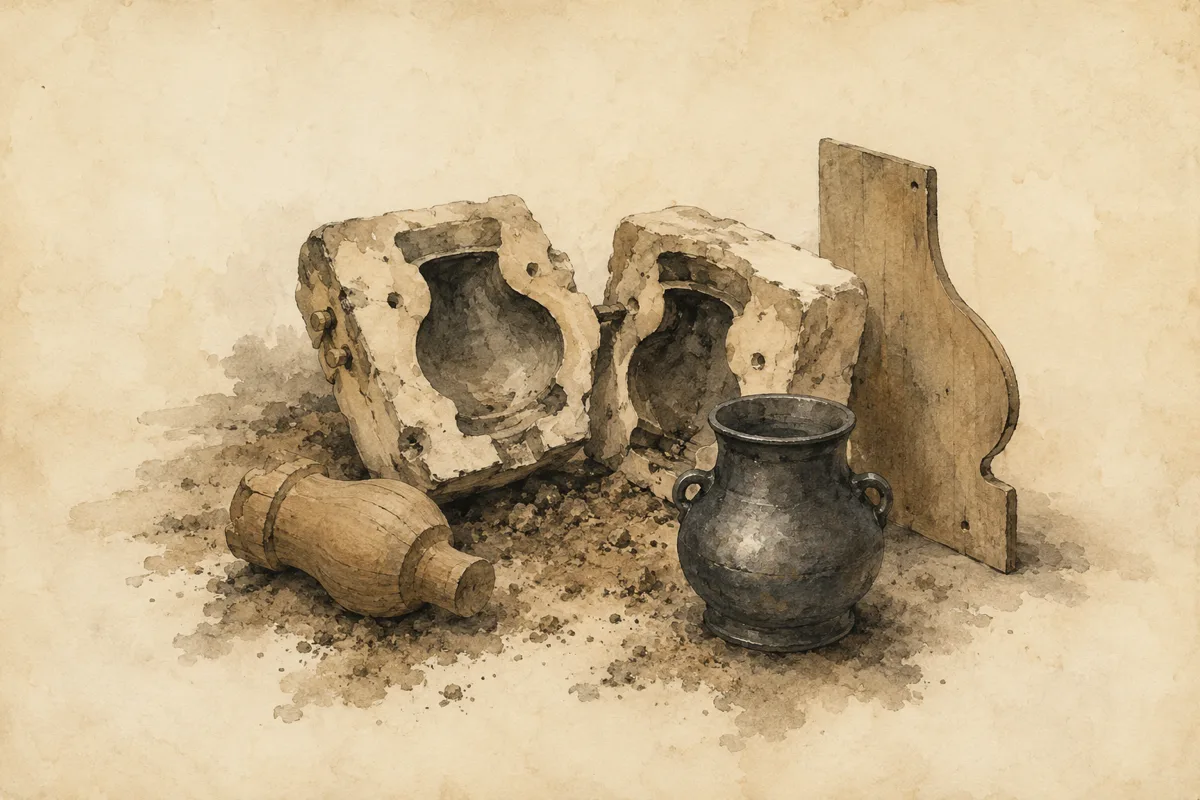
A casting begins as a hole. Everything difficult about the craft follows from the fact that the hole has to be built around a shape, filled with metal at well over a thousand degrees, and then somehow got away from the metal again without damaging either.
Japanese foundries are usually introduced through a list. Takaoka, the copper town in Toyama, names four traditional methods: namagata, sōgata, yakigata and rōgata. The list is accurate and almost useless, because nothing in it tells you why a foundry would pick one. Set the four side by side and ask a single mechanical question of each, and they stop being a list. How do you get the mould away from the metal? Each of the four answers it differently, and each answer charges for it differently.
Pull the pattern out before you pour
The cheapest answer is to remove the shape before the metal ever arrives.
In namagata, green sand casting, a pattern in the form of the finished object is set inside a two-part frame of wood or metal, and casting sand is packed hard around it. The Takaoka City Design and Crafts Center describes the next move in one sentence: take the frame apart, lift the pattern out, and what remains in the sand is the cavity. The sand is only lightly damp, mixed with a little clay and water, and it is never fired or chemically treated, which is exactly why it can be shovelled back into the pile and used again.
That single decision, drawing the pattern out of the sand, sets every limit this method has. A shape that would lock into the sand cannot be withdrawn from it, so undercuts are out. A Takaoka foundry names the other limit plainly. Fine surface patterns do not come out cleanly.
What you get in exchange is scale. The same foundry calls green sand the cheapest of the methods and the only one that copes equally with a short run and a long one. About 80 percent of Takaoka copperware is made this way. The industry cooperative, listing the four techniques, describes green sand as the method that carried the town's expansion, and it is not hard to see why: the mould is remade for every pour, but remaking it costs minutes and no material at all.
Split the mould and lift it off
Sōgata, the second answer, builds a mould that comes apart.
It is the oldest of the Takaoka methods and it works only on bodies of revolution: cylinders, cones, anything you could turn on a lathe. There is no three-dimensional pattern to lift out. Instead a board cut to half the object's vertical cross-section is mounted on a spindle and rotated through the packed sand, sweeping the profile into existence. The outer mould is a mix of clay and sand, and it is fired hard. A core, the nakago, is made separately and sits inside it. The national tourism agency's official English explanation of Japanese art casting describes the assembly nicely: the two halves of the outer mould fit together over the core much like the two halves of a wooden nesting doll.
Then comes the fact that undoes the tidy idea of the always-sacrificed Japanese mould. The Takaoka City Design and Crafts Center states that a sōgata outer mould will stand up to several dozen pours. None of the Japanese sources spells out the reason, though the geometry points at one: a symmetrical body split at its widest point gives each half of the mould nothing to catch on as it comes away.
So sōgata is the method behind the round objects that get made over and over and then last: braziers, tea ceremony kettles, temple bells. The cast surface it leaves is fine and takes patination vividly. The constraint is absolute in the other direction. The object can only be a solid of revolution, so the mould has settled the silhouette before a designer touches it.
A related answer, one that appears in the cultural-property vocabulary rather than the Takaoka industrial one, is komegata, sectional moulding. A clay model is coated in plaster, packed in mane clay, and then deliberately divided so that the pieces can be taken apart and reassembled, producing two mirrored clay shells, one very slightly smaller than the other, with the gap between them being the finished bronze. Sōgata splits the mould along a circle. Komegata splits it along whatever lines the model demands.
Break the mould
The third answer gives up on clean separation and destroys the mould instead.
Yakigata means baked mould. The material is mane, and one Takaoka foundry gives its recipe as clay, water and the fibres of washi paper, which hold the wet mould together the way horsehair holds plaster. The whole mould is then fired at around 900 degrees for somewhere between six and sixteen hours. What comes out is effectively a piece of unglazed ceramic in the shape of the intended void, hard enough to take molten bronze and rigid enough to hold sharp detail that no sand mould would survive.
Because the mould is fired hard and encloses complicated geometry, it is broken open to release the casting. It is the method for large bronze statues and for shapes too involved for a two-part sand mould. The same foundry is candid about the drawbacks. Yakigata castings come out carrying an unusually high proportion of flash and gating that has to be cut away by a skilled finisher, and it is not a method for mass production. Few foundries still hold the skill.
What a broken mould actually costs
The clearest place to price this is Iwate, up in the north, where cast iron kettles are made by both routes and sold side by side.
The traditional kettle mould is a yakigata. A brick former is built up, and sand is introduced in three grades, coarse, medium and fine, each one swept into shape by drawing a template around the axis. The final surface is drawn up in kinu-mane, literally silk clay, the finest grade of the material. While that surface is still workable the maker presses in the pattern, including the raised hailstone dots, one at a time. Then the mould is fired over a charcoal fire. Japanese accounts differ slightly on how hot. The Japan Foundry Engineering Society's Chugoku-Shikoku branch says around 1,300 degrees; a Japanese crafts merchant's account of the same process says around 1,200.
Then the iron goes in, and then the mould is broken to get the kettle out. How many kettles one mould gives is the one point where the Japanese sources genuinely disagree. The Iwate foundry Oigen, describing its own process, says a single mould yields only a few kettles. Other Japanese accounts treat the fired mould as good for one. Nobody claims it is reusable in the ordinary sense.
Oigen puts the traditional route at more than 80 separate steps and roughly a month per kettle. Against that, the same foundry describes what green sand did for the trade: machines compress the sand, the sand can be reused any number of times, and cast iron kettles reached a great many more people than had previously been able to own one.
So the gap between the two kettles on the shelf is not mysterious. A month of mould goes into the expensive one, and it is thrown away to release it.
At the top of the scale the arithmetic gets slower still. Oigo Seisakusho in Takaoka, which makes roughly 70 percent of Japan's temple bells and has delivered more than twenty thousand of them, builds the mould from a mixture of sand and clay, melts copper and tin in a gas furnace, waits for the mould to cool, and then removes the earth of the mould to take the bell out. The shortest bells take three to four months each.
Lose the model instead
The fourth answer keeps the mould intact and sacrifices the shape itself.
In rōgata, lost wax, the model is made from beeswax kneaded together with pine resin. It is packed in clay and fired, and the wax runs out. Remove the wax, in the Agency for Cultural Affairs' phrasing, and what is left is a fired-hard female mould: the object's exact negative, with nothing of the original inside it. The tourism agency's English account puts it in six words. The model is destroyed in the process.
You buy something real with that loss. Since nothing has to be withdrawn and nothing has to be split, the shape is free. A Takaoka foundry lists what follows: reverse tapers and undercuts are possible, fine surface texture reproduces cleanly, and there is much less flash to grind off afterwards. The costs are that it is dearer than green sand and unsuited to large work. And because the model is consumed, that model cannot be poured a second time. Modern shops get around this by mass-producing wax models in silicone moulds and coating them in ceramic, which is lost wax with the uniqueness engineered out of it.
Both ends of that are old and officially noticed. Cast metal objects reached Japan from the mainland in the early Yayoi period, and by the first century, on the tourism agency's account, craftspeople in Japan were making bronze swords, mirrors and dōtaku. The casting techniques were designated an Important Intangible Cultural Property in 1964, and lost wax was listed separately in April 1974 among intangible cultural properties for which documentation should be recorded.
The one mould that survives
There is a modern fifth answer, and it works by changing the metal rather than the mould.
The Takaoka foundry Nousaku, which built its business on cast tin, also casts into silicone rubber. Silicone moulds, as the company puts it, can be used repeatedly. The company's own reason is the metal: the method suits tin and other metals with a low melting point, and it picks up finer detail than sand while allowing one material to be cast around another.
None of these choices is made at the drawing stage. Picking a mould fixes the object's whole range of possible shapes, and with it how many of the thing there will ever be, and what each one has to carry in cost. A symmetrical bronze body can come out of a fired outer mould that will serve dozens more. A kettle with hailstone dots pressed in by hand cannot, because those dots exist nowhere except in one shell of fired clay, and the only way to see them is to break it.