
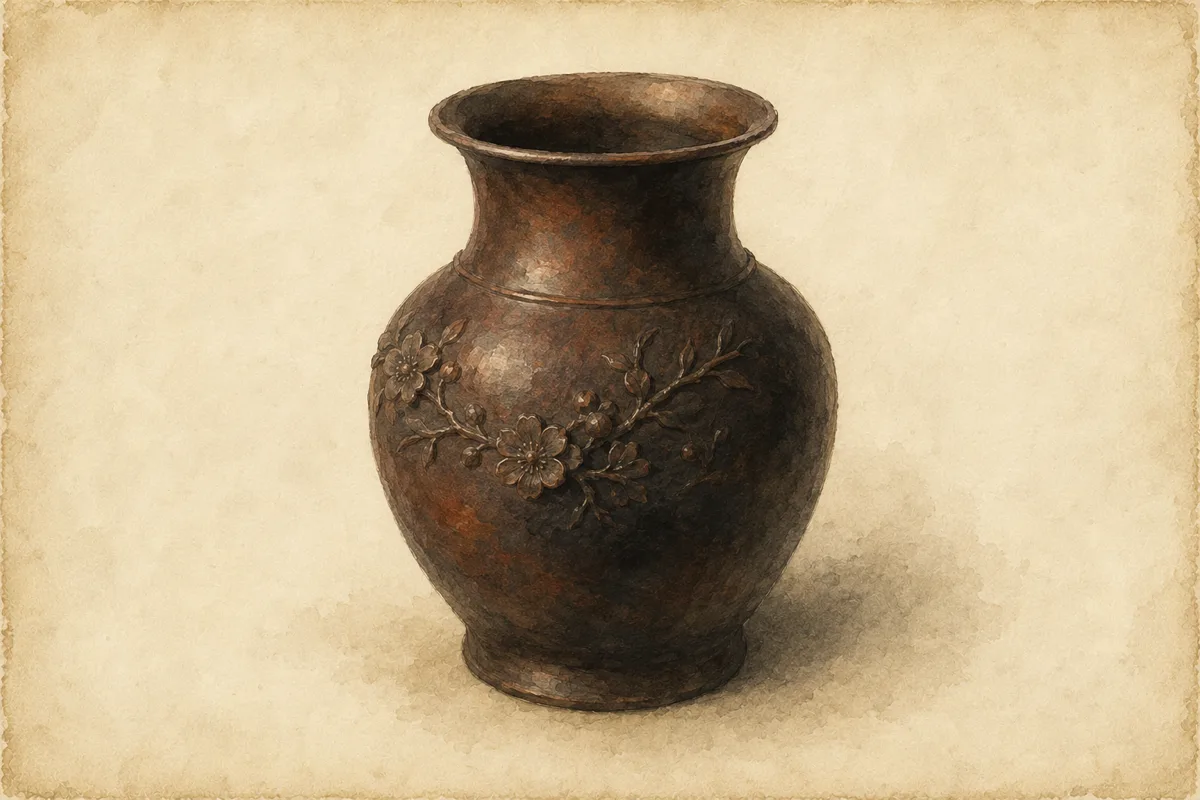
A Takaoka bronze gets handed off five times before anyone sells it. Pattern maker, caster, finisher, colourist, engraver, and each of them a separate business.
The town is the workshop
Casting in Takaoka goes back to 1611, when seven casters were settled in the castle town. They worked in iron first, and copper came much later, between 1830 and 1848. That founding story is told in more detail in the piece on Nousaku's tin ware, which starts from the same seven men.
The cooperative that represents the industry sets out its process in four stages: pattern making, casting, finishing, colouring. An English survey of the craft counts over ten processes in all, including polishing, metal engraving and colouring, each handled by specialist craftsmen. Its argument is that no one workshop could take on that kind of work alone.
The stages are not departments inside one company. Nakagawa Masashichi's account of the district describes pattern, casting, finishing, colouring and chased metalwork all present in Takaoka, with the normal case being that separate workshops split the stages between them. Not many towns hold the whole chain, and Nakagawa's account treats that as the point of the place.
Someone has to hold the chain together, and for most of the modern history of the craft that was the wholesaler. Division of labour advanced from the Meiji period onward, and the 問屋 behind it bought the raw material and parcelled the work out to subcontractors, then sold and marketed what came back. It also made the design decisions. The company name on a Takaoka bronze is usually that party rather than a caster.
Spelled out in full, the chain runs longer than four stages. A pattern maker works first, then a model is formed, then a sand mould is made from it, then the copper is melted and poured, then the mould is broken off the casting. Only after that do polishing, colouring and chased work follow, with engraving and inlay among them, and a final finishing stage at the end. The pour itself is the narrow point: copper alloy goes in at roughly 1150 to 1250°C, and controlling that temperature is described as critical.
Formal recognition arrived late and twice over. Takaoka was designated in the first round of national traditional crafts in February 1975, picked up a further designation as a specified production area in 1979, and in 2017 the city entered the UNESCO Creative Cities Network under crafts and folk arts.
How the decoration arrived
The engraving skill came to Takaoka as a side effect of a policy that had nothing to do with craft. When the sword abolition edict ended the wearing of swords, demand for sword-fitting engraving collapsed, and the skilled fitting engravers of Kanazawa lost their trade. They gathered in Takaoka, and the district's technical level rose accordingly.
The chasing and inlay, in other words, did not grow out of Takaoka's own casting tradition. Kanazawa's engravers were out of work, Takaoka had work, and that was the whole mechanism.
Colour is a chemical trade
Takaoka's reputation for finish rests mostly on the colouring, and the colouring is the stage visitors get wrong. Nothing is painted on. The colour is grown out of the metal, which is why the stage takes hours rather than minutes.
The classic method is nii-iro, boiled colour, a conversion treatment for copper alloys. The piece is simmered in a chemical bath until an oxide film forms across the surface, which gives it weather resistance along with its colour. A basic bath is 1.8 litres of water carrying 5.63 grams of verdigris and 5.63 grams of copper sulphate, with variants adding borax, plum vinegar or burnt alum. The work is stirred and simmered for anywhere between thirty minutes and three hours, longer for the alloys that resist taking colour. Before any of that, the surface is polished and thoroughly degreased.
The alloy then decides the result. Pure copper comes out azuki red and red brown. Shibuichi, copper alloyed with silver, gives you white through dark grey. Shakudo is copper with gold in it, and it goes bluish black or black purple. What the colourist picks is the alloy and how long it stays in the bath.
Higo province turned the same principle into a different craft, growing black rust on iron on purpose, which the article on higo zogan covers. The Takaoka version is the industrial one: a bath, a recipe, and a trade that does nothing else.
The numbers behind the district
In 1990 the Takaoka production area held 461 businesses employing 3,801 people, and its sales were credited with more than ninety percent of copperware nationally, the largest such district in Japan. Copperware sales that year reached 37.45 billion yen.
Sales fell continuously after 1990, and by 2003 they had dropped to less than half the peak. Japanese Wikipedia records that craftsmen aged 60 and over now account for 28 percent, and lists the copperware industrial estate cooperative at 49 member companies, of which 30 do casting. Nakagawa Masashichi's account gives 44 companies on the estate as of 2020.
Those last figures count members of one industrial estate cooperative and cannot be set against the 461, which covers the whole production area. You can see which way it went without pretending the two numbers subtract.
The ninety percent share has the same problem. It is repeated widely, including in English, but the version with a date attached belongs to 1990. Nobody has published a current figure.
What the district actually makes
The cooperative lists bronze statues, tea ceremony utensils, Buddhist implements, incense burners, flower vases, ornaments, lanterns, paperweights, tea kettles, temple bells and braziers. KOGEI JAPAN spans the same range, from small indoor ornaments up to temple bells and Buddhist and public statuary.
Much of that is demand tied to household Buddhist altars, temples and civic monuments, which is not a market that grows. Wikipedia's list of notable works has the Takaoka Daibutsu alongside eleven Kochikame character statues, twelve Sazae-san statues and a Captain Tsubasa.
Buying one
Attribution works differently here. On a Tsubame copper kettle raised from a single sheet the smith is the object, and a name means a person. On a Takaoka bronze the name on the box is usually whoever commissioned the work and ran the chain, and the colourist who gave the piece its surface will not appear anywhere. Nobody is hiding the colourist. There was never a slot on the box for one.
The colour is also a technical claim you can ask about. A boiled-colour finish is an oxide film grown in a bath with a stated recipe and a stated duration, and it carries weather resistance that a coating does not. Ask a seller how the piece was coloured. If nobody can tell you about a bath, you are probably looking at something bronze-coloured.