
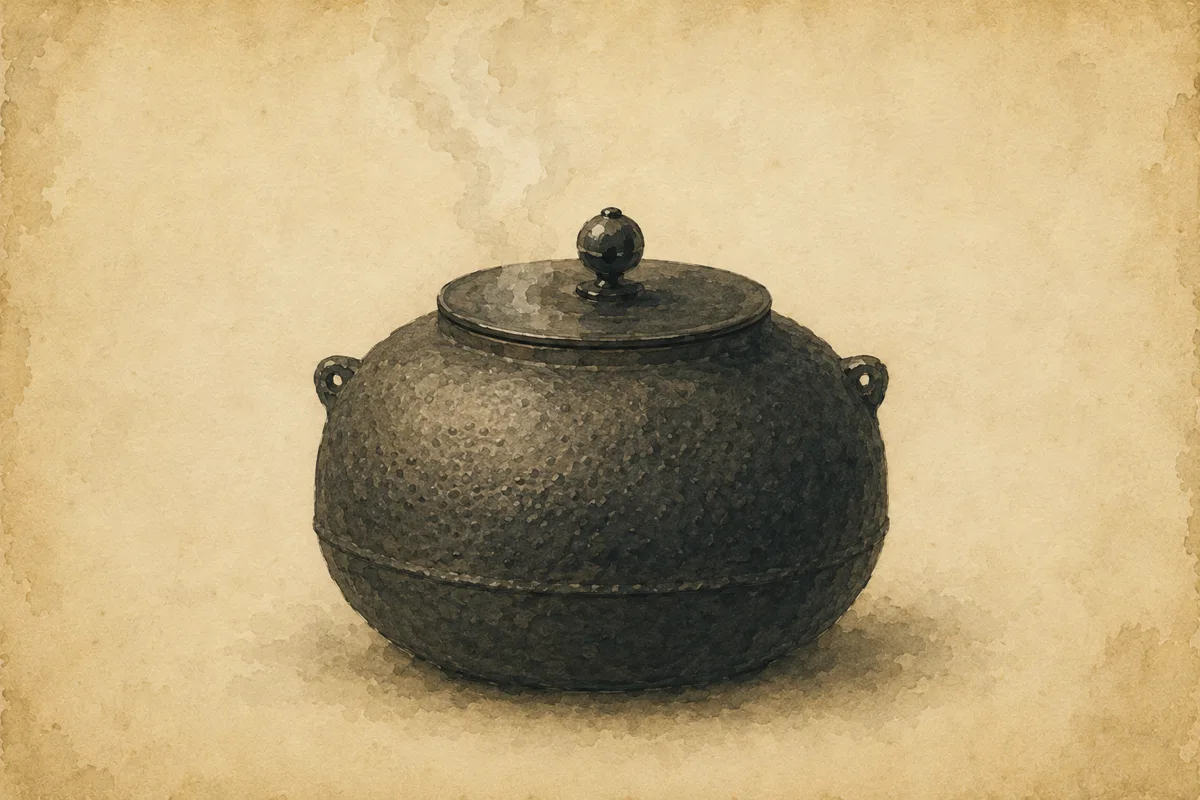
A tea room in winter has an iron pot set into a square hole in the floor. It has a lid, two small lugs on its shoulders, and nothing else. No spout. No handle across the top. When the host wants hot water, they lift the lid and dip a long bamboo ladle in.
As a way of getting hot water out of a container, this is close to the worst design available. It is not trying to be a good one.
What a chagama is
The chagama (茶釜) is the kama used in the tea ceremony, cast in iron, sometimes in copper. Its purpose is to heat water.
The lugs are called kantsuki (鐶付). Metal rings called kan slide through them when the kettle has to be carried or hung over the hearth, and then come out again. The handle exists only while the kettle is being moved. The lugs themselves are cast as figures: a demon face, kimen, or a lion's bite, shishikō.
This is the ancestor of the object most people know. A tetsubin has the spout, the lid, and the arched handle, and it exists to be picked up and poured. The chagama has none of it, and never did.
The kettle is tuned
Inside the floor of the kettle, several small fragments of iron are fixed down with lacquer. They are called narigane, or naritetsu, written 鳴鉄, sounding iron. They affect the pitch of the noise the kettle makes as it comes up to heat. The kettle is built with an intended sound, and a floor cast wrong makes a worse kettle regardless of whether it holds water.
The sound is treated as a sequence with named stages, the six sounds of the kettle, 釜の六音. It begins at gyogan (魚眼), fish eye, small bubbles forming steadily. Then the water finds a voice: kyūin (蚯音), earthworm sound, and after it two names borrowed from water heard at a distance, ganpa (岸波), waves reaching a shore, and enrō (遠浪), waves from far off. Matsukaze (松風), pine wind, is where the tea is served. After it comes muon (無音), silence, as the sound flattens and the fire goes down.
The same six carry a second set of names: 魚眼, 蟹眼 crab eye, 雀舌 sparrow tongue, 小濤 small billow, 大濤 great billow, 無声 voiceless.
The host judges the water by ear, against a scale the kettle was built to produce. A tea room is small, quiet, and largely empty. In a room like that, a low sound from a floor-level iron pot is the loudest thing present.
Ro and furo
The kettle changes with the calendar, and so does the fire under it.
In autumn and winter the fire is in the ro (炉), a hearth sunk into the floor of the room, and the heat comes up from below into the space where people are sitting. In spring and summer it moves into the furo (風炉), a portable brazier that sits on the floor surface, further from the guests.
Kettles for the furo are smaller than kettles for the ro. A single kettle equips a host for half the year, not the whole of it.
Ashiya, Tenmyo, Kyoto
Three centres made the kettles that collectors argue about.
Ashiya was casting from around the mid-14th century, on the coast of what is now Fukuoka Prefecture. Its signature is the shape called shinnari (真形), "true shape", round, with a rim originally running like a belt around the lower half. That form stayed the most common design right through the Edo period. Ashiya surfaces are smooth, called kinuhada, silk skin, and patterns are worked onto them. These were the kettles of the Kyoto nobility, and later of the Ōuchi clan.
Tenmyo kettles are rough, the ground surface left raw, the shapes inventive. They were cast in Shimotsuke province, now Sano in Tochigi Prefecture. Tenmyo's roughness suited wabi-cha taste in a way Ashiya's polish did not, and both were being cast at the same time.
Kyoto entered as a kettle centre in the 15th and 16th centuries and ended up prized even above Ashiya and Tenmyo, on refined design, range of expression, and the plain advantage of being in the capital where the customers were.
Not everyone had iron
Excavations in middle- and lower-class neighbourhoods turn up shinnari kettles too, made of clay rather than iron.
The shape was common. The metal was not. Kettles of this kind were in wide use at least as far back as the Kamakura period, boiling water in ordinary contexts long before the tea ceremony gave the form its reputation, and by the Edo period the kettle was familiar enough to carry a folk tale, the Bunbuku Tea Kettle, about a kettle that turns out to be a raccoon dog.
What happened to Ashiya
Ashiya casting stopped. Production ceased around the early Edo period, and the last documented Ashiya kettle was made in 1600.
Of the nine tea kettles designated Important Cultural Properties at national level, eight are Ashiya. A town that has not produced a kettle in four centuries holds most of the top rank.
Ashiya Town has since run a revival project to reconstruct the technique from the surviving objects, and one of the casters working in that lineage, Higuchi Yosuke, puts the training at sixteen years. Sixteen years to cast a pot whose floor has to get the pitch right.