
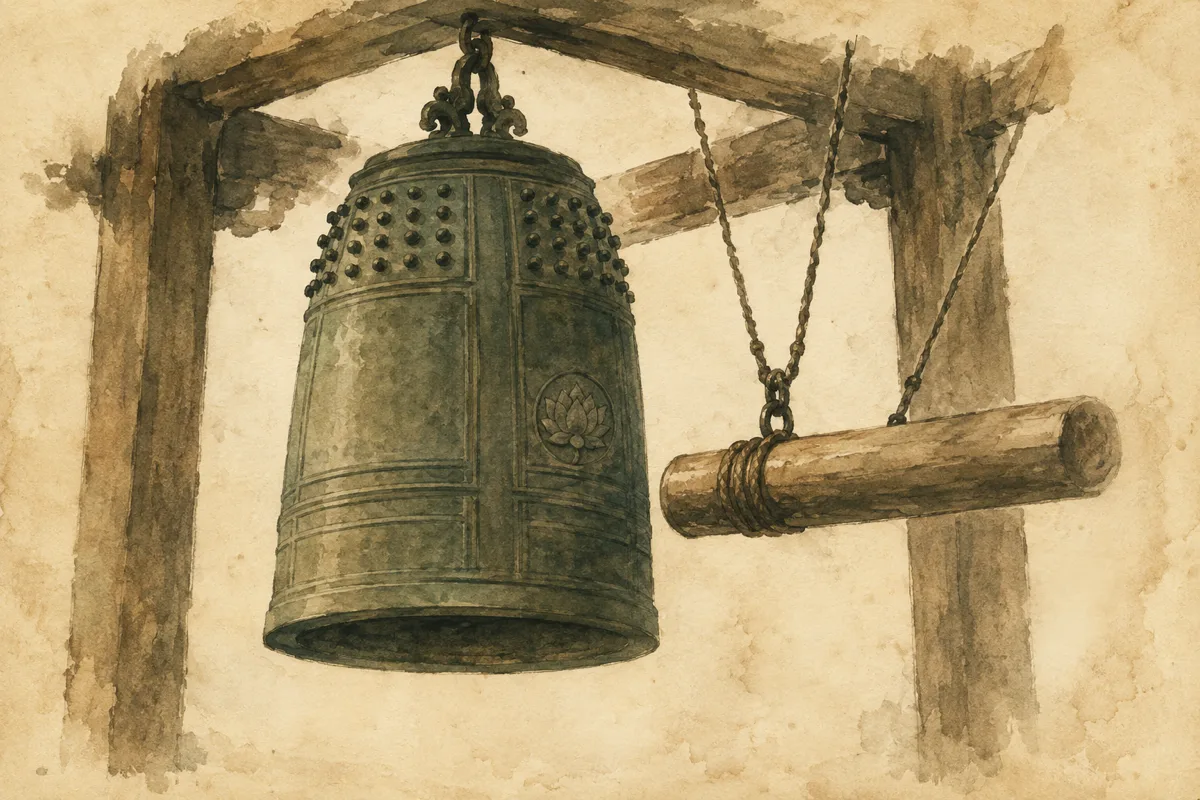
The deep boom that carries across a Japanese valley at midnight on New Year's Eve comes from a bell that nobody swings. A bonshō, the great bell in a Buddhist temple's tower, hangs dead still. It is struck instead from the outside, and the reason is simply that it is far too big to ring the way a Western bell is rung.
Too big to swing
A church bell in Europe is hung so it can rock, and a clapper inside swings against the sides to sound it, giving that bright repeated clang. A large temple bell can weigh several tonnes, and the biggest are far heavier still; you cannot swing an object like that back and forth, and no clapper hung inside would do more than thud.
The bell holds still and the striker moves instead. Beside it hangs a heavy wooden beam, the shu-moku, suspended on ropes. The ringer pulls it back and lets it swing forward into the bell's flank, landing on a reinforced pad on the surface called the tsuki-za, which is usually marked with a lotus. Smaller bells can be struck with a handheld mallet, but the swung beam is the image most people have of the sound.
Built for the fade, not the strike
The bell is not tuned for the clang of the strike. The strike itself is almost the least of it, and the bell is built so the long sound after it matters more.
The sound has three named stages. First is the atari, the clean tone of the impact. Then comes the oshi, a prolonged reverberation, higher and rich in overtones, that swells and holds for up to about ten seconds. Last is the okuri, the slow decay as the vibration dies away, which on a good bell can go on for close to a minute. A bonshō is hung where its sound can travel, and a large one is said to carry for tens of kilometres on a still day.
The upper part of the bell is studded with rows of small rounded bosses called nyū, or chichi, set in a band known as the chichi-no-ma. They read as decoration and they carry a meaning of fertility, but they are also acoustic, helping to build and sustain the long resonance the bell is valued for. The dragon-headed loop it hangs from, the ryūzu, is two downward-facing dragons gripping the crown between them.
Cast in one unforgiving piece
A bonshō is cast whole, in a single pour of bronze, mostly copper with around twelve to fifteen percent tin. The mould is made in two parts, an inner core and an outer shell; the core is built up as a dome of hardened sand, and the profile of the bell is swept into the clay with a strickle board, a flat template shaped like the bell's cross-section and turned around a central axis to shape the mould.
A bell's note is fixed by its exact size and thickness and the alloy, all of which are set the moment the metal cools, and there is no tuning a bonshō afterward the way you would file a small bell. By the accounts of the craft, a difference of a single hertz in the fundamental note can mean the bell has to be scrapped and cast again from scratch, and only around half of castings succeed on the first attempt.
The oldest bonshō whose casting date is known was made in 698 and still hangs at Myōshin-ji. The largest, at Chion-in in Kyoto, was cast in 1636, weighs about seventy metric tonnes, and takes a team of seventeen people to sound it on New Year's Eve.
The bell as a public clock and a New Year rite
For most of its history the bell was the temple's voice to the town. It marked the hours, called monks to dawn services and meals, and could warn of a coming storm. Its one moment of mass participation comes at the year's end. In the ceremony of joya no kane, temples ring the bell 108 times, once for each of the 108 earthly desires that Buddhist teaching counts as the sources of human suffering, and striking them out is meant to leave the new year with a clean mind. At many temples the public queues to take a turn on the beam.
The little orin sits on a household altar and is tapped once to open a chant; the bonshō does the same job for a whole town. Both are struck bronze bells tuned for a long decay, but the bonshō is large enough that it takes a swung log to sound it, and its note carries across a valley.