
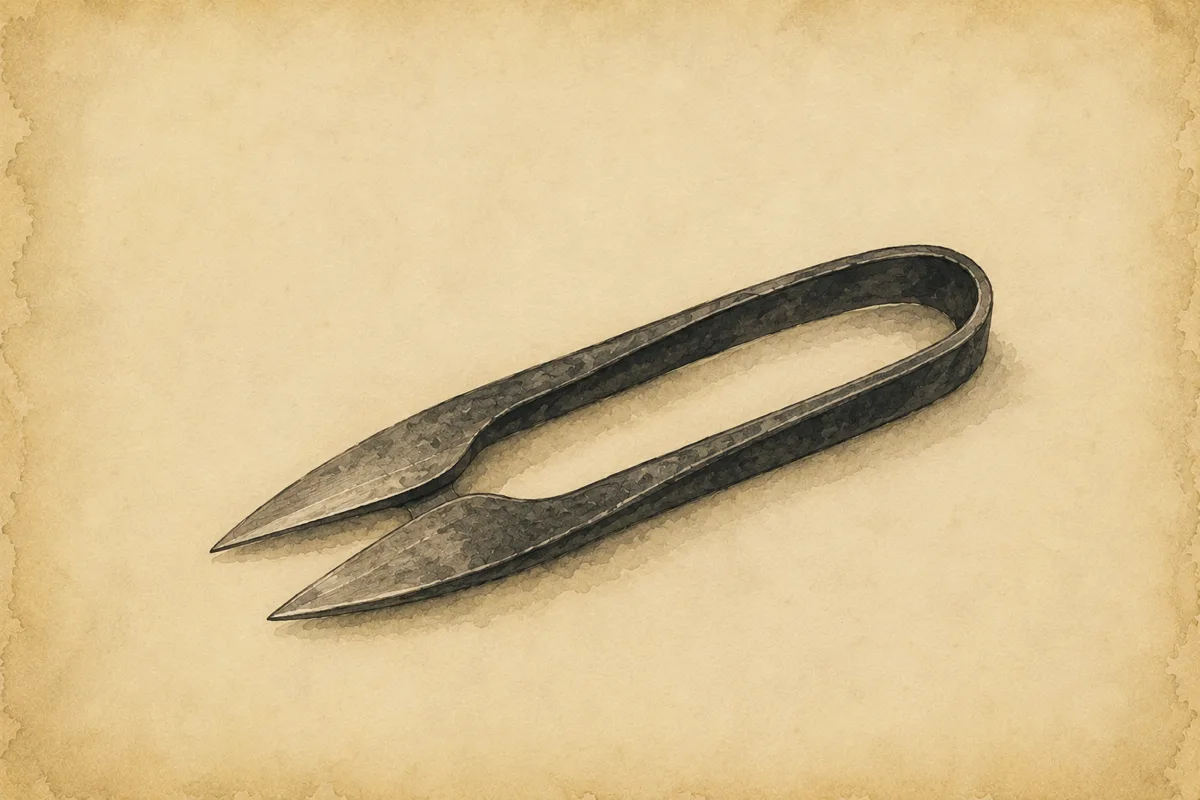
A nigiri-basami has no screw. Ordinary scissors are two blades bolted together at a joint, and the joint is the whole idea; this tool has none. It is a single bar of steel bent into a narrow U, with a cutting edge worked onto each free end, and you close it by squeezing the two arms toward each other until the edges pass.
Squeeze to cut, and let go to open
Let go, and it opens by itself. The bend at the back is not a handle, it is a spring, and it holds the blades apart until you press them shut again. Dictum, which sells them in Europe, describes the mechanism plainly: the scissors open automatically after each cut, and a light pressure from thumb and index finger is enough to make a clean one.
That changes how you hold it. You do not put fingers through loops, because there are no loops. You pinch the tool near the top, close to the blades, and work it against your fingertips. Japanese Knife Imports describes the grip as operating the scissors like tweezers, with the spring action built into the handle. For the repetitive snip-snip of dressmaking or hand sewing, the difference is real: the hand never has to open the blades, only close them, and the tool resets on its own between cuts.
None of this is decoration. A pivoted scissor needs a fulcrum, and the fulcrum needs a screw or rivet, which is a second part that can loosen and go out of true. The grip form deletes the joint and replaces it with the elasticity of the steel itself.
Two steels, welded by hand
The body and the cutting edge are two different claims, and they are easy to confuse.
The blades of a good nigiri-basami are laminated. A hard, high-carbon cutting steel is joined to a softer iron backing, so the edge can be taken to real hardness while the body stays tough and forgiving. This is the same bargain struck in a Japanese kitchen knife, where a brittle edge steel is carried on soft iron rather than asked to be the whole blade. If you want that logic at length, it is the subject of our guide to Japanese knife steel.
What the hand-forged versions do differently is refuse the shortcut. Japanese Knife Imports notes that the maker welds the soft and hard steels together by hand rather than starting from a pre-made clad sheet, then forges the blade and handle shape free-hand, without automatic machinery. The cutting layer is usually a named high-carbon steel: some makers use Blue Paper steel, others the Yasuki steels milled in nearby Shimane. The edge that finally cuts your thread is a thin skin of one of these, forge-welded and ground down to a wire.
So when a listing calls the blade "one piece," it is worth asking which sense is meant: the body with no joint, or the edge that is a bonded pair of metals.
Ono, and the word Banshu
Most of the hand-forged grip scissors come from one town: Ono, in Hyogo Prefecture, on the plain that old sources call Banshu. The miihin catalogue that sells them ranks Ono as the fourth of Japan's blade regions, after Seki, Sakai and Tsubame-Sanjo, and dates the local trade to more than two hundred and thirty years. The products were known for most of that time by their plainest possible names: Ono scissors and Ono sickles.
The label "Banshu hamono," Banshu blades, is younger than the blades. A designer, Kobayashi Shinya, gathered the region's anonymous household tools under that name in a 2013 rebranding and pushed them into export markets, later adding a colour-finished line to the classic grip and cloth scissors. The craft is old. The brand is a decade old, and it exists because the craft was quietly disappearing.
One hundred and sixty smiths, then one
It went fast. A local report on Ono put the average age of the town's blade craftspeople at seventy-three. Fifty years before that, the town had around a hundred and sixty scissors makers. By 2017, exactly one of them still forged grip scissors from raw metal by hand. His name is Mizuike, of the Mizuike scissors workshop in Ono, and he was seventy-one when a reporter visited, described flatly as Japan's last hand-forged scissors craftsman. The others had gone to machine presses, or gone.
He nearly did not learn it. His own father, he recalled, had told him only that it would not hurt to know the trade in case it was ever needed. It was needed. In about 2015 an applicant turned up from Kumamoto, on the far side of the country, thirty-six years old and wanting to be taught, and Mizuike took him on. Whether one apprentice is enough to carry a craft that once fed a hundred and sixty households is not something the sources claim to know.
Before you buy one
Look first at the blade edge in good light. On a laminated blade the boundary between the hard cutting steel and the soft backing is often faintly visible as a line running back from the edge, sometimes wavy. A snip stamped from a single uniform stainless strip will not show it. That is a different object at a different price, and the line is how you tell them apart.
The spring matters as much as the edge. Work it a few times before you commit: the bow should return the blades to the same open gap every time, without a dead spot or a wobble, and the edges should meet along their length rather than gapping at the tips. That meeting is set by the smith when the tool is cold, and on a hand-forged pair it can be adjusted rather than discarded.
Shape is the last thing to match to the job. A pointed pair gets into a knot or a tight seam; a version with a rounded lower blade sits under delicate cloth without catching it, which is why fabric models are built that way. If you have arrived here from a sashiko or hand-sewing kit, the small sprung snip in the tray is doing exactly what it was shaped to do. Keep it dry, let the spring rather than your hand do the opening, and it will last.