
You can bend a bar of tin with your hands. It will make a noise while you do it.
The metal, before the craft
Tin behaves unlike the other metals Japanese workshops use. Iron rusts. Copper work-hardens as you beat it up from a sheet, so it stiffens the more you shape it. Tin does neither.
It is soft, malleable and ductile: a bar of tin can be bent by hand with little effort. It melts at 231.9°C, the lowest melting point in group 14, which is why casting it is comparatively easy. It resists corrosion from water and does not oxidise readily in air or water, though acids and alkalis will attack it.
At room temperature the stable form is beta tin, sometimes called white tin, and its crystal structure is body-centred tetragonal.
Why tinware is usually not tin
Softness is a problem if you want a cup that survives being a cup. The traditional answer was to alloy it.
Pewter is 85 to 99 percent tin, with antimony at roughly 5 to 10 percent, copper at about 2 percent, plus bismuth and sometimes silver. The additions are there to stiffen the metal. It goes back a long way: pewter first appears around the beginning of the Bronze Age in the Near East, and the Egyptians and later the Romans used it for decorative items and tableware. A pewter drinking vessel is therefore a compromise, tin for its stability and other metals for stiffness.
Takaoka, and the reversal
Casting in Takaoka, in Toyama prefecture, goes back to 1611, when the lord of the castle town brought in seven casters and set them up in the Kanaya-machi district. They made pots, kettles, spades and hoes, which is to say nothing anyone would call art. Four centuries on the city still casts metal, and MADE IN NIHON puts Takaoka at the top of Japan's casting production by share, though no figure is attached to the claim.
Nousaku was founded there in 1916, making Buddhist ritual objects, tea ceremony utensils and flower vases in brass and bronze. Katsuji Nousaku joined in 1984 and spent eighteen years as a craftsman. MADE IN NIHON puts the turn to original products down to a wish to do something nobody else had done.
In 2003 the firm developed tableware in 100 percent tin.
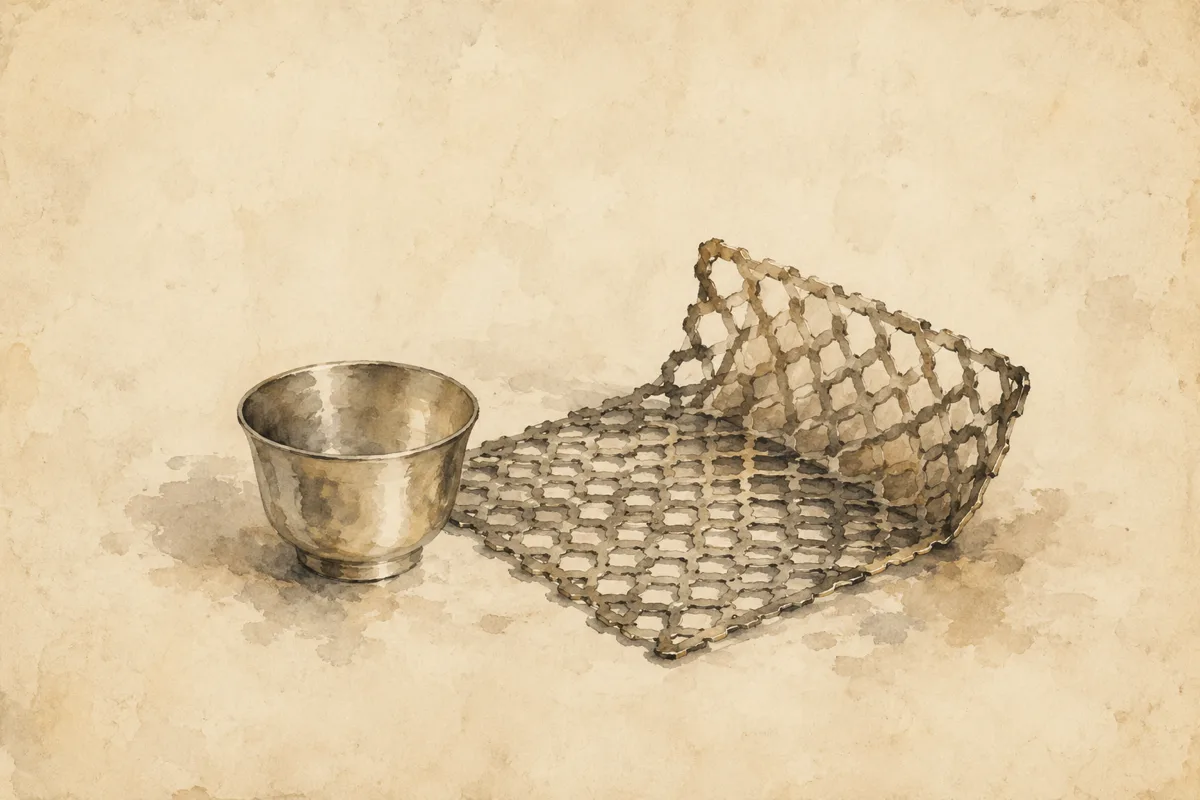
Unalloyed tin is too soft to behave like normal tableware. Rather than treat that as a defect to engineer around, they made it the point. The KAGO series ships as a flat mesh of tin that the buyer bends into a basket by hand, and it holds the shape because tin is soft enough to stay where it is put. The reasoning, as MADE IN NIHON records it, was simply: if it can be bent, let us make tableware that can be bent.
The softness pewter alloys were designed to remove was now the thing being sold.
The sound is real, and it is explainable
Bend a piece of tin and it emits a crackling or screaming noise. This is called tin cry, and of everything claimed for tin it is the part with a documented mechanism.
The cause is crystal twinning: the metal's crystals reorganise under the bend rather than anything breaking. The source names the cause without spelling out the acoustics, so that is as far as this goes.
It is not loud, despite the vocabulary of crying and screaming attached to it, and it is not unique to tin: niobium, indium, zinc, cadmium, gallium and solid mercury all do something comparable.
The claim that does not stand up the same way
Tin's reputation in Japan rests heavily on a flavour claim.
Nousaku's own English page puts it as received tradition: in Japan, it has been said that tin removes the bitterness from Japanese sake. KOGEI JAPAN, writing about Osaka tinware, says tin reportedly mellows the taste of sake.
Neither the maker nor the craft body asserts it in their own voice, and neither offers a mechanism or a measurement.
Compare that with the other properties on offer. The softness is measurable. The melting point is a number. The tin cry has a named crystallographic cause. The corrosion resistance is a documented property of the element. The taste effect has none of that behind it, only repetition.
None of which makes it false. But a shop that tells you tin removes bitterness is passing on folklore, not a result. Nousaku's own antibacterial claim sits in the same category: it is the company's description of its material, not a figure from a published test.
If you want to see how the same question plays out with a different metal, the iron kettle makes an almost identical set of claims about water.
Osaka, the other tin town
Takaoka is not where Japanese tin starts. Tin objects sit in the Shosoin Repository from the Asuka period, and an early Edo text, the Jinrin-kinmouzui, describes tin craftsmen working in Kyoto and the Kansai region.
Osaka's own production is dated to 1679 by a record in the Naniwa-suzume, and from the middle of the Edo period the Kamigata region, meaning Osaka, Kyoto, Nara, Shiga and Hyogo, was the largest production area in the country. It stayed substantial for a long time: at the end of the Taisho period, around 1926, there were nearly fifty manufacturers and more than three hundred artisans. Osaka Naniwa pewterware was designated a traditional craft by the Minister of International Trade and Industry in 1983.
The Osaka method is a lathe craft rather than a bending one. Pure tin, imported from Thailand, Malaysia and Indonesia, is cast in cement, clay or metal moulds, then cut and shaped on a lathe. Handles and spouts go on, surface patterns are raised using lacquer and nitric acid corrosion, and the piece is polished. KOGEI JAPAN notes that tin's softness is precisely why it cannot be machine-processed in the ordinary way.
Two products there are worth knowing about. Hand-engraved patterns inside beer vessels are said to make the head last longer. And tin tea canisters are lathe-cut to a close fit that KOGEI JAPAN credits with keeping moisture and oxygen away from the leaf, again with no figure attached.
Buying one
Ask first whether it is pure tin or an alloy, because that single fact predicts everything else. Pure tin will be softer, more easily marked, and more prone to deforming if you are careless with it. An alloyed piece will hold its shape better and will not perform the party tricks.
Then adjust your expectations to the metal rather than to the copy. Tin is stable against water and slow to tarnish, which is a genuine reason to drink from it. It is soft, which is why it marks easily and why it bends. Bend it and you will hear the crackle.
One footnote on the element, which none of the makers raise and which the sources do not connect to tableware: below 13.2°C, white tin is thermodynamically inclined to convert to a grey powdery form, the phenomenon called tin pest. Impurities such as aluminium and zinc push that transition well below 0°C. No source here reports it as a practical problem for tin vessels.
Tin asks for none of the force that copper needs when it is raised from a single sheet. It gives way at hand pressure, and that is the whole basis of the trade in it.