
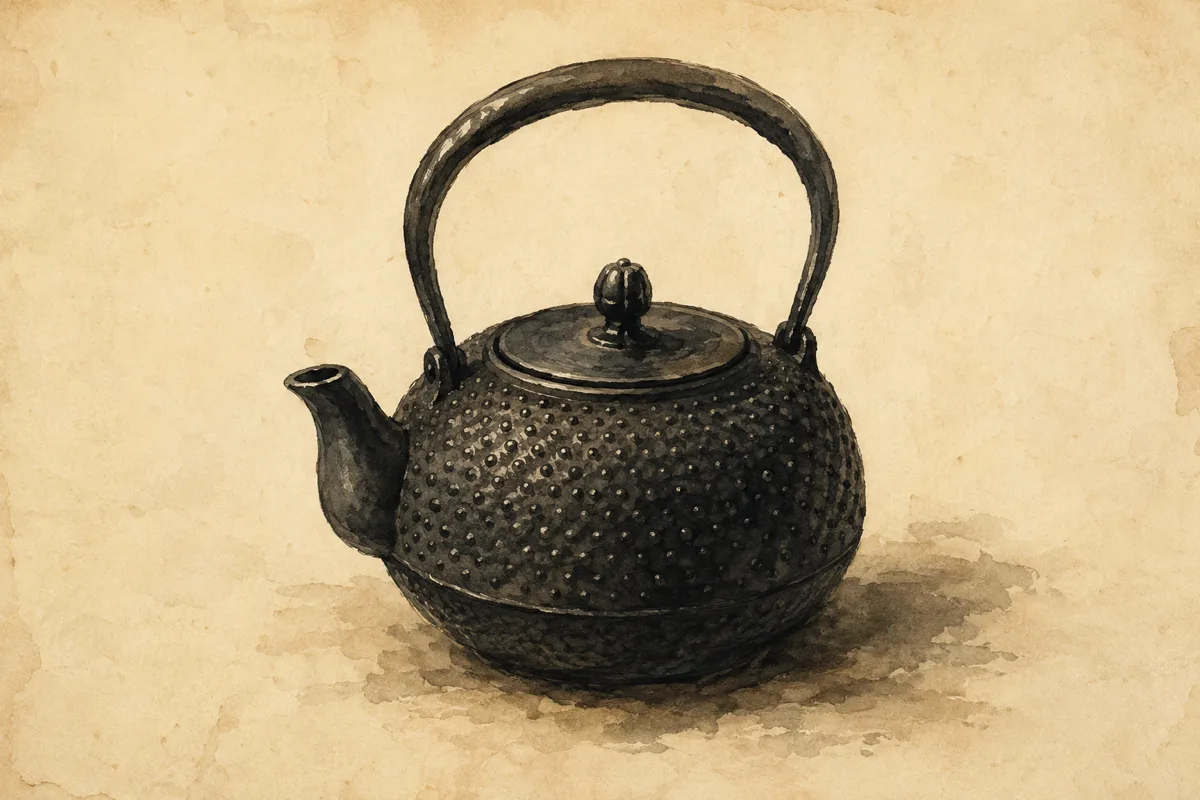
A Nambu kettle is heavy in a way a stamped-steel pot never is, and it pours in one thick, unhurried stream with no rattle to it. The word on the box, Nambu, reads like a brand name. It isn't. It names a region in the north of Japan, and a way of casting iron that breaks its own mold every time.
Nambu is a region, not a label
Nambu ironware (南部鉄器, Nambu tekki) is cast ironware from Iwate Prefecture, in the northeast of Japan's main island. It comes from two towns: Morioka, the prefectural capital, and Mizusawa, now folded into Oshu City. Japan's government recognized it as a national Traditional Craft in 1975.
So when a listing says "Nambu tetsubin," it is claiming an origin, the way a protected name like Champagne or Parmigiano does. A tetsubin (鉄瓶) is the iron kettle itself. Nambu tells you where and how it was made.
Two towns, two beginnings
The single name hides two different histories that only merged later.
Morioka is the younger of the two, and it is where the tetsubin as we know it was born. In 1659, the lord of the Nambu domain invited a caster named Koizumi Nizaemon from Kyoto to make kettles for the tea ceremony. Those were chagama, the large iron kettles used in chanoyu. Over generations the Koizumi line shrank and adapted the tea-ceremony kettle into a practical household version with a handle and a spout. That practical version is the tetsubin.
Mizusawa is older and came at iron from a different direction. Its casting tradition runs back roughly 950 years, to the late Heian period, when the Oshu Fujiwara clan ruled the north from Hiraizumi and brought in foundry workers from Omi Province, near present-day Shiga. This was a broader casting culture, not specifically a tea-kettle one. The two towns worked in parallel for centuries and were eventually grouped under the one Nambu ironware designation.
There is a moment when the name went national. In 1908, the eighth-generation Koizumi Nizaemon demonstrated Nambu ironware before the Crown Prince, later Emperor Taisho, during a visit to the region, and the press coverage carried the name across the country.
One mold, one kettle
Each Nambu kettle is cast individually, and the mold does not survive the pour.
A caster builds the mold from sand and clay, shaping the cavity by rotating a template through progressively finer sand until the wall is smooth. Before it dries, while the surface is still workable, the surface pattern is pressed in by hand, one dot at a time. Molten iron, poured at somewhere around 1,300 to 1,400 degrees Celsius, then fills the cavity. When it cools, the clay mold is broken to release the kettle. A baked-clay mold can only be used once. The next kettle needs a new mold.
You cannot stamp out identical copies this way, which is much of why they cost what they do. A finished tetsubin is described as taking roughly 60 to 80 steps and months of work, and no two come out quite the same even from the same workshop.
Casting isn't the end of it. The raw kettle goes through a heat treatment, sometimes called kama-yaki, at a high temperature that builds an oxide layer for rust resistance, and traditional finishing can include lacquer and tannin blackening before the handle, spout, and lid are fitted and the whole thing is inspected.
The hailstone dots
The pebbled texture you see on so many of these kettles has a name: arare (霰), meaning "hailstone." It's the signature look of Nambu ironware, and it isn't cast from a master pattern. Each raised dot is an indentation a maker presses into the soft mold before pouring, placed one at a time, and artisans design their own arrangements. The bumps aren't only decorative; they increase the kettle's iron surface area. A densely dotted kettle is that many more presses into the mold, one at a time.
Tetsubin vs. teapot: check the inside
A tetsubin is not a teapot, and the difference is the interior.
A genuine tetsubin has a bare, uncoated iron inside. It is built to sit directly over a flame or charcoal, and its only job is to boil water. You do not put tea leaves in it. Traditionally it was heated over charcoal in a brazier.
The object usually sold in the West as a "cast iron teapot" is a different thing, a tetsukyusu, and it typically has an enamel-coated interior. That enamel is made for steeping tea, and it means the water never touches iron at all. Many of them cannot go on direct heat. Neither object is wrong, but they are not interchangeable, and a lot of confusion at checkout comes from treating them as one. The tell is simple: look inside. Black bare iron and a kettle built for the stove is a tetsubin; a smooth coated lining made for brewing is a teapot.
Does iron really make the water taste better?
You'll see the promise on nearly every listing. It is widely said that water boiled in a bare-iron tetsubin tastes softer and rounder, and that the iron adds a small amount of dietary iron to the water. There's a plausible basis for a little iron entering hot water from bare cast iron, but how much depends on the kettle, the water, and how it's been seasoned, and the taste part is a traditional claim rather than something a neutral study here settles. Either way, it only applies to bare-iron tetsubin. An enamel-lined pot, by design, keeps water and iron apart.
A real one will outlast you, and it makes tea slower on purpose. When it comes time to actually heat the water, our guide to preparing matcha covers where temperature starts to matter.