
What Is Maki-e? Japan's Sprinkled-Gold Lacquer, Grade by Grade
The word maki-e (蒔絵) means "sprinkled picture": maki, to sow or scatter, and e, a picture. It is one of those rare craft names that tells you exactly how it is made. The gold in maki-e is not mixed into the lacquer and painted on. It is scattered, dry, onto a wet lacquer drawing, so the sap catches each grain where it lands. That one detail explains the cost and the grades.
The trick is sprinkling, not mixing
Almost every other gilding tradition dissolved gold into a medium and painted with it. The Chinese method known as kondei, "gold mud," ground gold into a paint. Japan did the opposite and made it a signature. An artisan draws the design in plain, bare urushi, and then, while that lacquer is still tacky, taps fine metal powder down onto it. The lacquer is the glue; the metal only ever sits on the surface. Because the gold and silver are not drowned in paint, they catch the light and read brighter than gilded lacquer anywhere else, which helped the technique take over.
The glue makes maki-e slow. Urushi does not dry; it cures, hardening only when it can pull moisture from damp air (the chemistry is urushi's whole strange story). So a freshly sprinkled piece goes into a muro, a humidified cabinet held 20–25°C and 70–85% relative humidity, and waits. That waiting is repeated at every stage.
Draw, sprinkle, fix, polish
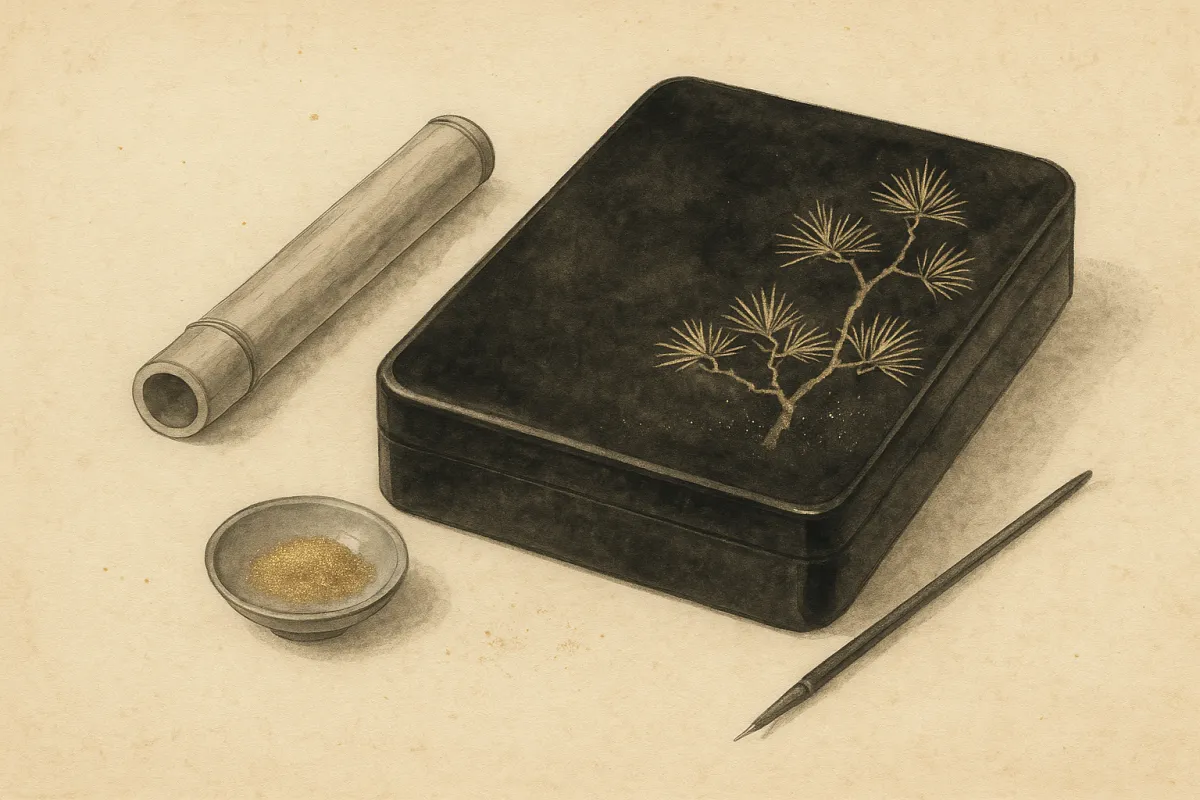
The core sequence is short to describe and long to do. The design is transferred to the surface (okime), its outlines drawn with a fine maki-e brush, and the shapes filled with lacquer (that fill is the adhesive bed). Then comes funmaki, the sprinkling itself: coarser powders are tapped from a funzutsu, a bamboo tube, drummed with a finger so the grains fall evenly; the finest powders are laid down with a soft kebo brush. Once it has hardened, the artisan seals everything under a thin wash of raw lacquer (fungatame), then grinds (togi) and polishes (migaki) the surface to a glow.
Powder is chosen along two axes: how big the grains are and what shape they are. The finest, keshifun, is around 0.3 micrometres, matte and delicate but weak; the coarsest marufun is rounder, tougher and more brilliant because it scatters light. Purity matters too: 24-karat gold (99%+) is soft and easily scratched, 23-karat (95–97%) is the working compromise, and 22-karat and below is harder but shifts the colour. All of this is why a single object runs to about two weeks of work, and a hand-decorated fountain pen takes two to six months or more.
The three grades, by surface
Almost everything sold as maki-e is one of three types, plus a rare fourth that combines two of them. The quickest way to tell them apart is by feel rather than by pattern.
| Grade | Surface | How it's made | When it developed |
|---|---|---|---|
| Hira maki-e (flat) | Almost level, a faint raised feel | Draw, sprinkle, fix, polish (the simplest form) | Began late Heian, completed in Kamakura |
| Togidashi maki-e (polished-out) | Perfectly flush, no edge to feel | The whole design is buried under black lacquer, then ground back until the powder is exposed | The oldest style; developed and perfected in the Heian period |
| Taka maki-e (raised) | Stands up in visible relief | A base of charcoal, tin or clay powder is built up first, then hira is worked on top | Developed in mid-Kamakura |
| Shishiai togidashi (combined) | Raised, yet polished flush at the surface | Taka's relief plus togidashi's grinding (the hardest of all) | Developed in Muromachi, popular in Edo |
The order in that table runs against intuition. Togidashi is the oldest technique yet produces the flattest, most seamless result, because you literally paint over your own gold picture in black lacquer and then polish it back into view. And hira, which sounds like it should have come first, actually arrived later. Japanese sources note it had to wait until artisans could grind metal powder fine enough to lie flat.
A sword that keeps the origin story open
Maki-e is old enough that its beginning is a live argument. In the Shōsōin repository in Nara sits the Kara-tachi, a ceremonial sword said to have belonged to Emperor Shōmu (701–756). Its scabbard is decorated with makkinru (sprinkled gold powder locked under lacquer and polished out), which is, in principle, the same as togidashi maki-e used today. A 1,300-year-old sword carries the technique in recognisable form.
Whether that technique was born in Japan or arrived from the mainland has never been settled. One scholar argued in 1910 that it came from China; another countered in 1932 that the Chinese gold-mud method was fundamentally different and maki-e was purely Japanese; a 2011 study showed the scabbard was decorated with something close to maki-e, using gold grains that only a file held in the same repository could have made. Even so, whether the sword itself was made in Japan remains unknown. The first named master we can attach to real work is Kōami Dōchō (1410–1478), and by the Momoyama era the craft had its showpiece style, Kōdaiji maki-e, named for the temple Kita-no-Mandokoro founded in 1606 to honour her late husband Toyotomi Hideyoshi. Kōdai-ji is still nicknamed the "maki-e temple," its interiors scattered with chrysanthemum and paulownia crests.
Real gold, or a printed gold?
Because maki-e now decorates fountain pens and watch dials as much as tea caddies, the honest question a buyer faces is whether the gold was sprinkled by a person at all. There are three tiers, and the middle one is the one buyers tend to overlook.
| Traditional (hon maki-e) | Modern (kindai maki-e) | Print / decal | |
|---|---|---|---|
| Underlayer | Drawn by hand in lacquer | Silk-screen or pad printed | Pattern printed straight on |
| Metal | Real gold or silver powder, sprinkled | Real powder sprinkled over the printed base | None (gold-coloured ink) |
| Surface | Raised or polished depending on grade | Flat, little relief | Completely flat and uniform |
| Time / price | Two to six months+; high | Much faster; low to mid | Mass-made; cheapest |
The catch: a pen can be labelled "maki-e" and still have a printed underlayer: kindai maki-e replaces the hand-drawn lacquer with silk-screen printing, then sprinkles real powder over it (a Platinum Preppy Wa runs around ten dollars). That is a legitimate hybrid, not a counterfeit; the powder is often genuine. But it is not months of handwork, and the price tells you so.
To read a piece, look for relief, particle, and tarnish. Relief: hand-sprinkled maki-e leaves a slightly uneven, raised texture (taka especially stands proud) while a print is dead flat (togidashi is flat too, but its flush surface still has real depth in the grains). Particle: under magnification, real maki-e shows irregular round or flaky metal grains; a print shows regular halftone dots. Tarnish: true gold powder stays bright for a thousand years, whereas brass substitutes look golden but darken and go green with age — a reason museums insist on the real thing. None of these is proof on its own, which is why collectors also lean on the maker's name (Namiki, Nakaya, Sailor, Platinum, Danitrio) the way you would trust a workshop's mark on any hand-finished lacquer.
Maki-e is as much a process as an image. It is the same sap that hardens in a damp box, the same gold that outlasts empires, coaxed grain by grain onto a surface, and, in kintsugi, sprinkled along a mended crack to turn a break into the brightest line on the bowl.