
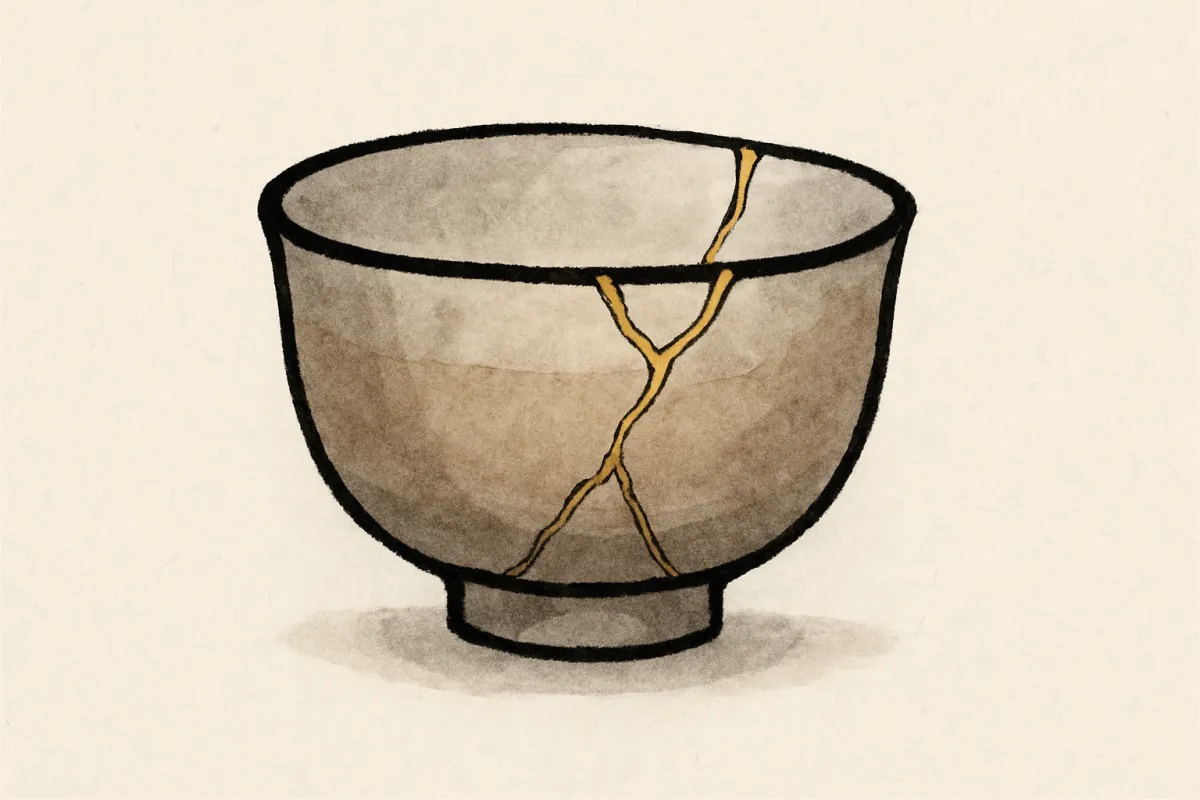
The photo shows up everywhere: a plain tea bowl laced with rivers of gold, each seam marking where it once broke. The caption usually says something about a shogun, and about broken things becoming more beautiful than they were. Kintsugi (金継ぎ, "golden joinery") is a real, specific craft, and it is more interesting than the caption suggests.
The gold isn't the glue
The gold does not hold anything together. The structural repair is made with urushi, the sap of the lacquer tree, the same material used on Japanese lacquerware. The gold goes on only at the very end, as a finish laid over the mended seam.
It's an easy mistake, because the gold is all you see. But as one Tokyo lacquer studio puts it, the notion that "the gold powder is mixed with the urushi lacquer to fill in the cracks" is a common misconception; doing so "would be extremely costly and impractical." You'd be gluing a bowl with molten money. Lacquer does the work, and a whisper of gold takes the credit.
A real repair takes months, not minutes
A genuine kintsugi mend is a stack of different lacquer preparations, each doing one job, each left to cure before the next. The pieces are first rejoined with mugi-urushi (麦漆), raw lacquer kneaded with wheat flour into a stiff, sticky paste that acts as the adhesive. A missing chip gets filled with kokuso-urushi, the same lacquer bulked out with wood powder. The mended line is then smoothed with sabi-urushi, lacquer mixed with fine tonoko clay, until the surface is fair. Only then does a warm red undercoat go down, and finally the gold.
That gold is applied by a decorative technique borrowed from lacquerware called maki-e (蒔絵, "sprinkled picture"): fine metal powder is dusted onto still-wet lacquer so it fixes to the surface. The seam is then sealed with one more coat and burnished to a soft shine.
The curing is what takes time. Urushi doesn't dry the way paint does; it cures by pulling moisture from humid air (see what urushi actually is). So every layer is rested in a damp cabinet, the furo or muro, at around 90% humidity, between two days and two weeks per coat. Stack up the layers and a full, authentic repair commonly runs from a few weeks to about four months. This slow curing is why real kintsugi is expensive.
Three ways to mend a break
There isn't one method but three, chosen by how much of the vessel survived:
- Crack (hibi, ひび): the fragments still fit, so they're simply rejoined and the seam highlighted. This is the classic gold-river look.
- Piece (kake): a chip is gone with no fragment to replace it, so the gap is filled with lacquer putty and gilded over.
- Joint-call (yobitsugi, 呼び継ぎ): the missing piece is replaced with a shard from a different vessel entirely, patchwork-style, so a fragment of blue-and-white might land in a brown tea bowl. It turns a repair into a collage.
What it's about
The philosophy sits on top of this real technique rather than replacing it. Kintsugi treats a break and its repair as part of an object's history, something to record rather than disguise. As one description has it, "not only is there no attempt to hide the damage, but the repair is literally illuminated." That instinct connects to a cluster of Japanese ideas: wabi-sabi, the beauty of the imperfect and impermanent; mottainai, the sense that throwing a good thing away is a waste; and mushin, a non-attachment that accepts change and accident. A broken bowl isn't failed; it's continued.
It also pairs with the opposite habit, the everyday care that keeps a piece from breaking in the first place, from seasoning porous clay to knowing what never goes in the microwave (how to care for Japanese pottery). Kintsugi is what you do when that care runs out.
The shogun who probably didn't invent it
The tidy origin story goes: the 15th-century shogun Ashikaga Yoshimasa broke a beloved Chinese tea bowl, sent it to China to be fixed, got it back stapled with ugly metal clamps, and ordered Japanese craftsmen to devise something more beautiful, and so kintsugi was born.
It's a good story with a fatal problem: there's no evidence it happened. One source puts it plainly: "there is a slim chance it may have happened like this, but unfortunately, there is no evidence that this ever happened." Even Wikipedia only says the ugly staples may have prompted the search for a prettier repair.
And the punchline is that the bowl still exists. Called the Bakōhan (馬蝗絆), it is a Longquan celadon bowl from Southern Song China, 13th century. It did crack, and it was sent back from China mended with big metal staples whose shape recalled a locust, which is how it got its name. It survives today in the Tokyo National Museum as an Important Cultural Property, celebrated as a named treasure, and stapled, never gilded. The one object the legend rests on disproves it. Kintsugi is better understood as the aesthetic inversion of that staple repair: instead of clamping the wound discreetly shut, you light it up. It likely emerged later, alongside the tea ceremony, with a documented anchor in the tea master Hon'ami Kōetsu (1558–1637).
Telling the real thing from a gilded fake
Most cheap "kintsugi kits" sold online are two-part epoxy plus gold-colored powder: resin, not lacquer and gold. A few tells:
| Genuine urushi kintsugi | Epoxy fake | |
|---|---|---|
| Setting | Layered in a humid cabinet over weeks | Sets at room temperature in about a day |
| Seam | Slightly irregular, alive under the light | Often suspiciously smooth and uniform |
| Gold | Real gold, inert, never tarnishes | Brass powder can darken; mica reads glittery |
| Food safety | Fully cured 22k-gold urushi is food-safe | Often not food-tested, so don't drink from it |
None of which makes the beginner kits worthless; they're a fine way to practice. But if you're paying for "kintsugi," find out whether you're buying months of lacquer or an afternoon of glue.