
What Is a Natsume? The Lacquer Tea Caddy at the Heart of Thin Matcha
You are watching someone prepare thin matcha, or scrolling a teaware shop, and there it is: a small, rounded, glossy-black lidded container, no taller than a shot glass, that the powdered tea comes out of. It is clearly not ceramic (too light-looking, too warm in tone), and it is clearly not just a lid on a tin. It has a name, and the name is natsume (棗).
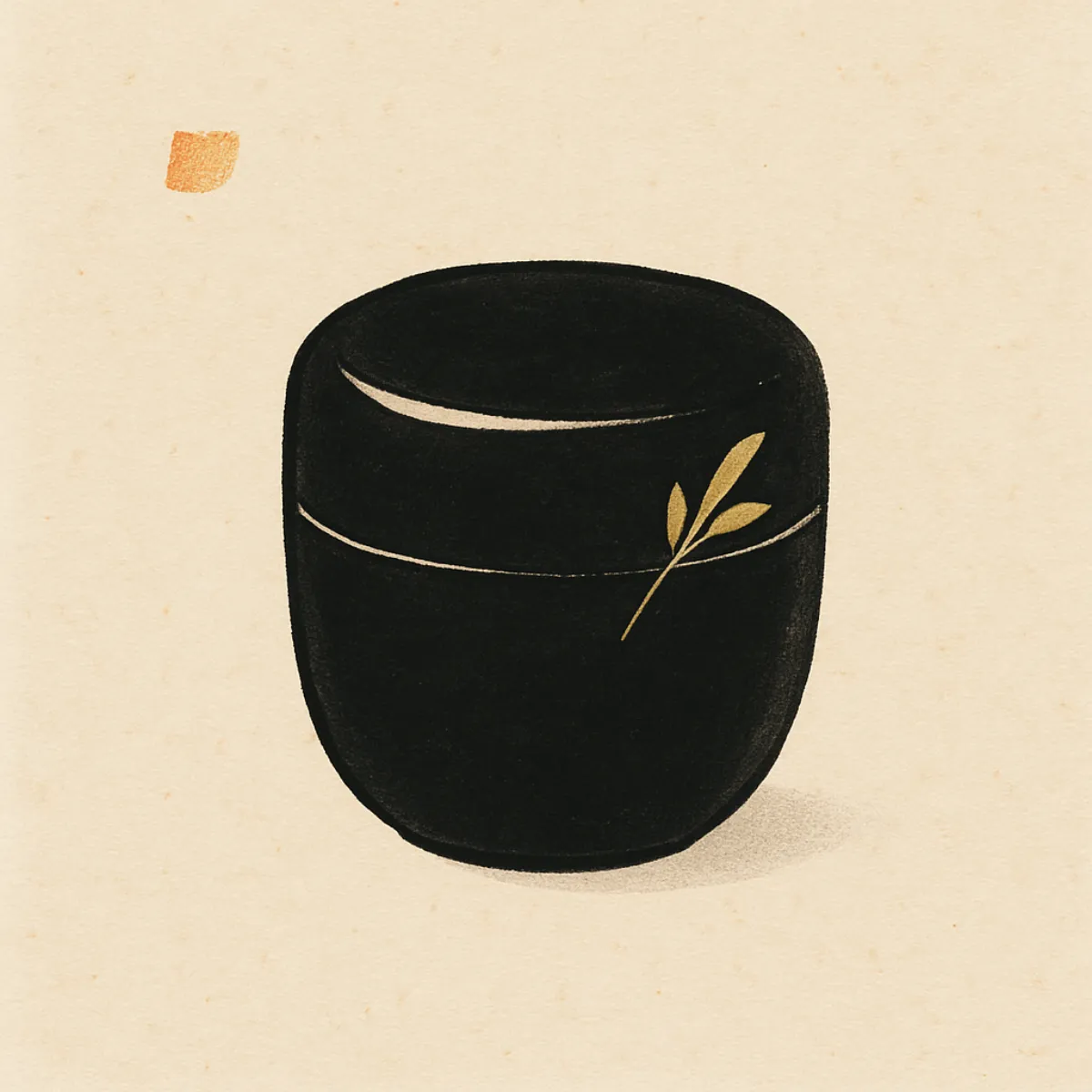
A natsume is a tea caddy for thin tea, made of turned wood coated in urushi, real Japanese lacquer. The word natsume is also the Japanese word for the jujube fruit, and that is exactly where the name comes from: the caddy's rounded body and gently domed lid were thought to resemble a jujube. Once you know that, the shape stops looking generic and starts looking like a small piece of fruit rendered in black lacquer.
Lacquer, not ceramic: why that matters
The natsume belongs to a pair. In the tea ceremony there are two kinds of tea and two kinds of caddy, and they do not mix:
| Natsume (棗) | Chaire (茶入) | |
|---|---|---|
| Material | Turned wood + urushi lacquer | Ceramic (stoneware) |
| Holds tea for | Usucha, thin tea | Koicha, thick tea |
| Feel | Light, warm to the hand | Dense, cool |
| Typical dress | The bare lacquered piece | Wrapped in a silk shifuku pouch |
| Register | Everyday, less formal | Reserved, more formal |
So the material is not decoration; it is information. At a gathering, a lacquered wooden caddy tells you thin tea is coming; a small ceramic jar, often kept in a silk pouch, tells you it is thick tea. That single distinction is most of what a beginner needs, and it is why the natsume is traditionally the first tea container a student learns to handle: start with thin tea.
Being wood-and-lacquer rather than clay is also why the natsume feels the way it does. It is light, it is warm to the touch, and it sets down without a clack. That lightness is the whole reason it can be urushi over turned wood in the first place: a thin wooden body takes coat after coat of lacquer and stays a thing you can lift with two fingers. Much of Japan's tea-caddy woodturning has long come out of Yamanaka in Ishikawa, the country's main source of lacquer kiji (wood blanks), so a natsume quietly ties the matcha you are about to drink to the lacquer craft that shaped its cup.
Sizes: start with a chū-natsume
The standard form is the "Rikyū shape" (利休形, Rikyū-gata), and it comes in three sizes:
- ō-natsume (大棗): large, around 8 cm
- chū-natsume (中棗): medium, and by far the most common
- ko-natsume (小棗): small, around 5 cm
If you buy one natsume, buy a chū. Sources put it at roughly 6.6 to 7 centimetres in both height and diameter. Tezumi says about 6.8 cm, another guide says 6.6, Wikipedia's example measures 7.4 cm tall, so treat "about 6.6 to 7 cm" as the honest range rather than a single magic number. The lid is generously domed, about a third of the total height, and on the orthodox shape it meets the body roughly a third of the way down from the top.
Plain black often outranks gold
In the tea ceremony's own grammar, a natsume covered in gold maki-e, the sprinkled-gold lacquer picture, does not automatically outrank the rest.
The most formal natsume is plain, undecorated, mirror-black true lacquer, called shin-nuri (真塗). From there the register loosens: red and vermilion, then decorated pieces with maki-e or shell inlay, then bare unlacquered wood, each a step further toward the informal and rustic. So a spotless black caddy can outrank a gilded one, even though the gilded one took far more labour to make.
That splits "rank" from "price," which are two different axes:
- Formality is highest at plain black and eases off as decoration and colour arrive.
- Price climbs the other way. A machine-turned, synthetically coated natsume is cheap beginner ware. A hand-turned wooden body under real urushi costs more. And maki-e or raden by a named artist raises the price sharply, because sprinkled-gold work is separate, painstaking hand-labour that can take weeks on a single piece.
Neither axis is "better." A plain black chū-natsume is the correct, versatile first purchase. Spend on a maki-e piece if you want a seasonal design and do not mind that it looks less formal.
It is a serving caddy, not a storage jar
If you drink matcha at home, this is the practical caveat worth the whole article. A natsume is a serving caddy, not an airtight container. As Tezumi's guide puts it plainly, "unless paired with an inner lid, the vast majority of natsume are not airtight and are not meant for long term storage of matcha."
Matcha is fragile: it stales quickly against air, light, heat, and moisture, and a friction-fit lacquer lid does not seal it. Leave your good matcha sitting in a natsume for weeks and it will go flat and hay-like. The fix is simple: sift in about a week's worth for daily use, and keep the bulk of your tin sealed in the fridge or freezer, exactly as our matcha buying and storage guide recommends. The natsume is the vessel you serve from and enjoy the look of — not the vault.
One last curiosity, because it flips the neat natsume-versus-chaire story on its head: the natsume is said to have begun life as a case for holding the ceramic chaire, and only later became its own tea container. The lacquer caddy that now stands opposite the ceramic one started out as its box.
Choosing one
For a first natsume, get a chū-natsume in plain black: versatile, correct in almost any setting, and the honest test of the lacquer itself. Treat it like any good lacquerware: wipe it, keep it off the dishwasher and the radiator, and let the finish settle over years. Add a maki-e piece later, when you want a design for a season rather than a caddy for every day. And whatever you buy, sift in a week of matcha, and keep the tin in the cold.