
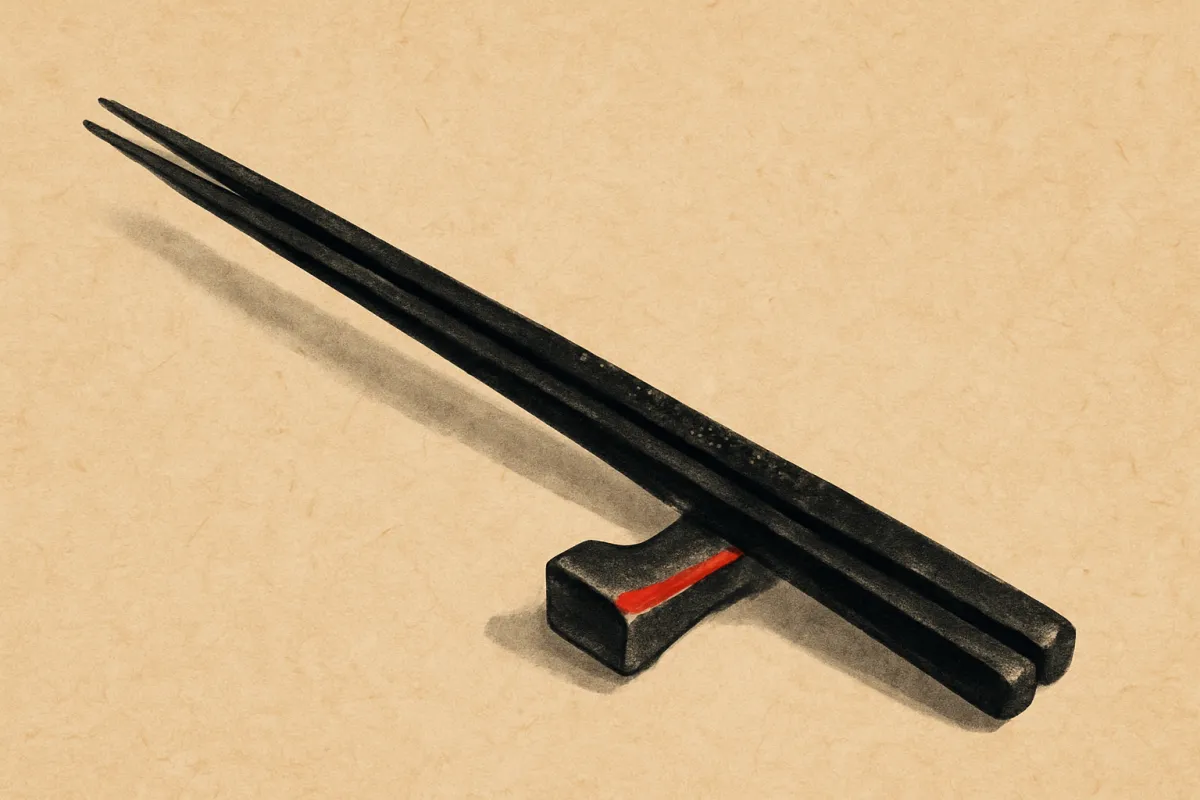
Japanese Lacquer Chopsticks: Are They Safe, and How to Choose a Pair
An $8 set labelled "lacquer chopsticks" sits beside a $40 pair called Wakasa-nuri, and nothing on the listing explains the gap. Chopsticks are the cheapest, most-bought piece of Japanese lacquerware, the object most people own first, so the question what am I actually buying, and is it safe? comes up over a pair more than over anything else. This guide covers how to size a pair to your own hand, tell real urushi from a synthetic coat, and use a pair so it lasts.
The shape of Japanese chopsticks
Japanese chopsticks are short and taper to a fine point, a shape often compared to a crane's beak. The point is shaped for the precise work Japanese food asks of it: lifting flesh off a fish bone, picking up a single grain of rice or a slippery soybean. Compared with its neighbours it is the specialist of the three.
| Length | Tip | Material | |
|---|---|---|---|
| Japanese | Shortest (adults ~20.5–24cm) | Fine, pointed | Wood or bamboo, often lacquered |
| Chinese | Longest | Blunt, rounded | Wood, bamboo or plastic — for shared dishes |
| Korean | Medium | Flat | Metal / stainless steel |
The pair matters in Japan for another reason: chopsticks are personal ware. Even within a family, each person has their own pair and their own rice bowl and does not swap them, a habit rooted less in hygiene than in the old Shintō sense that a chopstick you have put to your mouth carries something of you. This runs counter to the Chinese table, where reaching into shared dishes is the norm.
How to size a pair to your hand
You can measure your own correct length without a chart. Open your thumb and index finger to a right angle and note the straight distance between the two fingertips. That span is a traditional unit, the hito-ata, and your ideal chopstick length is about 1.5 times it (hito-ata-han). For most adults that falls between 20.5 and 24cm, 23–25cm for men, 21–23cm for women, with children moving up sizes as they grow. A finer tip favours delicate food like sashimi and noodles; a slightly thicker tip grips heavy or slippery pieces more securely.
Are lacquered chopsticks safe?
This is the worry many buyers arrive with, because urushi is the same plant family as poison ivy, and its sap contains the identical irritant, urushiol. The reassuring answer: that is the craftsperson's problem, not yours. Raw sap stings skin only while the piece is being made. Once fully cured, urushi is hard, insoluble and resistant to acid, alkali, salt and alcohol, a stable, inert film that has been trusted for eating vessels for thousands of years. The only honest caveat is that someone with a strong urushi allergy may, rarely, still react even to a cured surface.
The substitutes carry their own irony. The synthetic often sold in urushi's place, cashew coating, is urushi's botanical cousin, and its anacardic acid can, on rare occasions, cause the very rash people fear from the real thing. The genuine pair is the safe one.
Real urushi or a synthetic coat?
A true urushi pair is natural wood, keyaki, cherry, chestnut or bamboo, built up with several coats of hon-urushi. A cheap "lacquer chopstick" is usually molded synthetic resin sprayed with urethane or cashew. One check costs nothing: if a pair is sold as dishwasher-safe, it is synthetic. Real urushi cannot survive a hot drying cycle or strong detergent, so an honest maker can never print that claim on it. A "convenient, dishwasher-OK Wakasa chopstick" is telling you, in plain sight, that its coating is urethane. Price points the same way. A real Wakasa-nuri pair runs $19–79 (well past $200 for elaborate work), against about $8 for mass synthetic. For the full method, see how to spot real urushi.
Wakasa-nuri: the region behind most lacquered chopsticks
If you buy real lacquered chopsticks, they most likely come from one town. Wakasa-nuri, the lacquerware of Obama in Fukui Prefecture, makes more than 80% of Japan's lacquered chopsticks, one small town supplying most of the country's pairs. Its multi-layered, ground-back film is durable enough for something touched by the mouth every day, which is how a lacquer craft became a chopstick industry. The signature look is togidashi: eggshell and iridescent abalone shell sunk into the lacquer layers and then ground flat, surfacing a pattern likened to the sea floor. A common trap: a series name like "Saga Nishiki" is a Wakasa-nuri pattern, not a separate craft. See where Wakasa sits among the other centres in our guide to lacquerware by region, or browse pairs in the shop.
A pair as the gift
Chopsticks are the most-given piece of Japanese craft, and the reasons are worth knowing before you buy for someone. A meoto-bashi ("couple's pair") is two chopsticks of slightly different length sold together, a set that only works in two, which makes it the classic wedding and fifth-anniversary gift (the fifth is the "wooden" anniversary). Iwai-bashi, the celebration chopsticks of New Year and weddings, are pale willow tapered at both ends: one end is for you, the other, by tradition, for the gods to share the meal. And at okuizome, around a baby's hundredth day, a first pair of chopsticks is given with the wish that the child never wants for food. A pair, in other words, is rarely just cutlery.
Making a pair last
Good chopsticks are meant to be used daily and to age well, but only if you skip the machine. Wash by hand in warm water with a soft sponge, wipe dry at once, and let them air in the shade. Never soak them, and never use the dishwasher, bleach or an abrasive scrubber: heat and standing water warp the wood and lift the film. Treated this way a real urushi pair lasts for years, and a worn one can even be re-lacquered by a craftsperson, a revival a synthetic pair can never have. The longer care routine for all lacquerware applies to chopsticks too.
Back at the listing, the two pairs stop being interchangeable. One is a sprayed coat on molded resin that will look the same in ten years or peel; the other is layered sap on natural wood, safe to eat from, sized to your hand, and, used and wiped and used again, quietly getting better.