
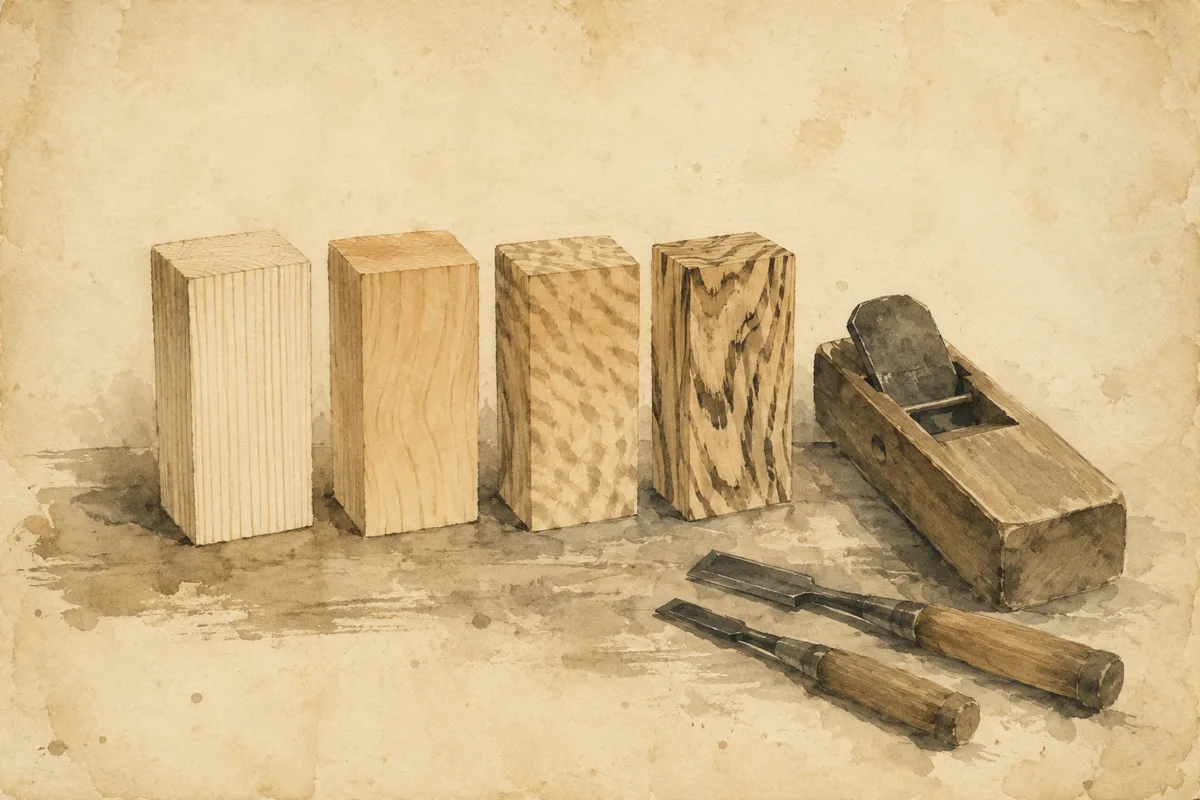
In Japanese craft the job comes first, and it dictates the wood so precisely that the object usually tells you the timber on sight. A shrine will be one wood, a sake barrel another, a kimono chest a third, and the choice is never arbitrary.
Four woods do most of the work. Learn what each is for and you can name the material before anyone tells you.
Hinoki: for anything that gets wet
Hinoki, Japanese cypress, is the wood for anything that has to survive being wet or has to stay clean. It resists rot and water better than almost anything else that grows in Japan, it is naturally antibacterial, and it smells faintly of lemon and resin.
So hinoki is the wood of shrines and temples, of the deep soaking bath, and of the counter and cutting board in a sushi restaurant. It is a softwood, straight-grained and workable, and it is said to keep gaining strength for centuries after felling.
Sugi: the default
Sugi is Japanese cedar, and it is everywhere: the most planted tree in the country, fast-growing and abundant, the wood you use for any job that does not demand something special.
Sugi is light and straight-grained, it splits easily into thin sheets, its heartwood resists rot, and it smells good. Those qualities suit a huge range of ordinary things: ceilings and house frames, rice tubs, bentwood boxes, and above all the sake barrel. Sugi's scent passes into sake aged in it, which drinkers treat as a virtue, and breweries still hang a sugidama, a ball of fresh green cedar fronds, at the door to announce a new batch. Hinoki is a choice; sugi is the default, and most of the country is built from it.
Keyaki: the hardwood exception
Hinoki and sugi are both softwood conifers, and for most of what Japan builds that is enough. Keyaki is the wood for the jobs they cannot do.
Keyaki, Japanese zelkova, is a true hardwood, dense and hard-wearing, with a bold wavy grain that takes a deep luster when polished. It costs more and works harder than the conifers, so it is reserved for jobs that need it. The great structural pillars of temples, shrines, and castles are keyaki, strong enough to carry the load and wide enough in the trunk to span a big interior. The best furniture is keyaki too, chosen for that grain. So is the body of a taiko drum, hollowed from a single block because the wood's density gives the drum its deep, low voice.
Kiri: light before anything else
The last of the four is the odd one out. Kiri, paulownia, is technically a hardwood, but it earns its place by being light rather than hard.
Kiri is the lightest wood in Japan, with a dried density around 280 kilograms per cubic meter, roughly a third the weight of oak. It barely moves as the air turns damp or dry, which means a drawer built from it keeps sliding freely for a century. It insulates well, it buffers humidity by taking on and giving off moisture, and in a fire its surface tends to char rather than burn through quickly.
Put those together and you get the traditional use: the kiri chest. A kiri-tansu was where a family kept its kimono, because the wood held a steady humidity around the silk, kept insects out, and, since it chars rather than burning through, gave the cloth inside some protection in a fire. The same stability is why kiri is used for the koto, the long zither whose sound depends on a board that will not warp.
Reading the wood
There is no best wood here, only the right property for the job: hinoki for water and hygiene, sugi for cheap and plentiful, keyaki for load and figure, kiri for protecting something delicate. In Japanese craft the species name is really a shorthand for what the wood can do, and the maker chose it for exactly that.