
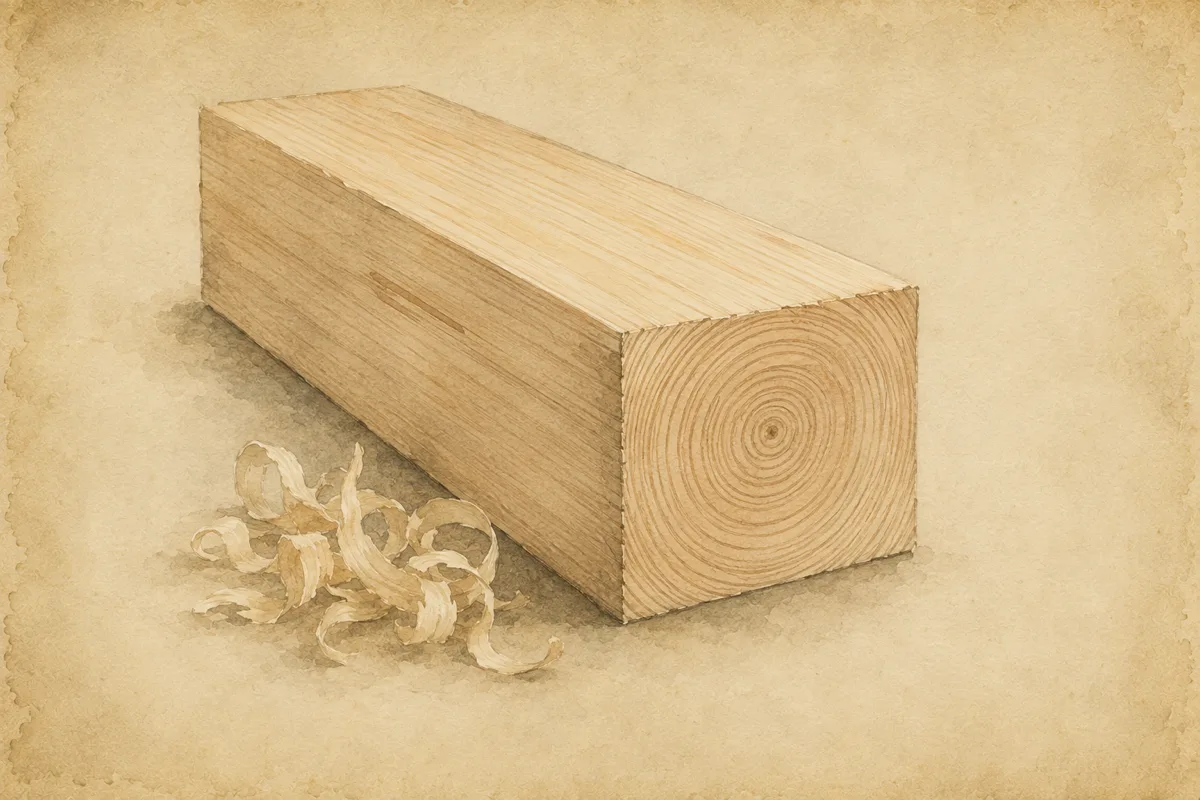
In the 1920s the shrine at Ise started planting trees for a rebuilding scheduled two centuries out.
A two-hundred-year purchase order
The sanctuaries at Ise are rebuilt every twenty years. The ritual, Shikinen Sengu, was first performed in 690, most recently in 2013, and is next due in 2033. Each rebuilding takes as many as ten thousand Japanese cypress trees.
Ten thousand mature trees every twenty years, indefinitely, is more than the open market can supply, and Japan has run out of them before. So the shrine grows its own. It holds 5,500 hectares, more than ninety percent of it forest, known as the Misoma-yama, and the afforestation plan there was drawn on a two-hundred-year timescale, with the goal of eventually supplying the whole rebuilding from shrine land.
Writing in 2004, Japan for Sustainability put the start of that effort eighty years earlier and reported that a quarter of the timber for the next sengu could by then come from the shrine's own ground. Do the arithmetic on those two figures and the trees planted in the 1920s come due somewhere in the twenty-second century. They will be cut by the great-grandchildren of the people who planted them.
Even once a tree is down, the schedule stays long. Preparation for a rebuilding takes over eight years, four of them for the timber alone: two years soaking in a lumber pond after felling, a year stacked outside to acclimatise, a final year to saw and prepare. The old buildings are not wasted either. Pillars from the retired sanctuaries serve another twenty years as parts of two torii gates, and other material goes out to shrines around the country.
One tree, one head
Before the shrine grew its own, it drew on Kiso, where the supply problem was met with law rather than with planting.
The Kiso valley in what is now Nagano was the direct domain of the Owari clan, and its forests were cut hard for about a century for castles, ships and civil works. The timber of the valley was exhausted. The response was a prohibition regime, the chojiboku system, which banned felling outright.
The ban covered five species, not one: hinoki, sawara, asunaro, nezuko and koyamaki, together the Kiso goboku. The Forestry Agency states the logic plainly. The purpose was to protect hinoki, and the other four were selected because they look like hinoki and are useful in their own right. A ban on one tree is unenforceable when four near-identical trees stand next to it, so the protection had to widen to cover the substitutes.
The penalty gave the system its byword: one tree, one head. The Forestry Agency reaches for that phrase to convey the severity rather than to itemise sentencing, so read it as the name the rule went by. Woodcutters in the valley knew what it promised.
The chojiboku system lasted until 1869, when the return of the domain registers made the forests state property. In 1889 they were absorbed into the imperial forests, and in 1906 a Jingu birin, a shrine reserve forest, was cut out of the Kiso holdings specifically to supply Ise. The forest railway reached Akasawa in 1916. The forests became national forest in 1947, and the annual cut peaked in 1964 at 1.28 million cubic metres. Ownership of the valley changed four times in eighty years.
What is actually in the wood
The measured numbers are unremarkable. Its air-dry specific gravity is 0.44, its bending strength 74 MPa, and its compressive strength along the grain 39 MPa. Those are ordinary figures for a softwood.
Its advantage is in how it behaves. The heartwood is described as particularly durable and able to withstand moisture for a long time, and the wood dries thoroughly through its thickness, so it resists warping. It smells strongly, and it is pink at the core against near-white sapwood. The Japanese timber literature also credits it with a quality it calls cleanliness, which is hard to pin down but is the word the trade uses.
That combination explains the use list. Shrines, temples, palaces, joinery, Buddhist sculpture and bath tubs are all either wet, exposed, permanent, or handled close to the body. The old division of labour in the texts is neat about it, hinoki for palaces and sugi for boats.
Hinoki also underwrites the longest-running demonstration anyone has. The Kondo at Horyu-ji is widely recognised as the world's oldest wooden building, and hinoki appears in the pagoda's base components. In 2001 Mitsutani Takumi dated the timber of the five-story pagoda's central pillar by its tree rings to a tree felled in 594, seventy-odd years before the fire of 670 that the surviving buildings were raised after.
The claim that nobody sources
Somewhere in every hinoki sales pitch you will meet the assertion that the wood gets stronger after it is felled. The Japanese trade version is precise: strength rises for about two hundred years, peaking near 120 percent of the value at felling, then declines gently, returning to the felling figure at around a thousand years, so that hinoki spends twelve centuries no weaker than the day it was cut.
The claim may be correct. None of the pages repeating it says where it comes from. The version quoted above credits recent chemical investigation and research, names no researcher, no institution and no paper, and the other trade sources carrying the same numbers do the same. The figures pass from page to page intact and unattributed.
Hinoki's durability is documented, and its thirteen-hundred-year field test is standing in Nara. The rising-strength curve is a separate assertion with a suspiciously round shape, and the documented durability does not rest on it.
The hinoki you can actually buy
None of that is what is in a cutting board.
Hinoki has the second largest plantation area of any species in Japan, after sugi. The conventional felling age for those plantations was forty-five years, and Forestry Agency policy has been moving it towards seventy, with long-rotation stands going from eighty years to a hundred and twenty. Ise plants on a two-hundred-year plan. The same species is sold at ages that differ by a factor of four, and the older stock costs accordingly.
This is how a shrine timber and a kitchen board can share a name. A forty-five-year plantation board is honest hinoki. It has the scent, the moisture behaviour and the durable heartwood, and it is a genuinely good thing to cut vegetables on. It is not shrine timber, and no shop selling a cutting board for the price of a meal is claiming otherwise, even when the label carries a photograph of a temple.
Keeping it
Hinoki's scent and its resistance to mould both come from the wood's own oils and resin, and both are lost if the piece is left wet.
Wipe it with a dry cloth after every use and stand it somewhere ventilated to air dry. Do not let it soak or sit damp, which is how mould gets in. Keep it away from direct sun and temperature extremes, which bend and crack it. When a stain appears, let the wood dry completely, then sand it gently with fine paper, following the grain. Native & Co, which sells the stuff, treats bleach on a cloth as a last resort and caps it at three times a year, and rules out abrasives such as a steel brush entirely. Sanding also opens fresh wood and brings the smell back.
The same approach runs through Japanese woodwork generally. The paulownia chest is built thick enough to be planed back to new twice in a century, and joinery that avoids nails and glue exists so that a building can be taken apart and repaired rather than replaced. Hinoki belongs to that way of thinking. The shrine at Ise plants it on a two-hundred-year plan, and a plantation board asks nothing more than to be dried after it is used.